 |
|
http://de.wikipedia.org/wiki/Benutzer:Michael_w |
 |
|
Translate this page:
Summary
Physical Characteristics

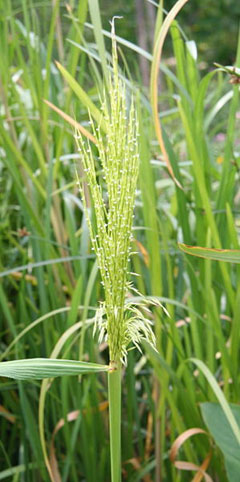
 Zizania aquatica is a ANNUAL growing to 3.5 m (11ft) by 0.2 m (0ft 8in) at a fast rate.
See above for USDA hardiness. It is hardy to UK zone 6. It is in flower from July to September, and the seeds ripen from September to October. The species is monoecious (individual flowers are either male or female, but both sexes can be found on the same plant) and is pollinated by Wind.
Suitable for: light (sandy), medium (loamy) and heavy (clay) soils. Suitable pH: mildly acid, neutral and basic (mildly alkaline) soils. It cannot grow in the shade. It can grow in water.
UK Hardiness Map
US Hardiness Map
Synonyms
Plant Habitats
Pond;
Edible Uses
Edible Parts: Seed Stem
Edible Uses:
Seed - cooked[257]. It can be used as a cereal. A staple food of the native North American Indians[95, 159], the long black delicious grain is eaten as an expensive gourmet meal[183]. It is used in the same ways that rice is used and is sometimes added to rice dishes to impart its subtle flavour. The seed can also be ground into a meal and used in making bread, thickening soups etc[183]. It is a very rich source of riboflavin and is also rich in niacin[160]. The base of the culms is used as a vegetable[74].
References More on Edible Uses
Medicinal Uses
Plants For A Future can not take any responsibility for any adverse effects from the use of plants. Always seek advice from a professional before using a plant medicinally.
None known
References More on Medicinal Uses
The Bookshop: Edible Plant Books
Our Latest books on Perennial Plants For Food Forests and Permaculture Gardens in paperback or digital formats.

Edible Tropical Plants
Food Forest Plants for Hotter Conditions: 250+ Plants For Tropical Food Forests & Permaculture Gardens.
More

Edible Temperate Plants
Plants for Your Food Forest: 500 Plants for Temperate Food Forests & Permaculture Gardens.
More

More Books
PFAF have eight books available in paperback and digital formats. Browse the shop for more information.
Shop Now
Other Uses
References More on Other Uses
Cultivation details
Easily grown in water up to 60cm deep, it tolerates water up to 1 metre deep though it prefers growing in water 10 - 20cm deep[136]. It dislikes stagnant water[20]. A very ornamental plant[1], it grows, flowers and fruits well in the lake and lily pond at Kew[136]. Plants can self-sow in Britain, but the seed tends to germinate too late to mature a fresh crop of seed in this country, so the plant gradually dies out[136]. It would possibly maintain itself in areas such as the Isle of Wight, Cambridgeshire and Norfolk[136]. It is a very hardy plant, the seed survives being frozen in ice[136]. Plants grown at a 30cm square spacing can produce 20 or more flowering shoots[136]. Often collected from the wild, this plant is now being cultivated commercially for its edible seed[183]. It is considered a gourmet's delicacy and is sold in many parts of the world, usually in health food shops and usually at a very high price[136]. Plants require protection from wild fowl otherwise they will devour the young growth[136]. Plants are occasionally sown by lakes and rivers in Europe to attract wild fowl[50].
References Carbon Farming Information and Carbon Sequestration Information
Temperature Converter
Type a value in the Celsius field to convert the value to Fahrenheit:
Fahrenheit:
The PFAF Bookshop
Plants For A Future have a number of books available in paperback and digital form. Book titles include Edible Plants, Edible Perennials, Edible Trees,Edible Shrubs, Woodland Gardening, and Temperate Food Forest Plants. Our new book is Food Forest Plants For Hotter Conditions (Tropical and Sub-Tropical).
Shop Now
Plant Propagation
Seed - it must not be allowed to dry out or it will quickly lose its viability, usually within 4 weeks[136]. Store collected seed in jars of water in a cool place such as the salad compartment of a fridge. Sow the seed in spring. Immerse the pots so that they are covered by about 5cm of water. It is best to sow 2 seeds per 7cm pot in a greenhouse in order to get early germination and a better chance of a crop[136]. Pot on as required and plant out about 30cm square in May, by which time the plants should be 20 - 30cm tall[136]. Larger quantities can be sown in shallow boxes and plunged into the pond etc in May.
Other Names
If available other names are mentioned here
Native Plant Search
Search over 900 plants ideal for food forests and permaculture gardens. Filter to search native plants to your area. The plants selected are the plants in our book 'Plants For Your Food Forest: 500 Plants for Temperate Food Forests and Permaculture Gardens, as well as plants chosen for our forthcoming related books for Tropical/Hot Wet Climates and Mediterranean/Hot Dry Climates. Native Plant Search
Found In
Countries where the plant has been found are listed here if the information is available
Weed Potential
Right plant wrong place. We are currently updating this section.
Please note that a plant may be invasive in one area but may not in your area so it’s worth checking.
Conservation Status
IUCN Red List of Threatened Plants Status :

Growth: S = slow M = medium F = fast. Soil: L = light (sandy) M = medium H = heavy (clay). pH: A = acid N = neutral B = basic (alkaline). Shade: F = full shade S = semi-shade N = no shade. Moisture: D = dry M = Moist We = wet Wa = water.

Expert comment
Author
L.
Botanical References
43200
Links / References
For a list of references used on this page please go here
Readers comment
© 2010, Plants For A Future. Plants For A Future is a charitable company limited by guarantee, registered in England and Wales. Charity No. 1057719, Company No. 3204567.