 |
|
commons.wikimedia.org/wiki/User:Miwasatoshi |
 |
| commons.wikimedia.org/wiki/User:Magnus_Manske |
Translate this page:
Summary
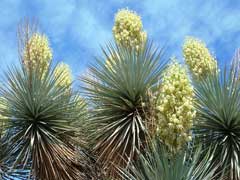
Bloom Color: White. Main Bloom Time: Early summer, Early spring, Late summer, Late spring, Mid summer, Mid spring. Form: Upright or erect.
Physical Characteristics

 Yucca gloriosa is an evergreen Shrub growing to 1.8 m (6ft) by 1.2 m (4ft in) at a slow rate.
See above for USDA hardiness. It is hardy to UK zone 7 and is not frost tender. It is in leaf all year, in flower from July to September. The species is hermaphrodite (has both male and female organs) and is pollinated by Hand.
Suitable for: light (sandy) and medium (loamy) soils, prefers well-drained soil and can grow in nutritionally poor soil. Suitable pH: mildly acid, neutral and basic (mildly alkaline) soils. It can grow in semi-shade (light woodland) or no shade. It prefers dry or moist soil and can tolerate drought. The plant can tolerate maritime exposure.
UK Hardiness Map
US Hardiness Map
Synonyms
Y. ellacombei
Plant Habitats
Cultivated Beds;
Edible Uses
Edible Parts: Flowers Fruit Root Stem
Edible Uses:
Fruit - raw or cooked. The fruit is up to 10cm long and 26mm wide[229]. The fruit is very rarely produced in the wild[82]. Flowers - raw or cooked. They are delicious raw, and can also be dried, crushed and used as a flavouring[164]. Flowering stem - cooked and used like asparagus[164]. Root - cooked. It can be dried, ground into a powder and made into a bread[105].
References More on Edible Uses
Medicinal Uses
Plants For A Future can not take any responsibility for any adverse effects from the use of plants. Always seek advice from a professional before using a plant medicinally.
Detergent Purgative
The fruit is purgative[240]. The root is detergent[240].
References More on Medicinal Uses
The Bookshop: Edible Plant Books
Our Latest books on Perennial Plants For Food Forests and Permaculture Gardens in paperback or digital formats.

Edible Tropical Plants
Food Forest Plants for Hotter Conditions: 250+ Plants For Tropical Food Forests & Permaculture Gardens.
More

Edible Temperate Plants
Plants for Your Food Forest: 500 Plants for Temperate Food Forests & Permaculture Gardens.
More

More Books
PFAF have eight books available in paperback and digital formats. Browse the shop for more information.
Shop Now
Other Uses
Fibre Soap
A fibre obtained from the leaves is used for making cloth, ropes, baskets and mats[46, 61, 82, 169]. The roots are rich in saponins and can be used as a soap substitute[82].
Special Uses
Carbon Farming Scented Plants
References More on Other Uses
Cultivation details
Agroforestry Services: Living fence Industrial Crop: Fiber Management: Standard Regional Crop
Landscape Uses:Massing, Specimen. Thrives in any soil but prefers a sandy loam and full exposure to the south[11]. Plants are hardier when grown on poor sandy soils[200]. Established plants are very drought resistant[190]. Judging by its native habitat, this plant should tolerate maritime exposure[K]. Very cold hardy, tolerating temperatures down to at least -15°c[200], or to -25°c according to another report[187], but plants are subject to injury and decay by winter damp and snow[11]. A very ornamental plant[1], there are some named varieties[187]. Plants do not flower every year, requiring hot summers to initiate flowering[190]. The flowers are produced in the autumn and are often damaged by early frosts[233]. The scent of the flowers is most pronounced at night[245]. In the plants native environment, its flowers can only be pollinated by a certain species of moth. This moth cannot live in Britain and, if fruit and seed is required, hand pollination is necessary. This can be quite easily and successfully done using something like a small paint brush. Individual crowns are monocarpic, dying after flowering[233]. However, the crown will usually produce a number of sideshoots before it dies and these will grow on to flower in later years[233]. Plants in this genus are notably resistant to honey fungus[200]. Members of this genus seem to be immune to the predations of rabbits[233]. Special Features:North American native, Attracts butterflies, Fragrant flowers, Blooms are very showy.
Carbon Farming
-
Agroforestry Services: Living fence
Simply managed rows of shrubs and trees.
-
Industrial Crop: Fiber
Clothing, rugs, sheets, blankets etc. Currently, almost none of our fiber are produced from perennial crops but could be!
-
Management: Standard
Plants grow to their standard height. Harvest fruit, seeds, or other products. Non-Destructive management systems.
-
Regional Crop
These crops have been domesticated and cultivated regionally but have not been adopted elsewhere and are typically not traded globally, Examples in this broad category include perennial cottons and many nuts and staple fruits.
References Carbon Farming Information and Carbon Sequestration Information
Temperature Converter
Type a value in the Celsius field to convert the value to Fahrenheit:
Fahrenheit:
The PFAF Bookshop
Plants For A Future have a number of books available in paperback and digital form. Book titles include Edible Plants, Edible Perennials, Edible Trees,Edible Shrubs, Woodland Gardening, and Temperate Food Forest Plants. Our new book is Food Forest Plants For Hotter Conditions (Tropical and Sub-Tropical).
Shop Now
Plant Propagation
Seed - sow spring in a greenhouse. Pre-soaking the seed for 24 hours in warm water may reduce the germination time. It usually germinates within 1 - 12 months if kept at a temperature of 20°c. Prick out the seedlings into individual pots when they are large enough to handle and grow them on in the greenhouse or cold frame for at least their first two winters. Plant them out into their permanent positions in early summer and consider giving them some winter protection for at least their first winter outdoors - a simple pane of glass is usually sufficient[K]. Seed is not produced in Britain unless the flowers are hand pollinated. Root cuttings in late winter or early spring. Lift in April/May and remove small buds from base of stem and rhizomes. Dip in dry wood ashes to stop any bleeding and plant in a sandy soil in pots in a greenhouse until established[78]. Cuttings can be made of the tops of old plants. These normally root quite easily in the growing season[11].
Other Names
If available other names are mentioned here
Native Plant Search
Search over 900 plants ideal for food forests and permaculture gardens. Filter to search native plants to your area. The plants selected are the plants in our book 'Plants For Your Food Forest: 500 Plants for Temperate Food Forests and Permaculture Gardens, as well as plants chosen for our forthcoming related books for Tropical/Hot Wet Climates and Mediterranean/Hot Dry Climates. Native Plant Search
Found In
Countries where the plant has been found are listed here if the information is available
Weed Potential
Right plant wrong place. We are currently updating this section.
Please note that a plant may be invasive in one area but may not in your area so it’s worth checking.
Conservation Status
IUCN Red List of Threatened Plants Status :

| Related Plants
|
| Latin Name | Common Name | Habit | Height | Hardiness | Growth | Soil | Shade | Moisture | Edible | Medicinal | Other |
| Hesperaloe funifera | New Mexico false yucca | Perennial | 1.8 |
6-9
| S | LM | N | DM | 0 | 0 | 2 |
| Yucca aloifolia | Spanish Bayonet, Aloe yucca, Dagger Plant, Yucca, Spanish Bayonet | Tree | 7.5 |
8-10
| S | LMH | SN | DM | 3 | 1 | 2 |
| Yucca angustissima | Narrowleaf yucca, Kanab yucca, Toft's yucca, Yucca | Shrub | 0.4 |
4-9
| S | LMH | SN | DM | 3 | 0 | 4 |
| Yucca baccata | Spanish Bayonet, Banana yucca, Blue Yucca, Spanish Yucca | Shrub | 0.9 |
6-11
| S | LMH | N | DM | 4 | 1 | 5 |
| Yucca brevifolia | Joshua Tree, Jaeger's Joshua tree, Yucca, Joshua Tree | Tree | 9.0 |
9-11
| M | LMH | SN | DM | 3 | 0 | 2 |
| Yucca constricta | Buckley's Yucca | Perennial | 1.5 |
8-11
| | LMH | SN | DM | 2 | 0 | 2 |
| Yucca elata | Soap Tree, Soaptree yucca, Soapweed, Soapweed Yucca | Shrub | 2.0 |
9-11
| S | LMH | SN | DM | 2 | 0 | 3 |
| Yucca filamentosa | Spoonleaf Yucca, Adam's needle, Desert Candle, Needle Palm, St. Peter's Palm, Spanish Bayonet, Comm | Shrub | 1.2 |
4-10
| M | LMH | SN | DM | 3 | 1 | 4 |
| Yucca filifera | | Shrub | 10.0 |
6-9
| | LMH | SN | DM | 2 | 0 | 2 |
| Yucca gigantea | Spineless yucca, Izote | Tree | 6.0 |
9-11
| F | LMH | SN | DM | 3 | 0 | 2 |
| Yucca glauca | Soapweed, Soapweed yucca, Gurney's yucca, American Vetch, Yucca, Narrowleaf Yucca, Soapweed | Shrub | 1.5 |
4-10
| S | LMH | SN | DM | 2 | 2 | 2 |
| Yucca harrimaniae | Spanish Bayonet, New Mexico Spanish bayonet | Shrub | 0.4 |
6-9
| S | LMH | SN | DM | 2 | 0 | 2 |
| Yucca recurvifolia | Curve-leaf yucca | Shrub | 2.5 |
7-10
| | LMH | SN | DM | 3 | 0 | 2 |
| Yucca rupicola | Twisted-Leaf Yucca, Texas yucca | Shrub | 0.6 |
8-11
| | LMH | SN | DM | 2 | 0 | 2 |
| Yucca schidigera | Mojave Yucca, Yucca | Tree | 4.5 |
9-10
| | LMH | N | DM | 3 | 0 | 2 |
| Yucca smalliana | Adam's Needle, Weak-leaf yucca | Shrub | 1.2 |
8-11
| | LMH | SN | DM | 2 | 0 | 2 |
| Yucca whipplei | Our Lord's Candle | Shrub | 2.0 |
7-11
| S | LMH | S | DM | 3 | 0 | 3 |
|
Growth: S = slow M = medium F = fast. Soil: L = light (sandy) M = medium H = heavy (clay). pH: A = acid N = neutral B = basic (alkaline). Shade: F = full shade S = semi-shade N = no shade. Moisture: D = dry M = Moist We = wet Wa = water.

Expert comment
Author
L.
Botanical References
1172200
Links / References
For a list of references used on this page please go here
Readers comment
| Add a comment |
|
If you have important information about this plant that may help other users please add a comment or link below. Only comments or links that are felt to be directly relevant to a plant will be included. If you think a comment/link or information contained on this page is inaccurate or misleading we would welcome your feedback at [email protected]. If you have questions about a plant please use the Forum on this website as we do not have the resources to answer questions ourselves.
* Please note: the comments by website users are not necessarily those held by PFAF and may give misleading or inaccurate information.
To leave a comment please Register or login here All comments need to be approved so will not appear immediately.
|
|