 |
|
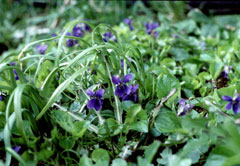
(c) 2010 Ken Fern & Plants For A Future |
 |
| commons.wikimedia.org/wiki/File:Viola_odorata_Sturm56.jpg |
Translate this page:
Summary
Bloom Color: Pink, Purple, White. Main Bloom Time: Early fall, Early spring, Late fall, Late winter, Mid fall, Mid spring. Form: Spreading or horizontal.
Physical Characteristics

 Viola odorata is an evergreen Perennial growing to 0.1 m (0ft 4in) by 0.5 m (1ft 8in) at a fast rate.
See above for USDA hardiness. It is hardy to UK zone 5 and is not frost tender. It is in leaf all year, in flower from February to April, and the seeds ripen from April to June. The species is hermaphrodite (has both male and female organs) and is pollinated by Bees, Cleistogomy (self-pollinating without flowers ever opening). The plant is self-fertile.
Suitable for: light (sandy), medium (loamy) and heavy (clay) soils and prefers well-drained soil. Suitable pH: mildly acid, neutral and basic (mildly alkaline) soils. It can grow in semi-shade (light woodland) or no shade. It prefers moist soil.
UK Hardiness Map
US Hardiness Map
Synonyms
Viola hirta L. Viola hirta subsp. brevifimbriata W. Beck
Plant Habitats
Woodland Garden Sunny Edge; Dappled Shade; Shady Edge; Ground Cover; Hedgerow; Cultivated Beds; North Wall. In. East Wall. In. South Wall. In. West Wall. In.
Edible Uses
Edible Parts: Flowers Leaves
Edible Uses: Condiment Tea
Young leaves and flower buds - raw or cooked[21, 85, 183]. Usually available all through the winter[K]. The leaves have a very mild flavour, though they soon become quite tough as they grow older. They make a very good salad, their mild flavour enabling them to be used in bulk whilst other stronger-tasting leaves can then be added to give more flavour[K]. When added to soup they thicken it in much the same way as okra[62, 85, 159]. Also used as a flavouring in puddings etc. A tea can be made from the leaves[85]. Flowers - raw. Used to decorate salads and desserts[5, 9, 85]. A sweet mild flavour with a delicate perfume, the flowers are an especially welcome decoration for the salad bowl since they are available in late winter[K]. The flowers are also used fresh to flavour and colour confectionery[238]. A soothing tea can be made from the leaves and flowers[85, 183]. A leaf extract is used to flavour sweets, baked goods and ice cream[183].
References More on Edible Uses
Medicinal Uses
Plants For A Future can not take any responsibility for any adverse effects from the use of plants. Always seek advice from a professional before using a plant medicinally.
Antiinflammatory Antirheumatic Cancer Demulcent Diaphoretic Diuretic Emetic Emollient
Expectorant Homeopathy Laxative Purgative Urinary
Sweet violet has a long and proven history of folk use, especially in the treatment of cancer and whooping cough[4, 165, 218]. It also contains salicylic acid, which is used to make aspirin[244]. It is therefore effective in the treatment of headaches, migraine and insomnia[244]. The whole plant is anti-inflammatory, diaphoretic, diuretic, emollient, expectorant, and laxative[4, 7, 21, 46, 165]. It is taken internally in the treatment of bronchitis, respiratory catarrh, coughs, asthma, and cancer of the breast, lungs or digestive tract[238]. Externally, it is used to treat mouth and throat infections[238]. The plant can either be used fresh, or harvested when it comes into flower and then be dried for later use[4]. The flowers are demulcent and emollient[240]. They are used in the treatment of biliousness and lung troubles[240]. The petals are made into a syrup and used in the treatment of infantile disorders[240]. The roots is a much stronger expectorant than other parts of the plant but they also contain the alkaloid violine which at higher doses is strongly emetic and purgative[4, 244, 254]. They are gathered in the autumn and dried for later use[7]. The seeds are diuretic and purgative. They have been used in the treatment of urinary complaints are considered to be a good remedy for gravel[4]. A homeopathic remedy is made from the whole fresh plant[4]. It is considered useful in the treatment of spasmodic coughs and rheumatism of the wrist[4]. An essential oil from the flowers is used in aromatherapy in the treatment of bronchial complaints, exhaustion and skin complaints[238].
References More on Medicinal Uses
The Bookshop: Edible Plant Books
Our Latest books on Perennial Plants For Food Forests and Permaculture Gardens in paperback or digital formats.
Edible Tropical Plants
Food Forest Plants for Hotter Conditions: 250+ Plants For Tropical Food Forests & Permaculture Gardens.
More
Edible Temperate Plants
Plants for Your Food Forest: 500 Plants for Temperate Food Forests & Permaculture Gardens.
More
More Books
PFAF have eight books available in paperback and digital formats. Browse the shop for more information.
Shop Now
Other Uses
Essential Litmus
An essential oil from the flowers and leaves is used in perfumery[57, 100]. 1000kg of leaves produces about 300 - 400g absolute[46]. The flowers are used to flavour breath fresheners[238]. A pigment extracted from the flowers is used as a litmus to test for acids and alkalines[4, 13, 100, 115]. Plants can be grown as a ground cover when spaced about 30cm apart each way[208]. They make an effective weed-excluding cover[K]. ornamental. A dynamic accumulator gathering minerals or nutrients from the soil and storing them in a more bioavailable form - used as fertilizer or to improve mulch.
Special Uses
Dynamic accumulator Food Forest Ground cover Scented Plants
References More on Other Uses
Cultivation details
Landscape Uses:Alpine garden, Border, Container, Ground cover, Massing, Rock garden, Woodland garden. Succeeds in most soils but prefers a cool moist well-drained humus-rich soil in partial or dappled shade and protection from scorching winds[1, 14, 31, 200]. When grown in the open it prefers a moderately heavy rich soil[1]. Plants have done very well in a hot dry sunny position on our Cornish trial grounds[K]. Tolerates sandstone and limestone soils. Plants are hardy to about -20°c[187]. Sweet violets are very ornamental plants, there are many named varieties[187]. They produce their delicately scented flowers in late winter and early spring - these are designed for fertilisation by bees and since there are few bees around at this time of year these flowers seldom set seed[4]. However, the plants also produce a second type of flower later in the year. These never open, but seed is produced within them by self-fertilization[4]. The plants will often self-sow freely when well-sited[188]. They can also spread fairly rapidly at the roots when they are growing well[K]. Responds well to an annual replanting in rich loose leafy soils[187]. All members of this genus have more or less edible leaves and flower buds, though those species with yellow flowers can cause diarrhoea if eaten in large quantities[62, 85, 159]. Special Features:
Edible, Not North American native, Invasive, Naturalizing, Suitable for cut flowers, Extended bloom season in Zones 9A and above, Fragrant flowers. For polyculture design as well as the above-ground architecture (form - tree, shrub etc. and size shown above) information on the habit and root pattern is also useful and given here if available. An evergreen. The plant growth habit is a runner spreading indefinitely by rhizomes or stolons [1-2]. The root pattern is rhizomatous with underground stems sending roots and shoots along their length [1-2]. The root pattern is stoloniferous rooting from creeping stems above the ground [1-2].
References Carbon Farming Information and Carbon Sequestration Information
Temperature Converter
Type a value in the Celsius field to convert the value to Fahrenheit:
Fahrenheit:
The PFAF Bookshop
Plants For A Future have a number of books available in paperback and digital form. Book titles include Edible Plants, Edible Perennials, Edible Trees,Edible Shrubs, Woodland Gardening, and Temperate Food Forest Plants. Our new book is Food Forest Plants For Hotter Conditions (Tropical and Sub-Tropical).
Shop Now
Plant Propagation
Seed - best sown in the autumn in a cold frame. The seed requires a period of cold stratification and the germination of stored seed can be erratic. Prick out the seedlings into individual pots when they are large enough to handle and plant them out in the summer. Division in the autumn or just after flowering. Larger divisions can be planted out direct into their permanent positions, though we have found that it is best to pot up smaller divisions and grow them on in light shade in a greenhouse or cold frame until they are growing away well. Plant them out in the summer or the following spring.
Other Names
If available other names are mentioned here
Native Plant Search
Search over 900 plants ideal for food forests and permaculture gardens. Filter to search native plants to your area. The plants selected are the plants in our book 'Plants For Your Food Forest: 500 Plants for Temperate Food Forests and Permaculture Gardens, as well as plants chosen for our forthcoming related books for Tropical/Hot Wet Climates and Mediterranean/Hot Dry Climates. Native Plant Search
Found In
Countries where the plant has been found are listed here if the information is available
Weed Potential
Right plant wrong place. We are currently updating this section.
Please note that a plant may be invasive in one area but may not in your area so it’s worth checking.
Conservation Status
IUCN Red List of Threatened Plants Status :

| Related Plants
|
| Latin Name | Common Name | Habit | Height | Hardiness | Growth | Soil | Shade | Moisture | Edible | Medicinal | Other |
| Aconitum violaceum | | Perennial | 0.0 |
5-9
| | LMH | SN | M | 1 | 1 | |
| Cardamine violacea | | Perennial | 0.3 |
-
| | LMH | SN | M | 2 | 0 | |
| Gigantochloa atroviolacea | Black Bamboo. Giant Black bamboo | Bamboo | 12.0 |
9-11
| M | LMH | SN | M | 2 | 0 | 3 |
| Hardenbergia violacea | Coral Pea, Purple Coral Pea, False Sarsaparilla, Vine Lilac | Climber | 2.0 |
9-11
| F | LMH | SN | M | 1 | 0 | 1 |
| Hymenanthera dentata | Tree Violet | Shrub | 6.0 |
8-11
| | LMH | N | M | 0 | 0 | 2 |
| Melicytus ramiflorus | Whitey Wood | Tree | 9.0 |
8-11
| | LMH | N | M | 1 | 0 | 2 |
| Orychophragmus violaceus | | Annual/Biennial | 0.3 |
6-9
| | LMH | N | M | 1 | 0 | |
| Oxalis violacea | Violet Wood Sorrel | Bulb | 0.3 |
4-8
| | LMH | SN | DM | 3 | 1 | |
| Tulbaghia violacea | Society Garlic | Perennial | 0.3 |
7-11
| F | LMH | N | M | 4 | 2 | 3 |
| Viola acuminata | | Perennial | 0.3 |
-
| | LMH | SN | M | 2 | 0 | |
| Viola adunca | Western Dog Violet, Hookedspur violet, Kirk's violet | Perennial | 0.1 |
4-8
| | LMH | SN | M | 3 | 1 | 2 |
| Viola biflora | Twoflower Violet, Arctic yellow violet, Carlott's violet | Perennial | 0.2 |
0-0
| | LMH | S | M | 3 | 1 | 1 |
| Viola brevistipulata | | Perennial | 0.3 |
-
| | LMH | SN | M | 2 | 0 | |
| Viola canadensis | Canada Violet, Canadian white violet, Creepingroot violet | Perennial | 0.4 |
3-8
| | LMH | SN | M | 3 | 1 | 2 |
| Viola canina | Dog Violet | Perennial | 0.4 |
5-9
| | LMH | SN | M | 3 | 1 | |
| Viola collina | | Perennial | 0.1 |
-
| | LMH | SN | M | 2 | 0 | |
| Viola cornuta | Horned Violet, Bedding Pansy, Tufted Pansy, | Perennial | 0.2 |
6-11
| F | LMH | SN | M | 3 | 0 | 3 |
| Viola cucullata | Marsh Blue Violet | Perennial | 0.2 |
3-8
| | LMH | SN | MWe | 3 | 1 | 3 |
| Viola diffusa | | Annual | 0.1 |
-
| | LMH | SN | M | 2 | 2 | |
| Viola epipsila | Dwarf Marsh Violet | Perennial | 0.1 |
4-8
| | LMH | SN | M | 3 | 0 | 1 |
| Viola esculenta | Salad violet | | 0.0 |
0-0
| | LMH | SN | M | 0 | 0 | |
| Viola glabella | Stream Violet, Pioneer violet | Perennial | 0.1 |
4-8
| | LMH | S | M | 2 | 0 | |
| Viola grypoceras | | Perennial | 0.3 |
-
| | LMH | SN | M | 2 | 0 | |
| Viola japonica | Japanese violet | Perennial | 0.2 |
0-0
| | LMH | SN | M | 3 | 2 | |
| Viola keiskei | | Perennial | 0.2 |
-
| | LMH | SN | M | 2 | 0 | |
| Viola labradorica | Labrador Violet, Alpine violet, Johnny Jump-Up, Alpine Violet | Perennial | 0.1 |
3-8
| F | LMH | FSN | M | 3 | 0 | 2 |
| Viola langsdorffii | Alaska Violet. Aleutian violet | Perennial | 0.1 |
-
| | LMH | SN | M | 3 | 0 | |
| Viola mandshurica | Manchurian Violet | Perennial | 0.2 |
7-10
| | LMH | SN | M | 3 | 0 | |
| Viola mirabilis | wonder violet | Perennial | 0.2 |
4-8
| | LMH | SN | M | 3 | 1 | |
| Viola obtusa | | Perennial | 0.1 |
-
| | LMH | SN | M | 2 | 0 | |
|
|
Growth: S = slow M = medium F = fast. Soil: L = light (sandy) M = medium H = heavy (clay). pH: A = acid N = neutral B = basic (alkaline). Shade: F = full shade S = semi-shade N = no shade. Moisture: D = dry M = Moist We = wet Wa = water.

Expert comment
Author
L.
Botanical References
17200
Links / References
For a list of references used on this page please go here
Readers comment
© 2010, Plants For A Future. Plants For A Future is a charitable company limited by guarantee, registered in England and Wales. Charity No. 1057719, Company No. 3204567.