 |
|
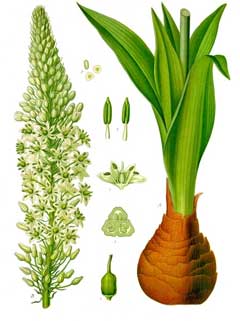
commons.wikimedia.org/wiki/File:Koeh-277.jpg |
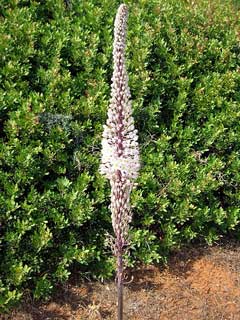 |
| commons.wikimedia.org/wiki/User:Oltau |
Translate this page:
Summary
Physical Characteristics

 Urginea maritima is a BULB growing to 1 m (3ft 3in) by 0.3 m (1ft).
See above for USDA hardiness. It is hardy to UK zone 9. It is in leaf from October to July, in flower from September to October. The species is hermaphrodite (has both male and female organs) and is pollinated by Bees.
It is noted for attracting wildlife.
Suitable for: light (sandy) and medium (loamy) soils and prefers well-drained soil. Suitable pH: mildly acid, neutral and basic (mildly alkaline) soils. It cannot grow in the shade. It prefers dry or moist soil. The plant can tolerates strong winds but not maritime exposure.
UK Hardiness Map
US Hardiness Map
Synonyms
U. anthericoides. U. scilla. Drimia maritima.
Plant Habitats
Cultivated Beds;
Edible Uses
References More on Edible Uses
Medicinal Uses
Plants For A Future can not take any responsibility for any adverse effects from the use of plants. Always seek advice from a professional before using a plant medicinally.
Antiarrhythmic Antidandruff Cardiotonic Diuretic Emetic Expectorant Miscellany
Sea squill contains cardiac glycosides which are strongly diuretic and relatively quick-acting[254]. They do not have the same cumulative effect as those present in foxglove (Digitalis spp.)[254]. The bulb has been widely used by herbalists, mainly for its effect upon the heart and for its stimulating, expectorant and diuretic properties[4]. The fresh bulb is slightly more active medicinally than the dried bulb, but it also contains a viscid acrid juice that can cause skin inflammations[4]. This is a very poisonous plant and it should only be used under the supervision of a qualified practitioner[238]. The dried bulb is cardiotonic, strongly diuretic, emetic when taken in large doses and expectorant[4, 46, 57, 61, 89, 165, 171, 254]. The bulb can weigh up to 2 kilos[4]. It is used internally in the treatment of bronchitis, bronchitic asthma, whooping cough and oedema[238] and is a potential substitute for foxglove in aiding a failing heart[254]. The bulb is harvested in the autumn, sliced transversally and dried for later use[238]. Externally, the bulb has been used in the treatment of dandruff and seborrhoea[238].
References More on Medicinal Uses
The Bookshop: Edible Plant Books
Our Latest books on Perennial Plants For Food Forests and Permaculture Gardens in paperback or digital formats.

Edible Tropical Plants
Food Forest Plants for Hotter Conditions: 250+ Plants For Tropical Food Forests & Permaculture Gardens.
More

Edible Temperate Plants
Plants for Your Food Forest: 500 Plants for Temperate Food Forests & Permaculture Gardens.
More

More Books
PFAF have eight books available in paperback and digital formats. Browse the shop for more information.
Shop Now
Other Uses
Miscellany
The red bulb form of this species contains the poisonous substance 'scilliroside'[238]. This substance is poisonous to rodents but does not kill other species (which vomit instead)[238].
Special Uses
Attracts Wildlife
References More on Other Uses
Cultivation details
Succeeds in ordinary garden soil according to one report[1], whilst another says that it requires a very free draining gritty or sandy soil in full sun[200]. The bulbs have a summer resting period and should be kept dry at this time[188]. Some protection from winter wet is strongly recommended[200]. Easily grown in a warm sunny position[90]. A very ornamental plant, it is not very hardy in Britain according to one report[1], whilst another says that it can be grown in N. European gardens[200] though it does not flower very freely there[90, 200]. Another report says that the plant can tolerate temperatures down to about -7°c[238]. The bulb should be only partially buried[200]. This species is cultivated in the Mediterranean area for its use in the drug industry[238]. The bulbs are harvested after 6 years growth with a yield of about 25,000 bulbs per hectare[238]. There are two main forms of this species, one has a white bulb and the other has a red one. The red bulb is the form that is used as a rat poison whilst the white bulb is used as a cardiotonic. Another report says that herbalists do not distinguish between the two forms[4]. Only the red form contains the rat poison 'scilliroside', though both forms can be used medicinally[238]. The bulb is very tenacious of life, one specimen that had been stored for 20 years in a museum was found to be trying to grow[4]. A good bee plant[89].
References Carbon Farming Information and Carbon Sequestration Information
Temperature Converter
Type a value in the Celsius field to convert the value to Fahrenheit:
Fahrenheit:
The PFAF Bookshop
Plants For A Future have a number of books available in paperback and digital form. Book titles include Edible Plants, Edible Perennials, Edible Trees,Edible Shrubs, Woodland Gardening, and Temperate Food Forest Plants. Our new book is Food Forest Plants For Hotter Conditions (Tropical and Sub-Tropical).
Shop Now
Plant Propagation
Seed - best sown as soon as it is ripe in a greenhouse[188]. Sow the seed thinly so that the seedlings can be left in the pot for their first growing season. Give them regular liquid feeds when in active growth to ensure that they do not suffer nutrient deficiency. Divide the young bulbs once the plant becomes dormant, placing 2- 3 bulbs in each put. Grow them on for at least another year in pots and plant them out into their permanent positions when they are dormant. Division of offsets in late summer when the bulb is dormant[188, 238]. Larger bulbs can be replanted immediately into their permanent positions. It is probably best to pot up smaller bulbs and grow them on in a greenhouse for a year before planting them out when they are dormant in late summer.
Other Names
If available other names are mentioned here
Native Plant Search
Search over 900 plants ideal for food forests and permaculture gardens. Filter to search native plants to your area. The plants selected are the plants in our book 'Plants For Your Food Forest: 500 Plants for Temperate Food Forests and Permaculture Gardens, as well as plants chosen for our forthcoming related books for Tropical/Hot Wet Climates and Mediterranean/Hot Dry Climates. Native Plant Search
Found In
Countries where the plant has been found are listed here if the information is available
Weed Potential
Right plant wrong place. We are currently updating this section.
Please note that a plant may be invasive in one area but may not in your area so it’s worth checking.
Conservation Status
IUCN Red List of Threatened Plants Status :

Growth: S = slow M = medium F = fast. Soil: L = light (sandy) M = medium H = heavy (clay). pH: A = acid N = neutral B = basic (alkaline). Shade: F = full shade S = semi-shade N = no shade. Moisture: D = dry M = Moist We = wet Wa = water.

Expert comment
Author
(L.)Baker.
Botanical References
50200
Links / References
For a list of references used on this page please go here
Readers comment
© 2010, Plants For A Future. Plants For A Future is a charitable company limited by guarantee, registered in England and Wales. Charity No. 1057719, Company No. 3204567.