 |
|
(c) 2010 Ken Fern & Plants For A Future |
|
|
Translate this page:
Summary
Physical Characteristics

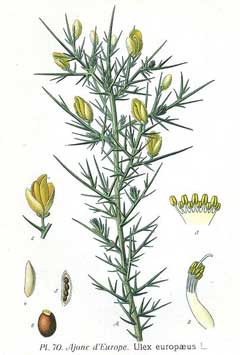
 Ulex europaeus is a deciduous Shrub growing to 1.5 m (5ft) by 1.5 m (5ft) at a fast rate.
See above for USDA hardiness. It is hardy to UK zone 6 and is not frost tender. It is in leaf all year, in flower all year, and the seeds ripen all year. The species is hermaphrodite (has both male and female organs) and is pollinated by Bees, flies, beetles.
It can fix Nitrogen.
It is noted for attracting wildlife.
Suitable for: light (sandy), medium (loamy) and heavy (clay) soils, prefers well-drained soil and can grow in nutritionally poor soil. Suitable pH: mildly acid and neutral soils and can grow in very acid soils.
It cannot grow in the shade. It prefers dry or moist soil and can tolerate drought. The plant can tolerate maritime exposure.
UK Hardiness Map
US Hardiness Map
Synonyms
Plant Habitats
Woodland Garden Sunny Edge; Hedge;
Edible Uses
Edible Parts: Flowers Shoots
Edible Uses: Tea
The flower buds are pickled in vinegar and then used like capers in salads[183]. A tea is made from the shoot tips[177, 183].
References More on Edible Uses
Medicinal Uses
Plants For A Future can not take any responsibility for any adverse effects from the use of plants. Always seek advice from a professional before using a plant medicinally.
Bach
Gorse has never played much of a role in herbal medicine, though its flowers have been used in the treatment of jaundice and as a treatment for scarlet fever in children[4]. The seed is said to be astringent and has been used in the treatment of diarrhoea and stones[4]. The plant is used in Bach flower remedies - the keywords for prescribing it are 'Hopelessness' and 'Despair'[209].
References More on Medicinal Uses
The Bookshop: Edible Plant Books
Our Latest books on Perennial Plants For Food Forests and Permaculture Gardens in paperback or digital formats.
Edible Tropical Plants
Food Forest Plants for Hotter Conditions: 250+ Plants For Tropical Food Forests & Permaculture Gardens.
More
Edible Temperate Plants
Plants for Your Food Forest: 500 Plants for Temperate Food Forests & Permaculture Gardens.
More
More Books
PFAF have eight books available in paperback and digital formats. Browse the shop for more information.
Shop Now
Other Uses
Dye Fertilizer Fuel Hedge Hedge Insecticide Pioneer Soap making Soil stabilization
A beautiful yellow dye is obtained from the flowers[4]. It is orange according to another report[168]. Gorse is very tolerant of maritime exposure, it can be used as a windbreak hedge in the most exposed positions, making an impenetrable barrier with its vicious thorns[4, 49, 75, 200]. Planted for soil stabilization on sandy substrates[200], it is very good for stabilizing roadside banks on poor soils[186]. Gorse is an excellent pioneer species for poor soils and areas with maritime exposure. It is fast-growing, feeds the soil with nitrogen and provides good conditions for woodland trees to become established. These trees will eventually out-compete the gorse, which is unable to reproduce well in the shady conditions and will thus gradually die out[K]. The plant has an old reputation as a pesticide, the soaked seed being used against fleas[4]. The wood burns very well, it was much used in the past for kindling, heating bakers ovens etc[11, 66]. The ashes from the burnt wood are rich in potassium and can be used in making soap[4, 115]. This soap can be made by mixing the ashes with a vegetable oil, or mixing them with clay and forming them into balls[4]. The ashes are also an excellent fertilizer[4, 115].
Special Uses
Attracts Wildlife Food Forest Hedge Hedge Nitrogen Fixer Scented Plants
References More on Other Uses
Cultivation details
An easily grown plant, it requires a poor soil and a sunny position to be at its best[11]. It does well on dry sunny banks or in poor gravelly soils[11]. It is intolerant of shade, nor does it do well on rich soils[11, 182]. Prefers a neutral to slightly acid soil[200], disliking alkaline soils[17]. Plants are very intolerant of root disturbance[11]. Very tolerant of maritime exposure and, once established, drought[75, 186, 200]. Although native to Britain and said to be hardy to about -20°c[184], gorse often suffers badly in severe winters[4, 17], but the plants usually recover[186]. They often accumulate dry dead spines at their centre, this can be a fire risk in dry summers[186, 200]. The plants often resprout from the base after a fire[200] and, even if killed, numerous seedlings will soon spring up to replace the dead plants[186]. Hybridizes freely with other members of this genus[200]. The flowers are strongly scented of coconut[K]. Another report says that the flowers have a smell of vanilla with undertones of orange or pineapple[245]. It is one of the most refreshing of all flower scents[245]. A food plant for the caterpillars of several lepidoptera species[30]. Plants often form dense thickets and these are ideal nesting areas for many species of birds[186]. Plants in this genus are notably resistant to honey fungus[200]. This species has a symbiotic relationship with certain soil bacteria, these bacteria form nodules on the roots and fix atmospheric nitrogen. Some of this nitrogen is utilized by the growing plant but some can also be used by other plants growing nearby[200]. In garden design, as well as the above-ground architecture of a plant, root structure considerations help in choosing plants that work together for their optimal soil requirements including nutrients and water. The root pattern is suckering with new plants from underground runners away from the plant [2-1].
References Carbon Farming Information and Carbon Sequestration Information
Temperature Converter
Type a value in the Celsius field to convert the value to Fahrenheit:
Fahrenheit:
The PFAF Bookshop
Plants For A Future have a number of books available in paperback and digital form. Book titles include Edible Plants, Edible Perennials, Edible Trees,Edible Shrubs, Woodland Gardening, and Temperate Food Forest Plants. Our new book is Food Forest Plants For Hotter Conditions (Tropical and Sub-Tropical).
Shop Now
Plant Propagation
Seed - pre-soak 24 hours in hot water and sow in individual pots in a greenhouse in late winter to early spring. Germination should take place within 2 weeks. When they are large enough to handle, prick the seedlings out into individual pots and grow them on in the greenhouse for their first winter. Plant them out into their permanent positions in late spring or early summer, after the last expected frosts. Plants are very intolerant of root disturbance and so should be planted into their permanent positions as soon as possible, though not until after the last expected frosts[78]. Cuttings of half-ripe wood, 7cm with a heel, July/August in a frame. Pot up in spring as soon as rooting commences and plant out into their permanent positions as soon as possible[78].
Other Names
If available other names are mentioned here
Native Plant Search
Search over 900 plants ideal for food forests and permaculture gardens. Filter to search native plants to your area. The plants selected are the plants in our book 'Plants For Your Food Forest: 500 Plants for Temperate Food Forests and Permaculture Gardens, as well as plants chosen for our forthcoming related books for Tropical/Hot Wet Climates and Mediterranean/Hot Dry Climates. Native Plant Search
Found In
Countries where the plant has been found are listed here if the information is available
Weed Potential
Right plant wrong place. We are currently updating this section.
Please note that a plant may be invasive in one area but may not in your area so it’s worth checking.
Conservation Status
IUCN Red List of Threatened Plants Status :

Growth: S = slow M = medium F = fast. Soil: L = light (sandy) M = medium H = heavy (clay). pH: A = acid N = neutral B = basic (alkaline). Shade: F = full shade S = semi-shade N = no shade. Moisture: D = dry M = Moist We = wet Wa = water.

Expert comment
Author
L.
Botanical References
1117200
Links / References
For a list of references used on this page please go here
Readers comment