 |
|
commons.wikimedia.org/wiki/User:NicolasGrandjean |
 |
|
Translate this page:
Summary
Physical Characteristics

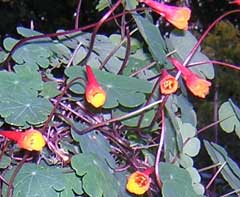
 Tropaeolum tuberosum is a PERENNIAL CLIMBER growing to 2 m (6ft) by 2 m (6ft) at a medium rate.
See above for USDA hardiness. It is hardy to UK zone 8 and is frost tender. It is in flower from June to October, and the seeds ripen from June to October. The species is hermaphrodite (has both male and female organs) and is pollinated by Insects.
Suitable for: light (sandy) and medium (loamy) soils and prefers well-drained soil. Suitable pH: mildly acid and neutral soils. It cannot grow in the shade. It prefers moist soil.
UK Hardiness Map
US Hardiness Map
Synonyms
Plant Habitats
Woodland Garden Sunny Edge; Dappled Shade; Shady Edge; Cultivated Beds;
Edible Uses
Edible Parts: Flowers Leaves Root
Edible Uses:
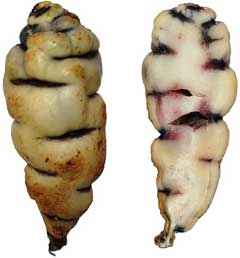
Tubers - cooked[1, 2]. A peppery flavour, it is rather unpleasant to many tastes[27, 34, 37]. The flavour can be improved somewhat by freezing the tubers after they have been cooked, they are then considered to be a delicacy by many people[183]. We have also noticed an improvement in the flavour if the tubers are harvested after they have been frosted, though if the frost is too heavy they can damage the tubers[K]. Other reports suggest half-drying the tubers before use[27, 34, 97, 183]. The tubers can be up to 10cm long and 5cm thick[260]. They are high in vitamin C[196]. The dried tuber contains up to 16% protein[196]. Leaves - raw or cooked as a vegetable[183, 196]. Flowers - raw[183, 196].
References More on Edible Uses
Medicinal Uses
Plants For A Future can not take any responsibility for any adverse effects from the use of plants. Always seek advice from a professional before using a plant medicinally.
Anaphrodisiac Vitamin C
The tuber is considered to be an anaphrodisiac in the Andes, reducing sexual desire. Many men, therefore, refuse to eat it, whilst recommending it for use by women![196]. Clinical trials have indicated a reduction of up to 45% in some male hormones when the tuber forms a considerable part of the diet, but no loss in fertility has been observed[196].
References More on Medicinal Uses
The Bookshop: Edible Plant Books
Our Latest books on Perennial Plants For Food Forests and Permaculture Gardens in paperback or digital formats.

Edible Tropical Plants
Food Forest Plants for Hotter Conditions: 250+ Plants For Tropical Food Forests & Permaculture Gardens.
More

Edible Temperate Plants
Plants for Your Food Forest: 500 Plants for Temperate Food Forests & Permaculture Gardens.
More

More Books
PFAF have eight books available in paperback and digital formats. Browse the shop for more information.
Shop Now
Other Uses
Repellent
The growing plant is very resistant to diseases and insects, it contains nematocidal, bactericidal and insecticidal compounds[196]. Tropaeolum tuberosum is known for attracting bees. It has nectar/pollen-rich flowers.
Special Uses
Food Forest
References More on Other Uses
Cultivation details
Requires well-drained lime-free soil in a warm sunny position[1, 33, 200]. Grows best with its roots in the shade and top growth in the sun[202]. Plants can become dormant in hot dry summers[90]. Grows best in a pH range from 5.3 to 7.5[196]. Prefers a turfy loam or a sandy peaty soil[1]. This species is not very hardy when grown outdoors in Britain. The top growth will survive light frosts, whilst the tubers, if well mulched, will survive to at least -5°c[1, 200]. Anu is sensitive to the number of hours of daylight in a day and most forms will not flower or form new tubers until late in the season (from September), so a mild autumn is required for good yields[33]. The variety 'Ken Aslet', however, is not affected by daylight hours, it flowers from June to October and produces larger tubers than the species from mid-summer onwards[90, 104, 200]. T. tuberosum var. lineamaculatum 'Ken Aslet' has gained the Royal Horticultural Society's Award of Garden Merit. The tubers are formed very near the surface of the soil[90] and so will require some protection, such as a mulch if they are to be left in the ground over the winter[K]. The tubers can also be stored in a cool dry frost-free place over the winter and then planted out in April[200]. Long cultivated in the Andes for its edible root, there are many named varieties[2, 61, 90, 104, 196]. A potentially very high-yielding species, individual plants can produce up to 4 kilos of tubers - yields of 50 tonnes per hectare are possible[196]. A climbing plant supports itself by twisting its leaf stalks around other plants etc[219]. The caterpillars of the cabbage white butterfly can be a nuisance and often cause considerable damage to the leaves[219]. The cultivar
References Carbon Farming Information and Carbon Sequestration Information
Temperature Converter
Type a value in the Celsius field to convert the value to Fahrenheit:
Fahrenheit:
The PFAF Bookshop
Plants For A Future have a number of books available in paperback and digital form. Book titles include Edible Plants, Edible Perennials, Edible Trees,Edible Shrubs, Woodland Gardening, and Temperate Food Forest Plants. Our new book is Food Forest Plants For Hotter Conditions (Tropical and Sub-Tropical).
Shop Now
Plant Propagation
Seed - sow early spring in a greenhouse. Prick the seedlings out into individual pots once they are large enough to handle and grow them on in the greenhouse for their first winter. Plant out in late spring or early summer, after the last expected frosts. So far we have been unable to obtain seed from plants grown in this country. Division of the tubers in the autumn or spring. In cold winter areas the tubers can be harvested in the autumn after top-growth has died down and they can then be stored in a cool frost-free position until planting them out in the spring. Cuttings of basal stems in the spring[200]. Pot them up into individual pots and place them in light shade in a frame until they are established. Plant out in early summer.
Other Names
If available other names are mentioned here
Mashwa (Ecuador and Peru), Maswallo, Mazuko, Mascho (Peru), Añu (in Peru and Bolivia), Isaño, Cubio (in Colombia), Tuberous nasturtium
Native Plant Search
Search over 900 plants ideal for food forests and permaculture gardens. Filter to search native plants to your area. The plants selected are the plants in our book 'Plants For Your Food Forest: 500 Plants for Temperate Food Forests and Permaculture Gardens, as well as plants chosen for our forthcoming related books for Tropical/Hot Wet Climates and Mediterranean/Hot Dry Climates. Native Plant Search
Found In
Countries where the plant has been found are listed here if the information is available
Andes, Argentina, Australia, Bolivia, Britain, Chile, Colombia, Ecuador, Europe, New Zealand, Pacific, Papua New Guinea, PNG, Peru, South America, USA, Venezuela [1-4].
Weed Potential
Right plant wrong place. We are currently updating this section.
Please note that a plant may be invasive in one area but may not in your area so it’s worth checking.
Conservation Status
IUCN Red List of Threatened Plants Status :

Growth: S = slow M = medium F = fast. Soil: L = light (sandy) M = medium H = heavy (clay). pH: A = acid N = neutral B = basic (alkaline). Shade: F = full shade S = semi-shade N = no shade. Moisture: D = dry M = Moist We = wet Wa = water.

Expert comment
Author
Ruiz.&Pav.
Botanical References
200
Links / References
For a list of references used on this page please go here
Readers comment