 |
|
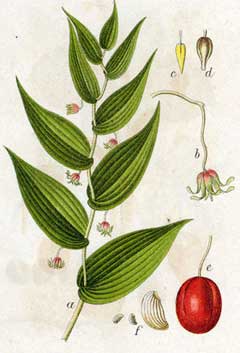
http://commons.wikimedia.org/wiki/File:Streptopus_amplexifolius_Sturm46.jpg |
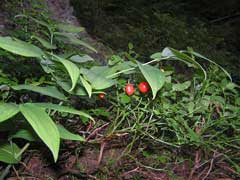 |
| http://commons.wikimedia.org/wiki/User:Don_Pedro28 |
Translate this page:
Summary
Physical Characteristics

 Streptopus amplexifolius is a PERENNIAL growing to 1 m (3ft 3in) by 0.3 m (1ft).
See above for USDA hardiness. It is hardy to UK zone 5. It is in flower from May to July, and the seeds ripen from September to October. The species is hermaphrodite (has both male and female organs).
Suitable for: light (sandy) and medium (loamy) soils. Suitable pH: mildly acid, neutral and basic (mildly alkaline) soils. It can grow in full shade (deep woodland) or semi-shade (light woodland). It prefers moist soil.
UK Hardiness Map
US Hardiness Map
Synonyms
S. distortus.
Plant Habitats
Woodland Garden Dappled Shade; Shady Edge; not Deep Shade;
Edible Uses
Edible Parts: Fruit Leaves Root Shoots
Edible Uses:
Fruit - raw or cooked in soups and stews[105, 161, 172]. Juicy with a cucumber flavour[183], they are reported to be slightly cathartic when growing in certain areas only[183]. The fruit is laxative if eaten in large quantities according to another report[172]. The oval berry is up to 15mm long[235]. Tender young shoots - raw in salads or cooked like asparagus[177, 183, 257]. A cucumber-like flavour[172, 183]. Root - raw. It is sometimes used in salads for its cucumber flavour[105, 177, 183].
References More on Edible Uses
Medicinal Uses
Plants For A Future can not take any responsibility for any adverse effects from the use of plants. Always seek advice from a professional before using a plant medicinally.
Analgesic Appetizer Cathartic Haemostatic Kidney Oxytoxic Stomachic VD
The fruit is cathartic[172, 207]. An infusion of the stems and fruit has been used to treat 'sickness in general'[257]. The plant is tonic[257]. An infusion of the whole plant has been used to treat stomach complaints and loss of appetite[257]. A compound infusion of the plant has been used in the treatment of spitting up of blood, kidney problems and gonorrhoea[257]. The root has been chewed in order to induce labour in cases of protracted delay[257]. A compound infusion of the root has been used as an analgesic in the treatment of internal pain[257].
References More on Medicinal Uses
The Bookshop: Edible Plant Books
Our Latest books on Perennial Plants For Food Forests and Permaculture Gardens in paperback or digital formats.
Edible Tropical Plants
Food Forest Plants for Hotter Conditions: 250+ Plants For Tropical Food Forests & Permaculture Gardens.
More
Edible Temperate Plants
Plants for Your Food Forest: 500 Plants for Temperate Food Forests & Permaculture Gardens.
More
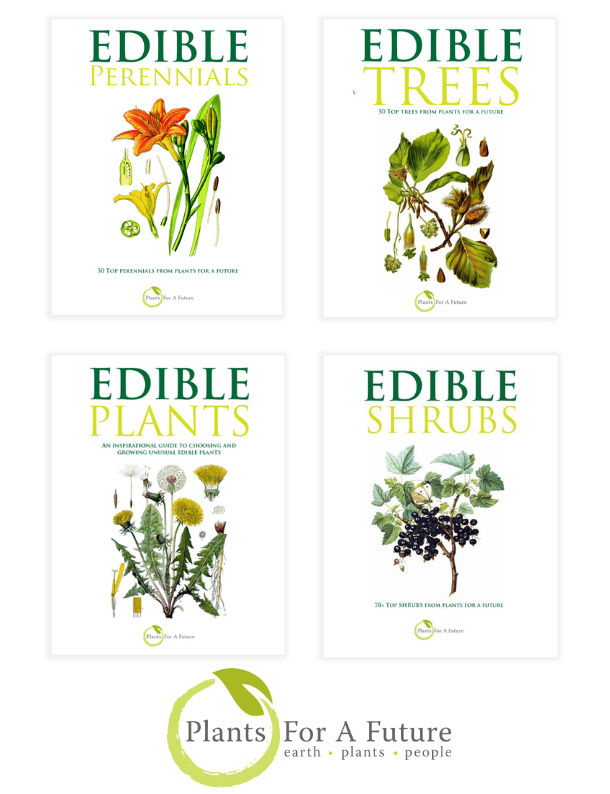
More Books
PFAF have eight books available in paperback and digital formats. Browse the shop for more information.
Shop Now
Other Uses
Incense
The plant has been tied to the clothes, body or hair and used as a scent[257].
Special Uses
Food Forest
References More on Other Uses
Cultivation details
Requires a cool leafy soil in shade or partial shade[187]. Thrives in a moist light soil containing organic matter[1]. Hardy to at least -20°c. A polymorphic species, there are many sub-species[43]. For polyculture design as well as the above-ground architecture (form - tree, shrub etc. and size shown above) information on the habit and root pattern is also useful and given here if available. The plant growth habit is a clumper with limited spread [1-2]. The root pattern is fibrous dividing into a large number of fine roots [1-2]. The root pattern is rhizomatous with underground stems sending roots and shoots along their length [1-2].
References Carbon Farming Information and Carbon Sequestration Information
Temperature Converter
Type a value in the Celsius field to convert the value to Fahrenheit:
Fahrenheit:
The PFAF Bookshop
Plants For A Future have a number of books available in paperback and digital form. Book titles include Edible Plants, Edible Perennials, Edible Trees,Edible Shrubs, Woodland Gardening, and Temperate Food Forest Plants. Our new book is Food Forest Plants For Hotter Conditions (Tropical and Sub-Tropical).
Shop Now
Plant Propagation
Seed - best sown in a cold frame as soon as it is ripe in the summer[200]. Sow stored seed in a cold frame as soon as it is received. The seed, especially if it has been stored, can be very slow to germinate, sometimes taking 18 months or more. Prick out the seedlings into individual pots once they are large enough to handle and grow them on in a shady part of the greenhouse or cold frame. It will normally take 2 or more growing seasons before the roots are large enough to plant out - this is best done when the plant is dormant in the autumn. Division as the plant comes into growth in early spring. Larger divisions can be planted out direct into their permanent positions. We have found that it is best to pot up smaller divisions and grow them on in light shade in a greenhouse or cold frame for their first year, planting them out in the following spring.
Other Names
If available other names are mentioned here
twistedstalk, clasping twistedstalk,claspleaf twistedstalk, white twisted-stalk, or watermelon berry.
Native Plant Search
Search over 900 plants ideal for food forests and permaculture gardens. Filter to search native plants to your area. The plants selected are the plants in our book 'Plants For Your Food Forest: 500 Plants for Temperate Food Forests and Permaculture Gardens, as well as plants chosen for our forthcoming related books for Tropical/Hot Wet Climates and Mediterranean/Hot Dry Climates. Native Plant Search
Found In
Countries where the plant has been found are listed here if the information is available
Weed Potential
Right plant wrong place. We are currently updating this section.
Please note that a plant may be invasive in one area but may not in your area so it’s worth checking.
Conservation Status
IUCN Red List of Threatened Plants Status :

Growth: S = slow M = medium F = fast. Soil: L = light (sandy) M = medium H = heavy (clay). pH: A = acid N = neutral B = basic (alkaline). Shade: F = full shade S = semi-shade N = no shade. Moisture: D = dry M = Moist We = wet Wa = water.

Expert comment
Author
(L.)DC.
Botanical References
4350200
Links / References
For a list of references used on this page please go here
Readers comment
© 2010, Plants For A Future. Plants For A Future is a charitable company limited by guarantee, registered in England and Wales. Charity No. 1057719, Company No. 3204567.