Plants For A Future Logo Full Contact Details
Registered Charity No. 1057719

Back to main Search Page

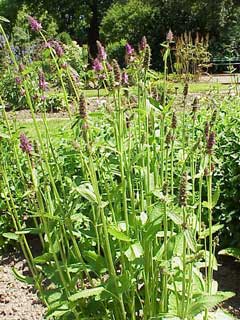
Stachys affinis - Bunge.

Chinese Artichoke

AuthorBunge. Botanical references200, 266
FamilyLabiatae GenusStachys
SynonymsStachys sieboldii - Miq.
Stachys tuberifera - Naudin.
Known HazardsNone known
RangeE. Asia - China, Japan.
HabitatWet and submersed areas; 0-3200 m. Gansu, Hebei, Nei Mongol, Ningxia, Qinghai, Shaanxi, Shandong, Shanxi, Xinjiang[266]
Edibility Ratingapple iconapple iconapple iconapple icon 4 (1-5) Medicinal Ratingapple icon 1 (1-5)

Physical Characteristics

icon of man icon of perennial/biennial/annual Perennial growing to 0.45m.
It is hardy to zone 5 and is frost tender. It is in leaf from May to November, in flower from July to August. The flowers are hermaphrodite (have both male and female organs) and are pollinated by Insects.

The plant prefers light (sandy), medium (loamy) and heavy (clay) soils and requires well-drained soil. The plant prefers acid, neutral and basic (alkaline) soils. It can grow in semi-shade (light woodland) or no shade. It requires moist soil.

Habitats

Cultivated Beds;

Edible Uses

Edible Parts: Leaves; Root.

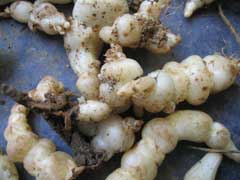
Tubers - raw or cooked[1, 2, 4, 16, 33]. Quite a pleasant mild flavour and easily digested[46], but fairly small and fiddly[K], they are about 5 - 8cm long and 2cm wide[200, 206]. A nutty artichoke-like flavour[183], it can be eaten raw on its own, be added to salads or be lightly cooked[K]. The tubers quickly discolour when exposed to the air[200] and are said to lose their flavour if they are peeled[183]. It is best to harvest them as required[206]. Yields are about 1kg per square metre[200]. Leaves - cooked. A famine food, they are only used when all else fails[179].

Medicinal Uses

Plants For A Future can not take any responsibility for any adverse effects from the use of plants. Always seek advice from a professional before using a plant medicinally.

Anodyne.

The dried and powdered root is anodyne[218]. The entire plant has been used in the treatment of colds and pneumonia[266].

Other Uses

None known

Cultivation details

Prefers a well-drained soil in a sunny position[16]. Thrives in an ordinary garden soil[1], preferring one that is not too heavy[16, 33]. It grows best in a soil that has been well fed and does not dry out in the growing season[16]. Plants seem to withstand even water-logged conditions in the winter[206]. The Chinese artichoke is occasionally cultivated for its edible tubers, they are planted out in March and harvested from October onwards[1, 58, 61]. Although top growth is killed back by frost, the tubers are very hardy and can be left in the ground over winter to be harvested as required[200]. It is virtually impossible to find all the tubers, there are always some left behind that will grow the following season[K]. Plants are very tolerant of high summer temperatures[206]. The tubers begin to sprout at temperatures above about 5°c[206]. Plants take 5 - 7 months to develop their tubers[206]. Plants rarely flower in Britain[1].

Propagation

Seed - sow spring in a cold frame. Prick out the seedlings into individual pots when they are large enough to handle. If sufficient growth has been made, it is possible to plant them out during the summer, otherwise grow them on in pots for their first summer, leaving the tubers in the pots to overwinter in a cold frame and then plant out in late spring when in active growth. Seed is rarely if ever produced on plants growing in Britain. Division. The tubers can be harvest and replanted at any time whilst they are dormant. They do start into growth fairly early in the year so it is better to have moved them by the end of March[K].

Links

This plant is also mentioned in the following PFAF articles: Alternative Root Crops.

References

[K] Ken Fern
Notes from observations, tasting etc at Plants For A Future and on field trips.

[1] F. Chittendon. RHS Dictionary of Plants plus Supplement. 1956 Oxford University Press 1951
Comprehensive listing of species and how to grow them. Somewhat outdated, it has been replaces in 1992 by a new dictionary (see [200]).

[2] Hedrick. U. P. Sturtevant's Edible Plants of the World. Dover Publications 1972 ISBN 0-486-20459-6
Lots of entries, quite a lot of information in most entries and references.

[4] Grieve. A Modern Herbal. Penguin 1984 ISBN 0-14-046-440-9
Not so modern (1930's?) but lots of information, mainly temperate plants.

[16] Simons. New Vegetable Growers Handbook. Penguin 1977 ISBN 0-14-046-050-0
A good guide to growing vegetables in temperate areas, not entirely organic.

[33] Organ. J. Rare Vegetables for Garden and Table. Faber 1960
Unusual vegetables that can be grown outdoors in Britain. A good guide.

[46] Uphof. J. C. Th. Dictionary of Economic Plants. Weinheim 1959
An excellent and very comprehensive guide but it only gives very short descriptions of the uses without any details of how to utilize the plants. Not for the casual reader.

[58] Ohwi. G. Flora of Japan. (English translation) Smithsonian Institution 1965
The standard work. Brilliant, but not for the casual reader.

[61] Usher. G. A Dictionary of Plants Used by Man. Constable 1974 ISBN 0094579202
Forget the sexist title, this is one of the best books on the subject. Lists a very extensive range of useful plants from around the world with very brief details of the uses. Not for the casual reader.

[179] Reid. B. E. Famine Foods of the Chiu-Huang Pen-ts'ao. Taipei. Southern Materials Centre 1977
A translation of an ancient Chinese book on edible wild foods. Fascinating.

[183] Facciola. S. Cornucopia - A Source Book of Edible Plants. Kampong Publications 1990 ISBN 0-9628087-0-9
Excellent. Contains a very wide range of conventional and unconventional food plants (including tropical) and where they can be obtained (mainly N. American nurseries but also research institutes and a lot of other nurseries from around the world.

[200] Huxley. A. The New RHS Dictionary of Gardening. 1992. MacMillan Press 1992 ISBN 0-333-47494-5
Excellent and very comprehensive, though it contains a number of silly mistakes. Readable yet also very detailed.

[206] Larkcom J. Oriental Vegetables John Murray 1991 ISBN 0-7195-4781-4
Well written and very informative.

[218] Duke. J. A. and Ayensu. E. S. Medicinal Plants of China Reference Publications, Inc. 1985 ISBN 0-917256-20-4
Details of over 1,200 medicinal plants of China and brief details of their uses. Often includes an analysis, or at least a list of constituents. Heavy going if you are not into the subject.

[266] Flora of China 1994
On-line version of the Flora - an excellent resource giving basic info on habitat and some uses.

Readers Comments

Plants for a Future does not verify the accuracy of reader comments, use at your own risk. In particular Plants For A Future can not take any responsibility for any adverse effects from the use of plants. You should always consult a professional before using plants medicinally.

Stachys affinis

Steve Dupey Thu Dec 1 2005

Id rate the plant as somewhat frost tolerant rather than tender. Seems to need a longer growing season than I have.. yields are low but it grows easily. Invasive.. tubers are very cold tolerant. Small and fiddly yes but easy enough to clean. Id say the flavor is good but a bit too mild. Possibly production could be increased with better knowlege of fertization requirements.. perhaps I gave it too much nitrogen. Id like to experiment with some of the other wild Stachys and I wonder why some selection for tuber size doesnt seem to have occurred. Are their cultivars of this we are not aware of. French.. crosne, Japanese... chorogi ??

Alternative Root Crops

Gaetane Godin Fri Nov 3 2006

I started cultivating Stachys affinis for the first time this year. I bought tubers from an organic grower of those. However, my planys never flowered but I got nice tubers. They did not grow high, 8 inches maximum, but they kind of expanded by the sides. I was wandering if someone has knowledge about this type of growth and why there was not flowering. Thanks, Gaetane

Stachys affinis

Mon Nov 6 2006

This is the normal growth patter of Stachys affinis, though plants usually grow taller - ours are usually 30 - 50cm tall. The reason plants seldom flower in Britain is because the summer is not normally hot enough to initiate flowering - I wonder if this will change if we continue to get hotter summers with global warming. Instead of flowering, the plants concentrate on root growth, send up lots of new growth from these roots and therefore producing a tight clump with lots of stems.

Stachys affinis

Ken Fern, Plants for a Future. Mon Nov 6 2006

This is the normal growth patter of Stachys affinis, though plants usually grow taller - ours are usually 30 - 50cm tall. The reason plants seldom flower in Britain is because the summer is not normally hot enough to initiate flowering - I wonder if this will change if we continue to get hotter summers with global warming. Instead of flowering, the plants concentrate on root growth, send up lots of new growth from these roots and therefore producing a tight clump with lots of stems.

Stachys affinis

Abayomi Mon Nov 6 2006

where can I get seeds?

Stachys affinis

Ken Fern, Plants for a Future Wed Nov 22 2006

This plant is not normally propagated by seed. The usual method is to obtain the small tubers and plant these out in early spring. There are a number of nurseries that offer the tubers in Britain, visit the Plant Finder at http://www.rhs.org.uk/RHSPlantFinder/plantfinder.asp for details of these.

Stachys affinis

Lauren Leach-Steffens Fri Feb 29 2008

Oh, my gosh. I have been digging this out from around my mini-pond for YEARS. Invasive? You bet. Edible? I didn't know -- maybe this will give me something to do with this beastly plant.

Stachys affinis

Eleanor Wed Apr 2 2008

Does anyone know of a Canadian nursery that ships stachys affinis? I can find only American and British ones, and am not sure that these tubers will be allowed past customs.

Stachys affinis

Nigel Murison Sun Oct 12 2008

I grew these for the fist time this year and most if not all plants flowered,seeds seemed to be developing but didn't come to much in the end. As it seems to be found in wet places I will try growing these in watery places next year.

Stachys affinis

Nigel Murison Sun Oct 12 2008

I forgot to add, that I grew these on the Rame Peninsula in East Cornwall.

Stachys affinis

Kristin Kaspersen Wed Nov 5 2008

Grows like a weed in southern Norway. I received some tubers a couple of years ago, and this summer they flowered for the first time.

Stachys affinis

Lise Fauteux Sun Feb 22 2009

You can buy some in Canada (Quebec) there

La société des plantes

Add a comment/link:

Enter your comment about this page here.
Note: please don't expect a quick reply to comments/questions posted here? We don't have the resources to answer questions ourselves. You can ask questions on our mailing list.

Subject: Stachys affinis


LinksTo add a link to another website with useful info add the details here.
Name of Site:
URL for Site:
Details:

Your Name:
email address:
Email addressed added here will not be displayed on the website or be passed to third parties.
They are used incase we need to get in touch with you.
To prevent spam all comments are moderated, comments with spam or swearing are blocked.

Discussion Monitor

To have posts to this page mailed to you enter your email address here:

email address: 

(Your email address will not appear on the webpage or be passed on to third parties).

All the information contained in these pages is Copyright (C) Plants For A Future, 1996-2008.

Plants For A Future is a charitable company limited by guarantee, registered in England and Wales. Charity No. 1057719, Company No. 3204567, 

HTML version prepared by Rich Morris - Home Page

Creative Commons License This work is licensed under a Creative Commons License. You can copy, distribute, display this works and to make derivative works but: Attribution is required, and it's Share Alike (GNUish/copyleft) i.e. has an identical license. We also ask that you let us know (webmaster@pfaf.org) if you link to, redistribute, make a derived work or do anything groovy with this information.