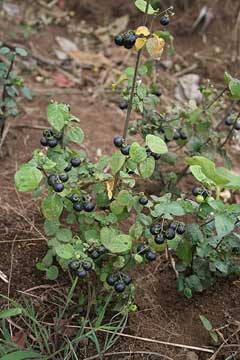
 |
|
http://commons.wikimedia.org/wiki/User:Marco_Schmidt |
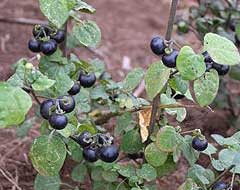 |
|
Translate this page:
Summary
Physical Characteristics

 Solanum scabrum is a ANNUAL growing to 0.6 m (2ft) by 0.3 m (1ft in).
See above for USDA hardiness. It is hardy to UK zone 6. It is in flower from July to September, and the seeds ripen from August to October. The species is hermaphrodite (has both male and female organs) and is pollinated by Insects.
Suitable for: light (sandy), medium (loamy) and heavy (clay) soils and prefers well-drained soil. Suitable pH: mildly acid, neutral and basic (mildly alkaline) soils. It cannot grow in the shade. It prefers moist soil.
UK Hardiness Map
US Hardiness Map
Synonyms
S. intrusum. S. melanocerasum. All. S. scabrum.
Plant Habitats
Cultivated Beds;
Edible Uses
Edible Parts: Fruit Leaves Shoots
Edible Uses:
Fruit - cooked[2, 27, 89, 179]. Used in preserves, jams and pies[183]. A pleasant musky taste[85]. Only the fully ripe fruits should be used, the unripe fruits contain the toxin solanine[65, 173, 183]. Often cooked with some baking soda first in order to remove any bitterness. The fruit contains about 2.5% protein, 0.6% fat, 5.6% carbohydrate, 1.2% ash[179]. The fruit is up to 12mm in diameter[200]. Young leaves and new shoots - raw or cooked as a potherb or added to soups[2, 27, 85, 89, 173, 179, 183]. See notes at the top of the page regarding possible toxicity.
References More on Edible Uses
Medicinal Uses
Plants For A Future can not take any responsibility for any adverse effects from the use of plants. Always seek advice from a professional before using a plant medicinally.
Antiperiodic Antiphlogistic Diaphoretic Diuretic Febrifuge Narcotic Purgative
The whole plant is antiperiodic, antiphlogistic, diaphoretic, diuretic, emollient, febrifuge, narcotic, purgative and sedative[4, 21, 145, 147, 192, 218]. It is harvested in the autumn when both flowers and fruit are upon the plant, and is dried for later use[4]. Use with caution[21], see notes above on toxicity. The leaves, stems and roots are used in the treatment of cancerous sores, leucoderma and wounds[218]. Extracts of the plant are analgesic, antispasmodic, anti-inflammatory and vasodilator[218]. The plant has been used in the manufacture of locally analgesic ointments and the juice of the fruit has been used as an analgesic for toothaches[7].
References More on Medicinal Uses
The Bookshop: Edible Plant Books
Our Latest books on Perennial Plants For Food Forests and Permaculture Gardens in paperback or digital formats.
Edible Tropical Plants
Food Forest Plants for Hotter Conditions: 250+ Plants For Tropical Food Forests & Permaculture Gardens.
More
Edible Temperate Plants
Plants for Your Food Forest: 500 Plants for Temperate Food Forests & Permaculture Gardens.
More
More Books
PFAF have eight books available in paperback and digital formats. Browse the shop for more information.
Shop Now
Other Uses
References More on Other Uses
Cultivation details
Succeeds in most soils[1]. Dislikes shade[1]. Caterpillars and slugs are particularly fond of this plant and can totally destroy it[K]. This is a cultivated form of S. nigrum, grown for its edible fruit. There is at least one named form[183]. See notes about possible toxicity at the top of this page. There is some disagreement among taxonomists as to the correct name of this plant. It is also listed as S. melanocerasum[200]. Grows well with clover[18]. Does not grow well with wormwood or white mustard and, when these plants are growing Closely related to S. nigra, they increase its content of toxic alkaloids[18].
References Carbon Farming Information and Carbon Sequestration Information
Temperature Converter
Type a value in the Celsius field to convert the value to Fahrenheit:
Fahrenheit:
The PFAF Bookshop
Plants For A Future have a number of books available in paperback and digital form. Book titles include Edible Plants, Edible Perennials, Edible Trees,Edible Shrubs, Woodland Gardening, and Temperate Food Forest Plants. Our new book is Food Forest Plants For Hotter Conditions (Tropical and Sub-Tropical).
Shop Now
Plant Propagation
Seed - sow spring in situ. The seed can also be sown in a greenhouse during the spring if required since this will normally produce larger crops of fruit. Prick out the seedlings into individual pots when they are large enough to handle and plant out in late spring.
Other Names
If available other names are mentioned here
Native Plant Search
Search over 900 plants ideal for food forests and permaculture gardens. Filter to search native plants to your area. The plants selected are the plants in our book 'Plants For Your Food Forest: 500 Plants for Temperate Food Forests and Permaculture Gardens, as well as plants chosen for our forthcoming related books for Tropical/Hot Wet Climates and Mediterranean/Hot Dry Climates. Native Plant Search
Found In
Countries where the plant has been found are listed here if the information is available
Weed Potential
Right plant wrong place. We are currently updating this section.
Please note that a plant may be invasive in one area but may not in your area so it’s worth checking.
Conservation Status
IUCN Red List of Threatened Plants Status :

| Related Plants
|
| Latin Name | Common Name | Habit | Height | Hardiness | Growth | Soil | Shade | Moisture | Edible | Medicinal | Other |
| Solanum aethiopicum | Mock Tomato, Ethiopian nightshade | Shrub | 2.5 |
10-12
| | LMH | N | M | 3 | 2 | 2 |
| Solanum ajanhuiri | Ajanhuiri | Perennial | 0.0 |
9-11
| | LMH | SN | M | 2 | 0 | |
| Solanum americanum | American Nightshade, American black nightshade | Annual | 1.0 |
0-0
| | LMH | N | M | 1 | 0 | 0 |
| Solanum andigenum | Andigena | Perennial | 0.0 |
-
| | LMH | N | M | 2 | 0 | |
| Solanum aviculare | Kangaroo Apple, New Zealand nightshade | Shrub | 1.8 |
8-11
| | LMH | N | M | 2 | 2 | 2 |
| Solanum boreale | | Perennial | 0.0 |
-
| | LMH | N | M | 1 | 0 | |
| Solanum boyacense | | Perennial | 0.0 |
-
| | LMH | N | M | 1 | 0 | |
| Solanum cari | | Perennial | 0.0 |
-
| | LMH | SN | M | 1 | 0 | |
| Solanum carolinense | Horse Nettle, Carolina horsenettle | Perennial | 1.0 |
3-7
| | LMH | SN | M | 0 | 2 | 1 |
| Solanum chaucha | Chaucha | Perennial | 0.0 |
-
| | LMH | SN | M | 1 | 0 | |
| Solanum curtilobum | Rucki | Perennial | 0.0 |
-
| | LMH | SN | M | 2 | 0 | |
| Solanum dulcamara | Bittersweet. Bittersweet Nightshade, Climbing nightshade, Bittersweet, Deadly Nightshade, Poisonous | Perennial Climber | 2.5 |
4-8
| M | LMH | SN | M | 0 | 3 | 0 |
| Solanum fendleri | Wild Potato, Fendler's horsenettle, Texan horsenettle | Perennial | 0.0 |
0-0
| | LMH | N | M | 3 | 2 | |
| Solanum jamesii | Colorado Wild Potato, Wild potato | Perennial | 0.2 |
8-11
| | LMH | N | M | 2 | 0 | |
| Solanum juzepczukii | Rucki | Perennial | 0.0 |
-
| | LMH | SN | M | 2 | 0 | |
| Solanum kurzii | | Perennial | 0.0 |
-
| | LMH | SN | M | 1 | 0 | |
| Solanum laciniatum | Kangaroo Apple | Shrub | 3.0 |
8-11
| | LMH | N | M | 2 | 2 | 2 |
| Solanum linearifolium | Mountain Kangaroo Apple | Shrub | 0.0 |
-
| | LMH | N | M | 2 | 0 | |
| Solanum liximitante | | Perennial | 0.0 |
-
| | LMH | SN | M | 1 | 0 | |
| Solanum luteum | | Annual | 0.0 |
-
| | LMH | SN | M | 1 | 0 | |
| Solanum lycopersicum | Tomato, Garden Tomato | Annual | 2.0 |
10-12
| F | LMH | N | M | 5 | 3 | 3 |
| Solanum lyratum | | Perennial Climber | 2.0 |
-
| | LMH | N | M | 1 | 2 | |
| Solanum maglia | | Perennial | 0.0 |
-
| | LMH | N | M | 2 | 0 | |
| Solanum melongena | Aubergine, Eggplant | Perennial | 1.0 |
8-11
| | LMH | N | M | 3 | 2 | |
| Solanum muricatum | Pepino | Shrub | 1.0 |
8-11
| | LMH | N | M | 4 | 0 | 0 |
| Solanum nigrum | Black Nightshade, Common Nightshade, Poisonberry, Black Nightshade | Annual | 0.6 |
0-0
| | LMH | N | DM | 2 | 2 | 2 |
| Solanum paniculatum | Jurubeba, Nightshade | Shrub | 2.0 |
10-12
| F | LMH | SN | M | 0 | 4 | 0 |
| Solanum phureja | Phureja, Nightshade | Perennial | 0.0 |
8-11
| | LMH | SN | M | 3 | 0 | |
| Solanum piliferum | | Perennial | 0.0 |
-
| | LMH | N | M | 2 | 0 | |
| Solanum pimpinellifolium | Currant Tomato | Annual/Biennial | 1.0 |
10-12
| F | LMH | N | M | 4 | 2 | 2 |
|
|
Growth: S = slow M = medium F = fast. Soil: L = light (sandy) M = medium H = heavy (clay). pH: A = acid N = neutral B = basic (alkaline). Shade: F = full shade S = semi-shade N = no shade. Moisture: D = dry M = Moist We = wet Wa = water.

Expert comment
Author
Mill.
Botanical References
200
Links / References
For a list of references used on this page please go here
Readers comment