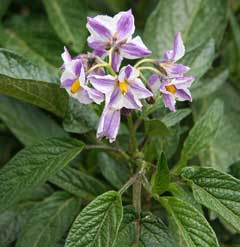
 |
|
http://de.wikipedia.org/wiki/Benutzer:Michael_w |
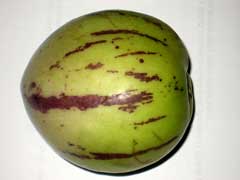 |
| http://cs.wikipedia.org/wiki/Wikipedista:Dezidor |
Translate this page:
Summary
Pepino or pepino dulce (sweet cucumber) is an evergreen Shrub growing to 1 m (3ft 3in) grown for its sweet edible fruit similar to honeydew or rockmelon and with a juicy melon-like texture. With a sprawling habit, it is an excellent ground cover plant possible to grow on a fence or trellis.
Physical Characteristics

 Solanum muricatum is an evergreen Shrub growing to 1 m (3ft 3in) by 1 m (3ft 3in).
See above for USDA hardiness. It is hardy to UK zone 9 and is frost tender. It is in leaf all year, in flower from August to October, and the seeds ripen from September to November. The species is hermaphrodite (has both male and female organs) and is pollinated by Insects. The plant is self-fertile.
Suitable for: light (sandy), medium (loamy) and heavy (clay) soils and prefers well-drained soil. Suitable pH: mildly acid, neutral and basic (mildly alkaline) soils. It cannot grow in the shade. It prefers moist soil.
UK Hardiness Map
US Hardiness Map
Synonyms
S. guatamalense.
Plant Habitats
Cultivated Beds;
Edible Uses
Edible Parts: Fruit
Edible Uses:
Fruit - raw. A juicy, sweet aromatic and very agreeable flavour[1, 46, 61], somewhat like a honeydew melon[183]. The skin of some varieties has a disagreeable flavour[196]. The fruit contains 35mg vitamin C per 100g, 7% carbohydrates and 92% water[196]. The fruit should be harvested just before it is fully ripe and will store for several weeks at room temperature[196]. The fruit is about 10cm long and 6cm wide[200].
References More on Edible Uses
Medicinal Uses
Plants For A Future can not take any responsibility for any adverse effects from the use of plants. Always seek advice from a professional before using a plant medicinally.
Vitamin C
None known
References More on Medicinal Uses
The Bookshop: Edible Plant Books
Our Latest books on Perennial Plants For Food Forests and Permaculture Gardens in paperback or digital formats.
Edible Tropical Plants
Food Forest Plants for Hotter Conditions: 250+ Plants For Tropical Food Forests & Permaculture Gardens.
More
Edible Temperate Plants
Plants for Your Food Forest: 500 Plants for Temperate Food Forests & Permaculture Gardens.
More
More Books
PFAF have eight books available in paperback and digital formats. Browse the shop for more information.
Shop Now
Other Uses
References More on Other Uses
Cultivation details
Succeeds in most well-drained soils in a sunny position[1, 196]. If the soil is too fertile fruit production will suffer due to excess vegetative growth[196]. Requires a pH above 6 in order to avoid disorders such as manganese toxicity or iron deficiency[196]. Frequently cultivated for its edible fruit in S. America, there are some named varieties[183, 196]. Yields of 40 - 60 tonnes per hectare have been achieved[196]. Plants are not very hardy in Britain, being cut to the ground by fairly light frosts. Seedlings show no resistance to frost, established plants are cut back at -3°c[196]. In a warm position and given a good mulch however, the roots can survive the winter and regrow from the base in the spring. Cuttings are exceedingly easy and these can be overwintered in a greenhouse to provide fresh plants for the following year[K]. Plants do not appear to have a sensitivity to day-length[196]. Plants can set fruit parthenocarpically (without fertilization or seed being formed) but self-fertilization or insect fertilization greatly encourages fruiting[196]. High temperatures, particularly above 30°c, at flowering time can cause the flowers to abort[196].
References Carbon Farming Information and Carbon Sequestration Information
Temperature Converter
Type a value in the Celsius field to convert the value to Fahrenheit:
Fahrenheit:
The PFAF Bookshop
Plants For A Future have a number of books available in paperback and digital form. Book titles include Edible Plants, Edible Perennials, Edible Trees,Edible Shrubs, Woodland Gardening, and Temperate Food Forest Plants. Our new book is Food Forest Plants For Hotter Conditions (Tropical and Sub-Tropical).
Shop Now
Plant Propagation
Seed - sow early spring in a warm greenhouse. When they are large enough to handle, prick the seedlings out into individual pots and grow them on in the greenhouse for at least their first winter. Plant them out into their permanent positions in late spring or early summer, after the last expected frosts. Give the plants some protection from the cold for at least their first winter outdoors. Cuttings of half-ripe wood, July/August in a frame. Very easy. Overwinter in a greenhouse and plant out after the last expected frosts.
Other Names
If available other names are mentioned here
Native Plant Search
Search over 900 plants ideal for food forests and permaculture gardens. Filter to search native plants to your area. The plants selected are the plants in our book 'Plants For Your Food Forest: 500 Plants for Temperate Food Forests and Permaculture Gardens, as well as plants chosen for our forthcoming related books for Tropical/Hot Wet Climates and Mediterranean/Hot Dry Climates. Native Plant Search
Found In
Countries where the plant has been found are listed here if the information is available
Weed Potential
Right plant wrong place. We are currently updating this section.
Please note that a plant may be invasive in one area but may not in your area so it’s worth checking.
Conservation Status
IUCN Red List of Threatened Plants Status :

| Related Plants
|
| Latin Name | Common Name | Habit | Height | Hardiness | Growth | Soil | Shade | Moisture | Edible | Medicinal | Other |
| Solanum aethiopicum | Mock Tomato, Ethiopian nightshade | Shrub | 2.5 |
10-12
| | LMH | N | M | 3 | 2 | 2 |
| Solanum ajanhuiri | Ajanhuiri | Perennial | 0.0 |
9-11
| | LMH | SN | M | 2 | 0 | |
| Solanum americanum | American Nightshade, American black nightshade | Annual | 1.0 |
0-0
| | LMH | N | M | 1 | 0 | 0 |
| Solanum andigenum | Andigena | Perennial | 0.0 |
-
| | LMH | N | M | 2 | 0 | |
| Solanum aviculare | Kangaroo Apple, New Zealand nightshade | Shrub | 1.8 |
8-11
| | LMH | N | M | 2 | 2 | 2 |
| Solanum boreale | | Perennial | 0.0 |
-
| | LMH | N | M | 1 | 0 | |
| Solanum boyacense | | Perennial | 0.0 |
-
| | LMH | N | M | 1 | 0 | |
| Solanum cari | | Perennial | 0.0 |
-
| | LMH | SN | M | 1 | 0 | |
| Solanum carolinense | Horse Nettle, Carolina horsenettle | Perennial | 1.0 |
3-7
| | LMH | SN | M | 0 | 2 | 1 |
| Solanum chaucha | Chaucha | Perennial | 0.0 |
-
| | LMH | SN | M | 1 | 0 | |
| Solanum curtilobum | Rucki | Perennial | 0.0 |
-
| | LMH | SN | M | 2 | 0 | |
| Solanum dulcamara | Bittersweet. Bittersweet Nightshade, Climbing nightshade, Bittersweet, Deadly Nightshade, Poisonous | Perennial Climber | 2.5 |
4-8
| M | LMH | SN | M | 0 | 3 | 0 |
| Solanum fendleri | Wild Potato, Fendler's horsenettle, Texan horsenettle | Perennial | 0.0 |
0-0
| | LMH | N | M | 3 | 2 | |
| Solanum jamesii | Colorado Wild Potato, Wild potato | Perennial | 0.2 |
8-11
| | LMH | N | M | 2 | 0 | |
| Solanum juzepczukii | Rucki | Perennial | 0.0 |
-
| | LMH | SN | M | 2 | 0 | |
| Solanum kurzii | | Perennial | 0.0 |
-
| | LMH | SN | M | 1 | 0 | |
| Solanum laciniatum | Kangaroo Apple | Shrub | 3.0 |
8-11
| | LMH | N | M | 2 | 2 | 2 |
| Solanum linearifolium | Mountain Kangaroo Apple | Shrub | 0.0 |
-
| | LMH | N | M | 2 | 0 | |
| Solanum liximitante | | Perennial | 0.0 |
-
| | LMH | SN | M | 1 | 0 | |
| Solanum luteum | | Annual | 0.0 |
-
| | LMH | SN | M | 1 | 0 | |
| Solanum lycopersicum | Tomato, Garden Tomato | Annual | 2.0 |
10-12
| F | LMH | N | M | 5 | 3 | 3 |
| Solanum lyratum | | Perennial Climber | 2.0 |
-
| | LMH | N | M | 1 | 2 | |
| Solanum maglia | | Perennial | 0.0 |
-
| | LMH | N | M | 2 | 0 | |
| Solanum melongena | Aubergine, Eggplant | Perennial | 1.0 |
8-11
| | LMH | N | M | 3 | 2 | |
| Solanum nigrum | Black Nightshade, Common Nightshade, Poisonberry, Black Nightshade | Annual | 0.6 |
0-0
| | LMH | N | DM | 2 | 2 | 2 |
| Solanum paniculatum | Jurubeba, Nightshade | Shrub | 2.0 |
10-12
| F | LMH | SN | M | 0 | 4 | 0 |
| Solanum phureja | Phureja, Nightshade | Perennial | 0.0 |
8-11
| | LMH | SN | M | 3 | 0 | |
| Solanum piliferum | | Perennial | 0.0 |
-
| | LMH | N | M | 2 | 0 | |
| Solanum pimpinellifolium | Currant Tomato | Annual/Biennial | 1.0 |
10-12
| F | LMH | N | M | 4 | 2 | 2 |
|
|
Growth: S = slow M = medium F = fast. Soil: L = light (sandy) M = medium H = heavy (clay). pH: A = acid N = neutral B = basic (alkaline). Shade: F = full shade S = semi-shade N = no shade. Moisture: D = dry M = Moist We = wet Wa = water.

Expert comment
Author
Aiton.
Botanical References
200
Links / References
For a list of references used on this page please go here
Readers comment