Plants For A Future Logo Full Contact Details
Registered Charity No. 1057719

Back to main Search Page

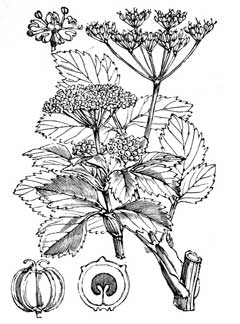
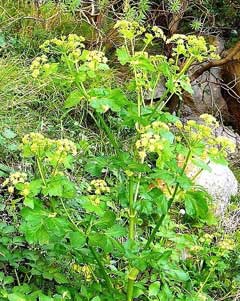
Smyrnium olusatrum - L.

Alexanders

AuthorL. Botanical references17, 200
FamilyUmbelliferae GenusSmyrnium
Synonyms
Known HazardsNone known
RangeEurope to Asia. Naturalized in Britain[17].
HabitatHedges and waste places, often near the sea[17].
Edibility Ratingapple iconapple iconapple icon 3 (1-5) Medicinal Ratingapple icon 1 (1-5)

Physical Characteristics

icon of man icon of perennial/biennial/annual Biennial growing to 1.2m by 0.7m.
It is hardy to zone 6 and is not frost tender. It is in flower from May to June, and the seeds ripen from June to August. The flowers are hermaphrodite (have both male and female organs) and are pollinated by Insects. The plant is self-fertile. It is noted for attracting wildlife.

The plant prefers light (sandy), medium (loamy) and heavy (clay) soils and requires well-drained soil. The plant prefers acid, neutral and basic (alkaline) soils. It can grow in semi-shade (light woodland) or no shade. It requires moist soil. The plant can tolerates strong winds but not maritime exposure.

Habitats

Woodland Garden; Sunny Edge; Dappled Shade; Shady Edge; Hedgerow;

Edible Uses

Edible Parts: Flowers; Leaves; Root; Stem.

Edible Uses: Condiment.

Leaves and young shoots - raw in salads or cooked in soups, stews etc[2, 5, 8, 12, 27, 37, 115, 183]. The plant comes into growth in the autumn and the leaves are often available throughout the winter[5, 52]. They have a rather strong celery-like flavour and are often blanched (by excluding light from the growing plant) before use[183]. Leafy seedlings can be used as a parsley substitute[183]. Stem - raw or cooked[2, 5, 8, 12, 27, 37, 53, 115]. It tastes somewhat like celery, but is more pungent[17, 244]. The stem is often blanched (by excluding light from the growing plant) before use[183]. Flower buds - raw[12, 52]. Added to salads, they have a celery-like flavour[K]. The spicy seeds are used as a pepper substitute[52, 183]. Root - cooked. Boiled and used in soups, its flavour is somewhat like celery. The root is said to be more tender if it has been kept in a cool place all winter[183].

Medicinal Uses

Plants For A Future can not take any responsibility for any adverse effects from the use of plants. Always seek advice from a professional before using a plant medicinally.

Bitter; Digestive.

The whole plant is bitter and digestive. It has been used in the past in the treatment of asthma, menstrual problems and wounds, but is generally considered to be obsolete as a medicinal plant[238].

Other Uses

None known

Scented Plants

Seed: Crushed Dried
The seeds are highly aromatic with a myrrh-like scent[245].

Cultivation details

Succeeds in most soils but prefers an open sunny position in a well-drained moisture retentive soil[200]. Hardy to about -15°c[200]. At one time this plant was extensively grown for its edible leaves and stems but it has now fallen into virtual disuse, having been replaced by celery[1, 2, 27, 37, 61, 183]. The seeds are highly aromatic with a myrrh-like scent[245]. A good bee plant.

Propagation

Seed - best sown in an outdoor seedbed in autumn and planted into its permanent position in late spring[1, 200]. Germination can be slow[200]. The seed can also be sown in situ in spring.

Links

This plant is also mentioned in the following PFAF articles: Winter Salads.

References

[K] Ken Fern
Notes from observations, tasting etc at Plants For A Future and on field trips.

[1] F. Chittendon. RHS Dictionary of Plants plus Supplement. 1956 Oxford University Press 1951
Comprehensive listing of species and how to grow them. Somewhat outdated, it has been replaces in 1992 by a new dictionary (see [200]).

[2] Hedrick. U. P. Sturtevant's Edible Plants of the World. Dover Publications 1972 ISBN 0-486-20459-6
Lots of entries, quite a lot of information in most entries and references.

[5] Mabey. R. Food for Free. Collins 1974 ISBN 0-00-219060-5
Edible wild plants found in Britain. Fairly comprehensive, very few pictures and rather optimistic on the desirability of some of the plants.

[8] Ceres. Free for All. Thorsons Publishers 1977 ISBN 0-7225-0445-4
Edible wild plants in Britain. Small booklet, nothing special.

[12] Loewenfeld. C. and Back. P. Britain's Wild Larder. David and Charles 0 ISBN 0-7153-7971-2
A handy pocket guide.

[17] Clapham, Tootin and Warburg. Flora of the British Isles. Cambridge University Press 1962
A very comprehensive flora, the standard reference book but it has no pictures.

[27] Vilmorin. A. The Vegetable Garden. Ten Speed Press 0 ISBN 0-89815-041-8
A reprint of a nineteenth century classic, giving details of vegetable varieties. Not really that informative though.

[37] Thompson. B. The Gardener's Assistant. Blackie and Son. 1878
Excellent general but extensive guide to gardening practices in the 19th century. A very good section on fruits and vegetables with many little known species.

[52] Larkcom. J. Salads all the Year Round. Hamlyn 1980
A good and comprehensive guide to temperate salad plants, with full organic details of cultivation.

[53] De. Bray. L. The Wild Garden. 0
Interesting reading.

[61] Usher. G. A Dictionary of Plants Used by Man. Constable 1974 ISBN 0094579202
Forget the sexist title, this is one of the best books on the subject. Lists a very extensive range of useful plants from around the world with very brief details of the uses. Not for the casual reader.

[115] Johnson. C. P. The Useful Plants of Great Britain. 0
Written about a hundred years ago, but still a very good guide to the useful plants of Britain.

[183] Facciola. S. Cornucopia - A Source Book of Edible Plants. Kampong Publications 1990 ISBN 0-9628087-0-9
Excellent. Contains a very wide range of conventional and unconventional food plants (including tropical) and where they can be obtained (mainly N. American nurseries but also research institutes and a lot of other nurseries from around the world.

[200] Huxley. A. The New RHS Dictionary of Gardening. 1992. MacMillan Press 1992 ISBN 0-333-47494-5
Excellent and very comprehensive, though it contains a number of silly mistakes. Readable yet also very detailed.

[238] Bown. D. Encyclopaedia of Herbs and their Uses. Dorling Kindersley, London. 1995 ISBN 0-7513-020-31
A very well presented and informative book on herbs from around the globe. Plenty in it for both the casual reader and the serious student. Just one main quibble is the silly way of having two separate entries for each plant.

[244] Phillips. R. & Foy. N. Herbs Pan Books Ltd. London. 1990 ISBN 0-330-30725-8
Deals with all types of herbs including medicinal, culinary, scented and dye plants. Excellent photographs with quite good information on each plant.

[245] Genders. R. Scented Flora of the World. Robert Hale. London. 1994 ISBN 0-7090-5440-8
An excellent, comprehensive book on scented plants giving a few other plant uses and brief cultivation details. There are no illustrations.

Readers Comments

Plants for a Future does not verify the accuracy of reader comments, use at your own risk. In particular Plants For A Future can not take any responsibility for any adverse effects from the use of plants. You should always consult a professional before using plants medicinally.

Smyrnium olusatrum

Paul Jinks Wed Aug 3 18:46:13 2005

Alexanders attracts many interesting insects, in particular hover flies and shield bugs. The flowers have an aromatic smell not unlike honey. A few plants in the garden will look lush and green in late winter when nothing else has yet appeared. Around a pond it can provide good early spring cover for frogs. However - take care it can dominate a small garden.

Smyrnium olusatrum

Peter C Horn Sat Jan 28 2006

Alexanders can become invasive in the garden. Kew Gardens are at the present (Jan 2006) having problems with the plant smothering out their bluebells. But this should be fairly easily solved. In my experience cutting the plants before they seed, if carried out annually for a few years, will get rid of it.

Smyrnium olusatrum

Adrian Bull Tue Feb 19 2008

In our village it is becoming invasive and threatens our primroses. What is an effective way of controlling it in gardens and verges, please?

Smyrnium olusatrum

Ken Fern, Plants for a Future Tue Feb 19 2008

The most effective way I know of controlling this plant, without the use of poisonous sprays which would also harm the primroses and other plants, is by cutting it down to ground level with a scythe or other cutting tool. The timing of this is very important. The most effective time to cut is towards the end of the plants flowering, but before the seeds have set. It is better to cut a little early rather than late, since the cut off plant is still capable of putting its last energies into ripening the seed and thus producing new plants the following autumn - if in doubt remove the cut tops and put them in the centre of a well made compost heap where the heat produced will destroy any seeds. Some of the plants might also put out short new growth from the base and try to flower and seed a few weeks later, so keep an eye out for this and cut them back again if need be. At least some of the plants will usually survive this treatment and come into growth again in the autumn, plus there will also be young plants that had not flowered in the current year that will try and flower in the following year, so it is important to cut again in the following year. By this time, populations of the plant will have greatly reduced, but there should still be survivors. At this stage I would suggest that you allow the reduced population to survive, but monitor them to make sure they do not get out of control. Although they can be aggressive growers, they do also have their beauty, bringing welcome green growth in the winter and providing a very valuable food source for pollinating insects.

Smyrnium olusatrum

Edward Hopkin Wed May 28 2008

Reference 17: Please correct the spelling of the second author's name "Tutin". In juvenile days the book was known to us as 'Clapham, Tooting and Wimbledon'.

Smyrnium olusatrum

Michelle Salmons Tue Aug 12 2008

Hello, What do the seeds of this plant look like and what colour are they? Thank you, Michelle

Smyrnium olusatrum

J. R. Johnstone Sat Jun 20 2009

In reference to Peter C. Horn's posting above, Smyrnium perfoliatum L., not Smyrnium olusatrum L. was becoming invasive at the Royal Botanical Gardens, Kew. Smyrnium perfoliatum - Telegraph

Add a comment/link:

Enter your comment about this page here.
Note: please don't expect a quick reply to comments/questions posted here? We don't have the resources to answer questions ourselves. You can ask questions on our mailing list.

Subject: Smyrnium olusatrum


LinksTo add a link to another website with useful info add the details here.
Name of Site:
URL for Site:
Details:

Your Name:
email address:
Email addressed added here will not be displayed on the website or be passed to third parties.
They are used incase we need to get in touch with you.
To prevent spam all comments are moderated, comments with spam or swearing are blocked.

Discussion Monitor

To have posts to this page mailed to you enter your email address here:

email address: 

(Your email address will not appear on the webpage or be passed on to third parties).

All the information contained in these pages is Copyright (C) Plants For A Future, 1996-2008.

Plants For A Future is a charitable company limited by guarantee, registered in England and Wales. Charity No. 1057719, Company No. 3204567, 

HTML version prepared by Rich Morris - Home Page

Creative Commons License This work is licensed under a Creative Commons License. You can copy, distribute, display this works and to make derivative works but: Attribution is required, and it's Share Alike (GNUish/copyleft) i.e. has an identical license. We also ask that you let us know (webmaster@pfaf.org) if you link to, redistribute, make a derived work or do anything groovy with this information.