 |
|
|
 |
| http://commons.wikimedia.org/wiki/User:Llez |
Translate this page:
Summary
Physical Characteristics

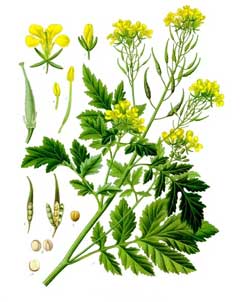
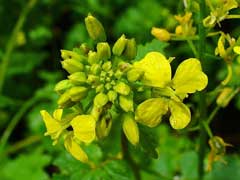
 Sinapis alba is a ANNUAL growing to 0.6 m (2ft) by 0.3 m (1ft in) at a fast rate.
See above for USDA hardiness. It is hardy to UK zone 6 and is not frost tender. It is in flower from June to August, and the seeds ripen from July to September. The species is hermaphrodite (has both male and female organs) and is pollinated by Bees, flies, wind.
Suitable for: light (sandy), medium (loamy) and heavy (clay) soils and prefers well-drained soil. Suitable pH: mildly acid, neutral and basic (mildly alkaline) soils. It can grow in semi-shade (light woodland) or no shade. It prefers moist soil.
UK Hardiness Map
US Hardiness Map
Synonyms
Bonannia officinalis. Brassica alba. Brassica hirta. Sinapis foliosa.
Plant Habitats
Cultivated Beds;
Edible Uses
Edible Parts: Leaves Oil Seed
Edible Uses: Condiment Oil
Leaves - raw or cooked[2, 5, 14, 52]. A hot pungent flavour, especially if eaten raw[K]. Young leaves are used as a flavouring in mixed salads, whilst older leaves are used as a potherb[183]. Seed - sprouted and eaten raw[1, 34, 37, 52]. The seed takes about 4 days to be ready[244]. A hot flavour, it is often used in salads. A nutritional analysis is available[218]. The seed can be ground into a powder and used as a food flavouring[17, 34, 89, 171], it is the 'white mustard' of commerce[100, 105]. This is milder than the black mustard obtained from Brassica nigra[183]. The pungency of mustard develops when cold water is added to the ground-up seed - an enzyme (myrosin) acts on a glycoside (sinigrin) to produce a sulphur compound. The reaction takes 10 - 15 minutes. Mixing with hot water or vinegar, or adding salt, inhibits the enzyme and produces a mild bitter mustard[238].
References More on Edible Uses
| Composition
|
| Figures in grams (g) or miligrams (mg) per 100g of food.
|
|
|
Seed (Dry weight)
|
|
- 500 Calories per 100g
- Water : 0%
- Protein: 27.2g; Fat: 35g; Carbohydrate: 34g; Fibre: 6g; Ash: 4.5g;
- Minerals - Calcium: 500mg; Phosphorus: 800mg; Iron: 16mg; Magnesium: 0mg; Sodium: 5mg; Potassium: 732mg; Zinc: 0mg;
- Vitamins - A: 400mg; Thiamine (B1): 0.5mg; Riboflavin (B2): 0.37mg; Niacin: 8mg; B6: 0mg; C: 0mg;
- Reference: [ 218]
- Notes: These are median figures of a range given in the report.
|
|
Medicinal Uses
Plants For A Future can not take any responsibility for any adverse effects from the use of plants. Always seek advice from a professional before using a plant medicinally.
Antibacterial Antifungal Antirheumatic Appetizer Carminative Cathartic Diaphoretic Digestive
Diuretic Emetic Expectorant Rubefacient Stimulant Vesicant
The seed is antibacterial, antifungal, appetizer, carminative, diaphoretic, digestive, diuretic, emetic, expectorant, rubefacient and stimulant[14, 176, 218, 238]. The seed has a cathartic action due to hydrolytic liberation of hydrogen sulphide[218]. In China it is used in the treatment of coughs with profuse phlegm and tuberculosis, pleurisy[176]. The seed is seldom used internally as a medicine in the west[238]. Externally it is usually made into mustard plasters (using the ground seed), poultices or added to the bath water. It is used in the treatment of respiratory infections, arthritic joints, chilblains and skin eruptions etc[238]. At a ratio of 1:3, the seed has an inhibitory action on the growth of fungus[176]. Care should be exercised in using this remedy because the seed contains substances that are extremely irritant to the skin and mucous membranes[238]. The leaves are carminative[218].
References More on Medicinal Uses
Now available: PLANTS FOR YOUR FOOD FOREST: 500 Plants for Temperate Food Forests and Permaculture Gardens.
An important new book from PFAF. It focuses on the attributes of plants suitable for food forests, what each can contribute to a food forest ecosystem, including carbon sequestration, and the kinds of foods they yield. The book suggests that community and small-scale food forests can provide a real alternative to intensive industrialised agriculture, and help to combat the many inter-related environmental crises that threaten the very future of life on Earth.
Read More
Other Uses
Green manure Oil
The seed contains up to 35% of a semi-drying oil[74]. It is used as a lubricant and for lighting etc[21, 46, 57, 61]. The plant can be grown as a green manure crop[17, 89]. It is very fast growing, producing a good bulk in just a few weeks from seed, but it is shallow rooted so does not do so well in dry periods[87]. It is also susceptible to all the diseases of the cabbage family such as club-root so is best avoided if this is likely to be a problem[17].
Special Uses
Food Forest
References More on Other Uses
Cultivation details
Prefers a light well-drained soil[52]. Succeeds on most soils when growing in a sunny position[238]. For best production, it requires high nutrient soils with a high level of nitrogen, but it may be grown on a wide range of soils from light to heavy, growing best on relatively heavy sandy loamy soils[269]. It is not suited to very wet soils[269]. White mustard grows best where the annual precipitation varies from 35 to 179cm, annual temperature from 5.6 to 24.9°C and pH from 4.5 to 8.2[269]. White mustard is a quick-growing long-day annual which prefers temperate climates with some humidity. It is sometimes cultivated, both in the garden and commercially, for its edible seed[4, 183]. The plant can withstand high temperatures, but very hot days during flowering and ripening may reduce seed setting and lower quality of seed[269]. There are some named varieties[183]. It is a very fast growing plant, but requires plenty of moisture for optimum growth[87]. Seed yields are usually a bit less than 1 tonne per hectare, though experimental plantings have suggested that up to 8 tonnes per hectare is possible[269]. White mustard is sometimes also grown as a seed sprout, usually with cress seeds (Lepidium sativum) to supply mustard and cress. This is a mixture of the two types of sprouted seeds, used when about 7 - 10 days old[K]. The mustard seed should be sown three days before the cress seed[238]. The plant is not very deep rooted[87], it self-sows freely when in a suitable site[14].
References Carbon Farming Information and Carbon Sequestration Information
Temperature Converter
Type a value in the Celsius field to convert the value to Fahrenheit:
Fahrenheit:
The PFAF Bookshop
Plants For A Future have a number of books available in paperback and digital form. Book titles include Edible Plants, Edible Perennials, Edible Trees,Edible Shrubs, Woodland Gardening, and Temperate Food Forest Plants. Our new book is Food Forest Plants For Hotter Conditions (Tropical and Sub-Tropical).
Shop Now
Plant Propagation
Seed - sow in situ from early spring to late summer. Germination takes place in less than a week. The earlier sowings are for a seed crop, the later sowings are for edible leaves and green manure[82]. When sowing seed for use in mustard and cress, the seed is soaked for about 12 hours in warm water and then placed in a humid position. Traditionally, it is sown in a tray on a thin layer of soil, or on some moist blotting paper, and the tray is placed in a warm dark place for a few days to encourage rapid and rather etiolated growth. The seedlings can then be placed in a lighter position for a couple more days to turn green before being eaten. The mustard seed should be sown about 3 - 4 days later than the cress for them both to be ready at the same time[264].
Other Names
If available other names are mentioned here
Native Plant Search
Search over 900 plants ideal for food forests and permaculture gardens. Filter to search native plants to your area. The plants selected are the plants in our book 'Plants For Your Food Forest: 500 Plants for Temperate Food Forests and Permaculture Gardens, as well as plants chosen for our forthcoming related books for Tropical/Hot Wet Climates and Mediterranean/Hot Dry Climates. Native Plant Search
Found In
Countries where the plant has been found are listed here if the information is available
Weed Potential
Right plant wrong place. We are currently updating this section.
Please note that a plant may be invasive in one area but may not in your area so it’s worth checking.
Conservation Status
IUCN Red List of Threatened Plants Status :

Growth: S = slow M = medium F = fast. Soil: L = light (sandy) M = medium H = heavy (clay). pH: A = acid N = neutral B = basic (alkaline). Shade: F = full shade S = semi-shade N = no shade. Moisture: D = dry M = Moist We = wet Wa = water.

Expert comment
Author
L.
Botanical References
17200
Links / References
For a list of references used on this page please go here
Readers comment
© 2010, Plants For A Future. Plants For A Future is a charitable company limited by guarantee, registered in England and Wales. Charity No. 1057719, Company No. 3204567.