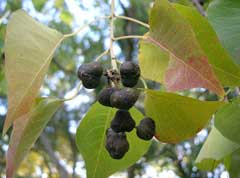
 |
|
http://commons.wikimedia.org/wiki/User:KENPEI |
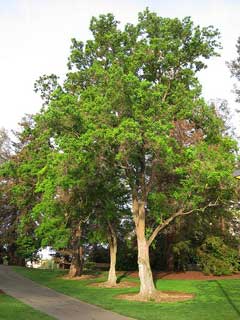 |
|
Translate this page:
Summary
Bloom Color: Yellow. Main Bloom Time: Early spring, Late spring, Mid spring. Form: Oval.
Physical Characteristics

 Sapium sebiferum is a deciduous Tree growing to 9 m (29ft) by 5 m (16ft) at a fast rate.
See above for USDA hardiness. It is hardy to UK zone 9. It is in flower from January to February, and the seeds ripen in November. The species is monoecious (individual flowers are either male or female, but both sexes can be found on the same plant) and is pollinated by Insects, bees.
Suitable for: light (sandy), medium (loamy) and heavy (clay) soils. Suitable pH: mildly acid, neutral and basic (mildly alkaline) soils and can grow in saline soils.
It cannot grow in the shade. It prefers moist soil.
UK Hardiness Map
US Hardiness Map
Synonyms
Triadica sebifera. Croton sebiferus. Stillingia sebifera.
Plant Habitats
Woodland Garden Sunny Edge; Dappled Shade; South Wall. By. West Wall. By.
Edible Uses
Edible Parts: Oil Oil
Edible Uses: Oil Oil
The wax from the seed is used as a lard substitute or in cacao butter[105, 183]. The seed contains 8.1 - 9.2% protein and 40.5 - 50.7% fat[218].
References More on Edible Uses
Medicinal Uses
Plants For A Future can not take any responsibility for any adverse effects from the use of plants. Always seek advice from a professional before using a plant medicinally.
Acrid Antidote Depurative Diuretic Emetic Hydrogogue Laxative Purgative
Skin Vesicant
The leaves and the roots are depurative, diuretic and laxative[4, 147, 178]. A decoction is used in the treatment of oedema, constipation, poisoning by two plants - Polygonum perfoliatum and Tripterygium wilfordii, skin diseases etc[147, 218]. The leaves are particularly useful for treating boils[218]. The seed is antidote, emetic, hydragogue and purgative[218]. In China it is taken internally, which is a rather questionable practice considering its toxic nature[218]. The root bark is diuretic[218]. It is used in the treatment of snake bites and skin ulcers[218]. The juice of the tree (the sap is probably meant here[K]) is acrid and vesicant[240].
References More on Medicinal Uses
The Bookshop: Edible Plant Books
Our Latest books on Perennial Plants For Food Forests and Permaculture Gardens in paperback or digital formats.
Edible Tropical Plants
Food Forest Plants for Hotter Conditions: 250+ Plants For Tropical Food Forests & Permaculture Gardens.
More
Edible Temperate Plants
Plants for Your Food Forest: 500 Plants for Temperate Food Forests & Permaculture Gardens.
More
More Books
PFAF have eight books available in paperback and digital formats. Browse the shop for more information.
Shop Now
Other Uses
Biomass Compost Dye Fuel Hair Incense Oil Oil Soil stabilization Tannin Wax Wood
The seed is coated with a wax. This wax, which comprises about 24% of the seed[269], can be used to make candles and soap[1, 4, 11, 46, 103, 171]. It has excellent burning quality, and gives an inodorous clear bright flame[269]. The wax is also used for making soap, cloth dressing and fuel[269]. Pure tallow fat is known in commerce as Pi-yu[269]. The wax is separated from the seed by steeping it in hot water and skimming off the wax as it floats to the surface[146, 158]. The wax is solid at temperatures below 40°c[146]. It is said to change grey hair to black[218]. The seed contains about 20% of a drying oil[269]. It is used to make candles and soap[11, 146, 158]. The oil is used in making varnishes and native paints because of its quick-drying properties[269]. It is also used in machine oils and as a crude lamp oil[269]. The pure oil expressed from the inner part of the seeds is known in commerce as Ting-yu[269]. The residual cake, after the oil is expressed, is used as manure, particularly for tobacco fields[269]. The leaves are rich in tannin[178], a black dye can be obtained by boiling them in alum water[103, 146, 158, 269].The plant is used as a soil binder along the sides of roads and canals[269]. The wood is white, even and close grained, light, soft or moderately hard[158, 269]. It is suitable for carving and is also used for making blocks in Chinese printing, furniture making and incense[269]. The wood is light and soft. It is used for fuel[269]. Carbon Farming - Industrial Crop: biomass, oil. Other Systems: SRC, strip intercrop, multistrata.
Special Uses
Carbon Farming Coppice Food Forest
References More on Other Uses
Cultivation details
Industrial Crop: Biomass Industrial Crop: Oil Management: Coppice Management: Standard Minor Global Crop Other Systems: Multistrata Other Systems: SRC Other Systems: Strip intercrop
Landscape Uses:Pest tolerant, Aggressive surface roots possible. Succeeds in a sunny position in any well-drained soil[200]. Grows well on canal banks, steep mountain slopes, granite hills and sandy beaches, succeeding in alkaline, saline or acid soils[269]. It is said to thrive in alluvial forests, on low alluvial plains, and on rich leaf-molds, growing best in well-drained clayey-peat soils[269]. Requires the protection of a south or south-west wall when grown in areas at the limits of its hardiness[200]. Favourable climatic conditions are mean air temperatures of 12.5 to 30.1°C, and an annual precipitation from 130 to 370cm[269]. This tree is not reliably hardy in Britain, though it was successfully grown here in the 18th century[11]. It is able to withstand a few degrees of frost, but unripened twigs are particularly susceptible to frost injury[269]. It succeeds outdoors in the milder parts of Britain when grown in a woodland garden[166]. A fast-growing tree[188], it is much cultivated in warm temperate regions for its seeds which are a source of vegetable tallow, a drying oil and protein food[269]. The fruits yield two types of fats - the outer covering of the seeds contains a solid fat with a low iodine value and is known as Chinese Vegetable Tallow whilst the kernels produce a drying oil with high iodine value which is called Stillingia Oil[11, 109, 269]. Many named varietis have been developed in the Orient, especially in Taiwan, for improved oil production[269]. Plants require from 3 - 8 years to bear, but then continue to bear for an average of 70 - 100 years. They attain their full size in 10 - 12 years[269]. Yields of 14 tonnes of seed per hectare, containing 2.6 tonnes of oil and 2.8 tones of tallow have been achieved[269]. This yield could increase with age[269]. The plant has escaped from cultivation in N. America and has become a serious pest there, displacing native vegetation. It apparently produces root secretions that modify soil chemistry and discourage the establishment of native species[274]. Responds well to coppicing[146]. Special Features:
Attracts birds, Not North American native, Invasive, Naturalizing, All or parts of this plant are poisonous, Wetlands plant, Inconspicuous flowers or blooms.
Carbon Farming
-
Industrial Crop: Biomass
Three broad categories: bamboos, resprouting woody plants, and giant grasses. uses include: protein, materials (paper, building materials, fibers, biochar etc.), chemicals (biobased chemicals), energy - biofuels
-
Industrial Crop: Oil
Materials, chemicals and energy include bioplastics, biomass, glycerin, soaps, lubricants, paints, biodiesel. Oilseed crop types.
-
Management: Coppice
Cut to the ground repeatedly - resprouting vigorously. Non-destructive management systems maintaining the soil organic carbon.
-
Management: Standard
Plants grow to their standard height. Harvest fruit, seeds, or other products. Non-Destructive management systems.
-
Minor Global Crop
These crops are already grown or traded around the world, but on a smaller scale than the global perennial staple and industrial crops, The annual value of a minor global crop is under $1 billion US. Examples include shea, carob, Brazil nuts and fibers such as ramie and sisal.
-
Other Systems: Multistrata
Multistrata agroforests feature multiple layers of trees often with herbaceous perennials, annual crops, and livestock.
-
Other Systems: SRC
Short-rotation coppice.
-
Other Systems: Strip intercrop
Tree crops grown in rows with alternating annual crops.
References Carbon Farming Information and Carbon Sequestration Information
Temperature Converter
Type a value in the Celsius field to convert the value to Fahrenheit:
Fahrenheit:
The PFAF Bookshop
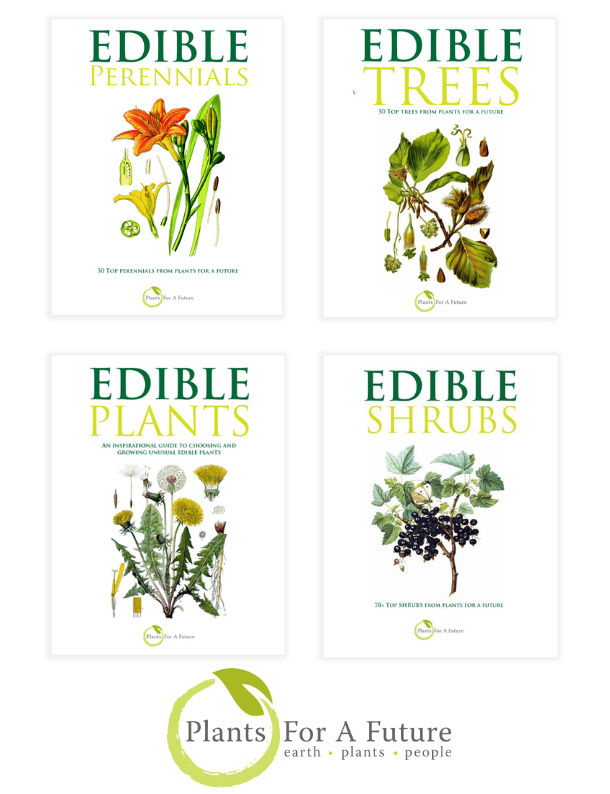
Plants For A Future have a number of books available in paperback and digital form. Book titles include Edible Plants, Edible Perennials, Edible Trees,Edible Shrubs, Woodland Gardening, and Temperate Food Forest Plants. Our new book is Food Forest Plants For Hotter Conditions (Tropical and Sub-Tropical).
Shop Now
Plant Propagation
Seed - do not cold stratify the seed since this can lead to secondary dormancy. Sown in April in a warm greenhouse, it usually germinates within 4 weeks[113]. Prick out the seedlings into individual pots when they are large enough to handle. Overwinter in a greenhouse for at least their first 2 winters and plant out in late spring. Cuttings of half-ripe wood, July/August in a frame.
Other Names
If available other names are mentioned here
Tallow Tree. Chinese tallow tree, Payaung
Native Plant Search
Search over 900 plants ideal for food forests and permaculture gardens. Filter to search native plants to your area. The plants selected are the plants in our book 'Plants For Your Food Forest: 500 Plants for Temperate Food Forests and Permaculture Gardens, as well as plants chosen for our forthcoming related books for Tropical/Hot Wet Climates and Mediterranean/Hot Dry Climates. Native Plant Search
Found In
Countries where the plant has been found are listed here if the information is available
Africa, Asia, Australia, Bangladesh, China, Cuba, East Africa, India, Indochina, Japan, Madagascar, Myanmar, Northeastern India, Pakistan, SE Asia, Sikkim, Taiwan, USA, Vietnam, Zimbabwe,
Weed Potential
Right plant wrong place. We are currently updating this section.
Please note that a plant may be invasive in one area but may not in your area so it’s worth checking.
No
Conservation Status
IUCN Red List of Threatened Plants Status : This taxon has not yet been assessed

Growth: S = slow M = medium F = fast. Soil: L = light (sandy) M = medium H = heavy (clay). pH: A = acid N = neutral B = basic (alkaline). Shade: F = full shade S = semi-shade N = no shade. Moisture: D = dry M = Moist We = wet Wa = water.

Expert comment
Author
(L.)Roxb.
Botanical References
11109200
Links / References
For a list of references used on this page please go here
Readers comment
© 2010, Plants For A Future. Plants For A Future is a charitable company limited by guarantee, registered in England and Wales. Charity No. 1057719, Company No. 3204567.