 |
|
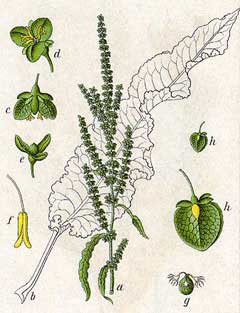
http://commons.wikimedia.org/wiki/File:Rumex_crispus_Sturm52.jpg |
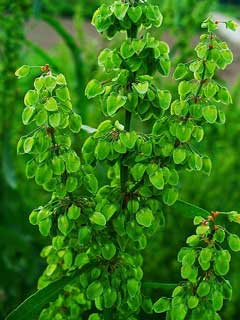 |
| http://commons.wikimedia.org/wiki/User:Llez |
Translate this page:
Summary
Physical Characteristics

 Rumex crispus is a PERENNIAL growing to 0.6 m (2ft) by 0.3 m (1ft in).
See above for USDA hardiness. It is hardy to UK zone 5 and is not frost tender. It is in flower from June to October, and the seeds ripen from July to October. The species is hermaphrodite (has both male and female organs) and is pollinated by Wind.
It is noted for attracting wildlife.
Suitable for: light (sandy), medium (loamy) and heavy (clay) soils. Suitable pH: mildly acid, neutral and basic (mildly alkaline) soils. It can grow in semi-shade (light woodland) or no shade. It prefers moist soil.
UK Hardiness Map
US Hardiness Map
Synonyms
Lapathum crispum Garsault [Invalid]. Lapathum crispum (L.) Scop. Rumex elongatus Guss.
Plant Habitats
Woodland Garden Dappled Shade; Shady Edge; Meadow;
Edible Uses
Edible Parts: Leaves Seed
Edible Uses: Coffee
Leaves - raw or cooked[5, 85, 159]. They can also be dried for later use[12]. The leaves can be added to salads, cooked as a potherb or added to soups[183]. Only the very young leaves should be used, preferably before the stems have developed, and even these are likely to be bitter[12, 95, 257]. If used in early spring and in the autumn they can often be fairly pleasant tasting[85, 159, K]. The leaves are very rich in vitamins and minerals, especially iron and the vitamins A and C[183, 244]. A nutritional analysis is available[218]. Stems - raw or cooked[257]. They are best peeled and the inner portion eaten[257]. Seed - raw or cooked[172, 257]. It can be used as a piñole or can be ground into a powder and used as a flour for making pancakes etc[85, 102, 183, 257]. The seed is very fiddly to harvest and prepare[62]. The roasted seed has been used as a coffee substitute[207].
References More on Edible Uses
| Composition
|
| Figures in grams (g) or miligrams (mg) per 100g of food.
|
|
|
Leaves (Fresh weight)
|
|
- 21 Calories per 100g
- Water : 92.6%
- Protein: 1.5g; Fat: 0.3g; Carbohydrate: 4.1g; Fibre: 0.9g; Ash: 1.5g;
- Minerals - Calcium: 74mg; Phosphorus: 56mg; Iron: 5.6mg; Magnesium: 0mg; Sodium: 0mg; Potassium: 0mg; Zinc: 0mg;
- Vitamins - A: 1.38mg; Thiamine (B1): 0.06mg; Riboflavin (B2): 0.08mg; Niacin: 0.4mg; B6: 0mg; C: 30mg;
- Reference: [ 218]
- Notes: The figure for vitamin A is in milligrammes.
|
|
Medicinal Uses
Plants For A Future can not take any responsibility for any adverse effects from the use of plants. Always seek advice from a professional before using a plant medicinally.
Alterative Antiscorbutic Astringent Cancer Cholagogue Depurative Homeopathy Laxative
Poultice Salve Tonic
Curled dock has a long history of domestic herbal use. It is a gentle and safe laxative, less powerful than rhubarb in its action so it is particularly useful in the treatment of mild constipation[254]. The plant has valuable cleansing properties and is useful for treating a wide range of skin problems[254]. All parts of the plant can be used, though the root is most active medicinally. The root is alterative, antiscorbutic, astringent, cholagogue, depurative, laxative and mildly tonic[4, 21, 46, 94, 165]. It used to be sold as a tonic and laxative[212]. It can cause or relieve diarrhoea according to the dose, harvest time and relative concentrations of tannin(astringent) and anthraquinones (laxative) that are present[222]. It is used internally in the treatment of constipation, diarrhoea, piles, bleeding of the lungs, various blood complaints and also chronic skin diseases[4, 238, 257]. Externally, the root can be mashed and used as a poultice and salve, or dried and used as a dusting powder, on sores, ulcers, wounds and various other skin problems[257]. The root has been used with positive effect to restrain the inroads made by cancer, being used as an alterative and tonic[4]. The root is harvested in early spring and dried for later use[4]. Some caution is advised in its use since excess doses can cause gastric disturbance, nausea and dermatitis[222, 238]. The seed is used in the treatment of diarrhoea[4, 218]. A homeopathic remedy is made from the fresh root, harvested in the autumn before frost has touched the plant[232]. It is only used in the treatment of a specific type of cough[232].
References More on Medicinal Uses
The Bookshop: Edible Plant Books
Our Latest books on Perennial Plants For Food Forests and Permaculture Gardens in paperback or digital formats.
Edible Tropical Plants
Food Forest Plants for Hotter Conditions: 250+ Plants For Tropical Food Forests & Permaculture Gardens.
More
Edible Temperate Plants
Plants for Your Food Forest: 500 Plants for Temperate Food Forests & Permaculture Gardens.
More
More Books
PFAF have eight books available in paperback and digital formats. Browse the shop for more information.
Shop Now
Other Uses
Compost Dye
Yellow, dark green to brown and dark grey dyes can be obtained from the roots. They do not need a mordant[168]. An alternative ingredient of 'QR' herbal compost activator[32]. (is it the flowers?) This is a dried and powdered mixture of several herbs that can be added to a compost heap in order to speed up bacterial activity and thus shorten the time needed to make the compost[K].
Special Uses
Attracts Wildlife Dynamic accumulator Food Forest
References More on Other Uses
Cultivation details
Succeeds in most soils, preferring a moist moderately fertile well-drained soil in a sunny position[200]. The plant does not need any help in growing, it is doing very nicely in Britain where it is a serious weed of agriculture. A very important food plant for the caterpillars of many species of butterfly[30]. In garden design, as well as the above-ground architecture of a plant, root structure considerations help in choosing plants that work together for their optimal soil requirements including nutrients and water. The root pattern is fleshy. Thick or swollen - fibrous or tap root [2-1].
References Carbon Farming Information and Carbon Sequestration Information
Temperature Converter
Type a value in the Celsius field to convert the value to Fahrenheit:
Fahrenheit:
The PFAF Bookshop
Plants For A Future have a number of books available in paperback and digital form. Book titles include Edible Plants, Edible Perennials, Edible Trees,Edible Shrubs, Woodland Gardening, and Temperate Food Forest Plants. Our new book is Food Forest Plants For Hotter Conditions (Tropical and Sub-Tropical).
Shop Now
Plant Propagation
Seed - this plant does not require any help in its propagation.
Other Names
If available other names are mentioned here
Native Plant Search
Search over 900 plants ideal for food forests and permaculture gardens. Filter to search native plants to your area. The plants selected are the plants in our book 'Plants For Your Food Forest: 500 Plants for Temperate Food Forests and Permaculture Gardens, as well as plants chosen for our forthcoming related books for Tropical/Hot Wet Climates and Mediterranean/Hot Dry Climates. Native Plant Search
Found In
Countries where the plant has been found are listed here if the information is available
Weed Potential
Right plant wrong place. We are currently updating this section.
Please note that a plant may be invasive in one area but may not in your area so it’s worth checking.
Conservation Status
IUCN Red List of Threatened Plants Status :

Growth: S = slow M = medium F = fast. Soil: L = light (sandy) M = medium H = heavy (clay). pH: A = acid N = neutral B = basic (alkaline). Shade: F = full shade S = semi-shade N = no shade. Moisture: D = dry M = Moist We = wet Wa = water.

Expert comment
Author
L.
Botanical References
17
Links / References
For a list of references used on this page please go here
Readers comment
| Add a comment |
|
If you have important information about this plant that may help other users please add a comment or link below. Only comments or links that are felt to be directly relevant to a plant will be included. If you think a comment/link or information contained on this page is inaccurate or misleading we would welcome your feedback at [email protected]. If you have questions about a plant please use the Forum on this website as we do not have the resources to answer questions ourselves.
* Please note: the comments by website users are not necessarily those held by PFAF and may give misleading or inaccurate information.
To leave a comment please Register or login here All comments need to be approved so will not appear immediately.
|
|