 |
|
http://commons.wikimedia.org/wiki/User:Wsiegmund |
 |
| http://commons.wikimedia.org/wiki/User:Wsiegmund |
Translate this page:
Summary
Physical Characteristics

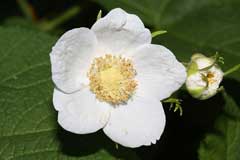
 Rubus parviflorus is a deciduous Shrub growing to 2.5 m (8ft) by 2 m (6ft) at a medium rate.
See above for USDA hardiness. It is hardy to UK zone 3 and is not frost tender. It is in flower in June, and the seeds ripen from July to August. The species is hermaphrodite (has both male and female organs) and is pollinated by Insects.
Suitable for: light (sandy), medium (loamy) and heavy (clay) soils and prefers well-drained soil. Suitable pH: mildly acid, neutral and basic (mildly alkaline) soils. It can grow in semi-shade (light woodland) or no shade. It prefers moist soil.
UK Hardiness Map
US Hardiness Map
Synonyms
R. nutkanus.
Plant Habitats
Woodland Garden Sunny Edge; Dappled Shade; Ground Cover;
Edible Uses
Edible Parts: Flowers Fruit Shoots Stem
Edible Uses:
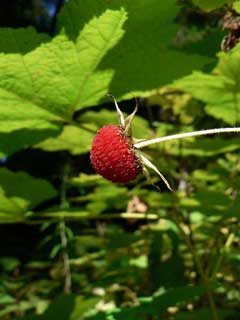
Fruit - raw or cooked[62, 101, 118, 183]. It makes excellent jams and preserves[257]. The fruit can also be dried for later use[183]. A sweet and pleasant flavour[2, 85, 94] though this is not always properly developed in the cooler summers of Britain[11]. The fruit is very seedy[155]. Rich in vitamin C[183]. The hemispherical fruit is about 20mm in diameter[200]. Young shoots - peeled and eaten cooked or raw[2, 85, 101, 118, 172]. The shoots are harvested as they emerge in the spring, and whilst they are still young and tender[161, 183]. They can be cooked like asparagus[257]. The shoots are rich in vitamin C[183]. Flowers - raw[172].
References More on Edible Uses
Medicinal Uses
Plants For A Future can not take any responsibility for any adverse effects from the use of plants. Always seek advice from a professional before using a plant medicinally.
Antiemetic Antiphlogistic Appetizer Astringent Blood tonic Dysentery Poultice Salve
Stomachic Tonic Vitamin C Women's complaints
The leaves are antiemetic, astringent, blood tonic and stomachic[172, 257]. An infusion is used internally in the treatment of stomach complaints, diarrhoea and dysentery, anaemia, the spitting up of blood and to treat vomiting[238, 257]. An infusion has been taken by women when their periods are unusually long[257]. A poultice of the dried powdered leaves has been used to treat wounds and burns[257]. The leaves have been crushed and rubbed over the skin to treat pimples and blackheads[257]. A poultice of the leaf ashes, mixed with oil, has been used to treat swellings[257]. The young shoots are alterative and antiscorbutic[257]. The roots are appetizer, astringent, stomachic and tonic[172, 257]. An infusion has been used by thin people to help them gain weight[257]. An infusion has also been used in the treatment of stomach disorders, diarrhoea and dysentery[238, 257]. A decoction of the roots has been taken in the treatment of pimples and blackheads[257].
References More on Medicinal Uses
The Bookshop: Edible Plant Books
Our Latest books on Perennial Plants For Food Forests and Permaculture Gardens in paperback or digital formats.
Edible Tropical Plants
Food Forest Plants for Hotter Conditions: 250+ Plants For Tropical Food Forests & Permaculture Gardens.
More
Edible Temperate Plants
Plants for Your Food Forest: 500 Plants for Temperate Food Forests & Permaculture Gardens.
More
More Books
PFAF have eight books available in paperback and digital formats. Browse the shop for more information.
Shop Now
Other Uses
Dye Lining Soap
The leaves are used to line baskets etc for carrying soft fruit or other delicate items[99, 118]. Plants are very vigorous and can be grown as a tall ground cover for large areas[208]. A soap is obtained from the boiled bark[99, 118, 257]. A purple to dull blue dye is obtained from the fruit[168].
Special Uses
Food Forest Ground cover
References More on Other Uses
Cultivation details
Easily grown in a good well-drained loamy soil in sun or semi-shade[1, 11, 200]. Can be grown in a woodland garden though it is less likely to fruit well in such a position[K]. This plant has perennial stems without prickles[200] and is less invasive than the related R. odoratus[182]. Plants in this genus are notably susceptible to honey fungus[200]. For polyculture design as well as the above-ground architecture (form - tree, shrub etc. and size shown above) information on the habit and root pattern is also useful and given here if available. The plant growth habit is multistemmed with multiple stems from the crown [1-2]. The root pattern is suckering with new plants from underground runners away from the plant [1-2].
References Carbon Farming Information and Carbon Sequestration Information
Temperature Converter
Type a value in the Celsius field to convert the value to Fahrenheit:
Fahrenheit:
The PFAF Bookshop
Plants For A Future have a number of books available in paperback and digital form. Book titles include Edible Plants, Edible Perennials, Edible Trees,Edible Shrubs, Woodland Gardening, and Temperate Food Forest Plants. Our new book is Food Forest Plants For Hotter Conditions (Tropical and Sub-Tropical).
Shop Now
Plant Propagation
Seed - requires stratification, is best sown in early autumn in a cold frame. Sow stored seed as early as possible in the year in a cold frame and stratify for a month at 3°c if sowing later than February. Prick out the seedlings when they are large enough to handle and grow on in a cold frame. Plant them out into their permanent positions in late spring of the following year. Tip layering in July. Plant out in autumn. Division in early spring.
Other Names
If available other names are mentioned here
Native Plant Search
Search over 900 plants ideal for food forests and permaculture gardens. Filter to search native plants to your area. The plants selected are the plants in our book 'Plants For Your Food Forest: 500 Plants for Temperate Food Forests and Permaculture Gardens, as well as plants chosen for our forthcoming related books for Tropical/Hot Wet Climates and Mediterranean/Hot Dry Climates. Native Plant Search
Found In
Countries where the plant has been found are listed here if the information is available
Weed Potential
Right plant wrong place. We are currently updating this section.
Please note that a plant may be invasive in one area but may not in your area so it’s worth checking.
Conservation Status
IUCN Red List of Threatened Plants Status :

Growth: S = slow M = medium F = fast. Soil: L = light (sandy) M = medium H = heavy (clay). pH: A = acid N = neutral B = basic (alkaline). Shade: F = full shade S = semi-shade N = no shade. Moisture: D = dry M = Moist We = wet Wa = water.

Expert comment
Author
Nutt.
Botanical References
11200
Links / References
For a list of references used on this page please go here
Readers comment
© 2010, Plants For A Future. Plants For A Future is a charitable company limited by guarantee, registered in England and Wales. Charity No. 1057719, Company No. 3204567.