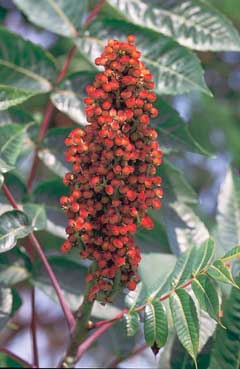
 |
|
USDA-NRCS PLANTS Database |
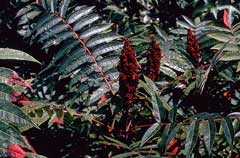 |
| USDA-NRCS PLANTS Database |
Translate this page:
Summary
Bloom Color: Green, Yellow. Main Bloom Time: Early summer, Late summer, Mid summer. Form: Rounded, Upright or erect.
Physical Characteristics

 Rhus glabra is a deciduous Shrub growing to 3 m (9ft) by 3 m (9ft) at a medium rate.
See above for USDA hardiness. It is hardy to UK zone 2 and is not frost tender. It is in flower from July to August, and the seeds ripen from September to November. The species is dioecious (individual flowers are either male or female, but only one sex is to be found on any one plant so both male and female plants must be grown if seed is required). and is pollinated by Bees. The plant is not self-fertile.
It is noted for attracting wildlife.
Suitable for: light (sandy), medium (loamy) and heavy (clay) soils, prefers well-drained soil and can grow in nutritionally poor soil. Suitable pH: mildly acid, neutral and basic (mildly alkaline) soils. It cannot grow in the shade. It prefers dry or moist soil. The plant can tolerates strong winds but not maritime exposure.
UK Hardiness Map
US Hardiness Map
Synonyms
Plant Habitats
Woodland Garden Sunny Edge; Dappled Shade; Hedge;
Edible Uses
Edible Parts: Fruit Oil Root Shoots Stem
Edible Uses: Drink Oil
Fruit - raw or cooked[2, 22, 46]. An acid flavour, it has been used as a substitute for lemon juice[2]. The fruit is rather small and with very little flesh, but it is produced on fairly large panicles and so is easily harvested. When soaked for 10 - 30 minutes in hot or cold water it makes a very refreshing lemonade-like drink (without any fizz of course)[85, 95, 101, 102, 149, 159, 183]. The mixture should not be boiled since this will release tannic acids and make the drink astringent. Root - peeled and eaten raw[161, 183]. This report should be treated with some caution due to possible toxicity[214]. Young shoots - peeled and eaten raw[183, 257]. This report should be treated with some caution due to possible toxicity[214]. The bark has been eaten as a delicacy by children[257]. This report should be treated with some caution due to possible toxicity[214].
References More on Edible Uses
Medicinal Uses
Plants For A Future can not take any responsibility for any adverse effects from the use of plants. Always seek advice from a professional before using a plant medicinally.
Alterative Antiseptic Appetizer Astringent Diuretic Dysentery Emetic Emmenagogue
Febrifuge Galactogogue Haemostatic Ophthalmic Refrigerant Rubefacient Salve
TB Tonic
Smooth sumach was employed medicinally by various native North American Indian tribes who used it to treat a variety of complaints[257]. It is occasionally used in modern herbalism where it is valued for its astringent and antiseptic qualities. Some caution should be employed in the use of this species since it can possibly cause skin irritations. It is best only used under the supervision of a qualified practitioner. A tea made from the bark or root bark is alterative, antiseptic, astringent, galactogogue, haemostatic, rubefacient and tonic[4, 222, 238, 257]. It is used in the treatment of diarrhoea, fevers, general debility, sore mouths, rectal bleeding, uterine prolapse etc[222, 254]. It is used as a gargle to treat sore throats and applied externally to treat excessive vaginal discharge, burns and skin eruptions[254, 257]. The powdered bark can be applied as a poultice to old ulcers, it is a good antiseptic[4]. A tea made from the roots is appetizer, astringent, diuretic and emetic[222, 257]. An infusion is used in the treatment of colds, sore throats, painful urination, retention of urine and dysentery[257]. The root is harvested in the autumn and dried for later use[254]. An infusion of the green or dried branches has been used in the treatment of TB[257]. A decoction of the branches, with the seed heads, has been used to treat itchy scalps and as a bathing water for frost-bitten limbs[257]. The milky latex from the plant has been used as a salve on sores[257]. A tea made from the leaves was used in the treatment of asthma, diarrhoea and stomatitis[222]. A poultice of the leaves has been used to treat skin rashes[257]. The leaves have been chewed to treat sore gums and they have been rubbed on the lips to treat sore lips[257]. The berries are diuretic, emetic, emmenagogue, purgative and refrigerant[4, 257]. They are used in the treatment of late-onset diabetes, stranguary bowel complaints, febrile diseases, dysmenorrhoea etc[4, 254, 257]. They have been chewed as a remedy for bed-wetting[222, 257]. The blossoms have been chewed as a treatment for sore mouths[257]. A decoction of the blossoms has been used as a mouthwash for teething children[257]. An infusion of the blossoms has been used as an eye wash for sore eyes[257].
References More on Medicinal Uses
The Bookshop: Edible Plant Books
Our Latest books on Perennial Plants For Food Forests and Permaculture Gardens in paperback or digital formats.

Edible Tropical Plants
Food Forest Plants for Hotter Conditions: 250+ Plants For Tropical Food Forests & Permaculture Gardens.
More

Edible Temperate Plants
Plants for Your Food Forest: 500 Plants for Temperate Food Forests & Permaculture Gardens.
More

More Books
PFAF have eight books available in paperback and digital formats. Browse the shop for more information.
Shop Now
Other Uses
Dye Hedge Hedge Mordant Oil Pioneer Shelterbelt Soil stabilization Tannin Wood
The leaves are rich in tannin, containing about 10 - 25%[171]. Up to 31.2% has been obtained from some plants[223]. They can be collected as they fall in the autumn and used as a brown dye or as a mordant[169]. The twigs and root are also rich in tannin[149]. A black and a red dye is obtained from the fruit[4, 257]. A black dye is obtained from the leaves, bark and roots[257]. An orange or yellow dye is obtained from the roots harvested in spring[46, 61, 257]. A light yellow dye is obtained from the pulp of the stems[257]. The inner bark, mixed with bloodroot (Sanguinaria canadensis) and the inner bark of wild plum (Prunus sp.) has been used to make a yellow dye[257]. An oil is extracted from the seeds[4]. It attains a tallow-like consistency on standing and is used to make candles. These burn brilliantly, though they emit a pungent smoke[4]. The plant has an extensive root system and is fairly wind tolerant, though branches can be broken off in very strong winds. It is planted for soil stabilization and as a shelter screen[200]. It can quickly establish itself in open sunny locations and so can be used as a pioneer species for establishing woodlands[229]. Wood - soft, light, brittle[101, 149].
Special Uses
Attracts Wildlife Food Forest Hedge Hedge
References More on Other Uses
Cultivation details
Landscape Uses:Border, Specimen. Succeeds in a well-drained fertile soil in full sun[11, 200]. Tolerates poor sandy soils[200]. A very hardy plant, when fully dormant it can tolerate temperatures down to at least -25°c[200]. However, the young growth in spring can be damaged by late frosts. A fast-growing but short-lived plant in the wild[229]. Single-stem plants are short-lived in cultivation, but if the plants are coppiced regularly and allowed to form thickets, then they will live longer and also be more ornamental with larger leaves[238]. Any coppicing is best carried out in early spring[238]. It is a very ornamental plant, there are some named varieties[182]. Closely allied to R. typhina[11], it hybridizes with that species where their ranges overlap[101, 229]. Plants have brittle branches and these can be broken off in strong winds[200]. Plants are also susceptible to coral spot fungus[11]. Plants in this genus are notably resistant to honey fungus[200]. A good bee plant[K]. Many of the species in this genus are highly toxic and can also cause severe irritation to the skin of some people, whilst other species such as this one are not poisonous. It is relatively simple to distinguish which is which, the poisonous species have axillary panicles and smooth fruits whilst non-poisonous species have compound terminal panicles and fruits covered with acid crimson hairs[1, 4]. The toxic species are sometimes separated into their own genus, Toxicodendron, by some botanists[200]. Dioecious. Male and female plants must be grown if seed is required. Special Features:
Attracts birds, North American native, Attractive flowers or blooms. The plant is heat tolerant in zones 8 through 1. (Plant Hardiness Zones show how well plants withstand cold winter temperatures.
Plant Heat Zones show when plants would start suffering from the heat.
The Plant Heat Zone map is based on the number of "heat days" experienced in a given area where the temperature climbs to over 86 degrees F (30°C).
At this temperature, many plants begin to suffer physiological damage. Heat Zones range from 1 (no heat days) to 12 (210 or more heat days).
For example Heat Zone. 11-1 indicates that the plant is heat tolerant in zones 11 through 1.) For polyculture design as well as the above-ground architecture (form - tree, shrub etc. and size shown above) information on the habit and root pattern is also useful and given here if available. The plant growth habit is a running thicket former forming a colony from shoots away from the crown spreading indefinitely [1-2]. The root pattern is flat with shallow roots forming a plate near the soil surface [1-2]. The root pattern is suckering with new plants from underground runners away from the plant [1-2].
References Carbon Farming Information and Carbon Sequestration Information
Temperature Converter
Type a value in the Celsius field to convert the value to Fahrenheit:
Fahrenheit:
The PFAF Bookshop
Plants For A Future have a number of books available in paperback and digital form. Book titles include Edible Plants, Edible Perennials, Edible Trees,Edible Shrubs, Woodland Gardening, and Temperate Food Forest Plants. Our new book is Food Forest Plants For Hotter Conditions (Tropical and Sub-Tropical).
Shop Now
Plant Propagation
Seed - best sown in a cold frame as soon as it is ripe. Pre-soak the seed for 24 hours in hot water (starting at a temperature of 80 - 90c and allowing it to cool) prior to sowing in order to leach out any germination inhibitors[200]. This soak water can be drunk and has a delicious lemon-flavour. The stored seed also needs hot water treatment and can be sown in early spring in a cold frame[200]. When they are large enough to handle, prick the seedlings out into individual pots and grow them on in the greenhouse for their first winter. Plant them out into their permanent positions in late spring or early summer, after the last expected frosts. Cuttings of half-ripe wood, 10cm with a heel, July/August in a frame[200]. Root cuttings 4cm long taken in December and potted up vertically in a greenhouse. Good percentage[78, 200]. Suckers in late autumn to winter[200].
Other Names
If available other names are mentioned here
Native Plant Search
Search over 900 plants ideal for food forests and permaculture gardens. Filter to search native plants to your area. The plants selected are the plants in our book 'Plants For Your Food Forest: 500 Plants for Temperate Food Forests and Permaculture Gardens, as well as plants chosen for our forthcoming related books for Tropical/Hot Wet Climates and Mediterranean/Hot Dry Climates. Native Plant Search
Found In
Countries where the plant has been found are listed here if the information is available
Weed Potential
Right plant wrong place. We are currently updating this section.
Please note that a plant may be invasive in one area but may not in your area so it’s worth checking.
Conservation Status
IUCN Red List of Threatened Plants Status :

| Related Plants
|
| Latin Name | Common Name | Habit | Height | Hardiness | Growth | Soil | Shade | Moisture | Edible | Medicinal | Other |
| Rhus ambigua | | Climber | 0.0 |
6-9
| | LMH | SN | M | 0 | 0 | 2 |
| Rhus aromatica | Lemon Sumach, Fragrant sumac | Shrub | 1.2 |
3-9
| S | LMH | N | DM | 4 | 2 | 2 |
| Rhus chinensis | Chinese Gall, Chinese sumac | Tree | 6.0 |
7-10
| | LMH | N | M | 2 | 3 | 2 |
| Rhus copallina | Dwarf Sumach, Winged sumac, Flameleaf Sumac, Winged Sumac, Shining Sumac | Shrub | 2.0 |
4-10
| F | LMH | N | DM | 4 | 2 | 3 |
| Rhus coriaria | Elm-Leaved Sumach, Sicilian sumac | Shrub | 3.0 |
8-11
| | LMH | N | DM | 2 | 1 | 2 |
| Rhus diversiloba | Western Poison Oak, Pacific poison oak | Shrub | 2.5 |
4-8
| | LMH | N | M | 0 | 2 | 2 |
| Rhus integrifolia | Lemonade Berry, Lemonade sumac | Shrub | 2.0 |
8-10
| M | LMH | N | DM | 2 | 0 | 2 |
| Rhus microphylla | Desert Sumach, Littleleaf sumac | Shrub | 2.0 |
8-11
| | LMH | N | D | 2 | 0 | 2 |
| Rhus ovata | Sugar Bush, Sugar sumac | Shrub | 2.0 |
8-11
| | LM | N | DM | 2 | 1 | 2 |
| Rhus potaninii | | Tree | 12.0 |
4-8
| | LMH | N | M | 0 | 2 | 2 |
| Rhus punjabensis | | Tree | 12.0 |
5-9
| | LMH | N | M | 3 | 2 | 2 |
| Rhus punjabensis sinica | | Tree | 12.0 |
5-9
| | LMH | N | M | 3 | 2 | 2 |
| Rhus radicans | Poison Ivy | Climber | 2.5 |
4-8
| F | LMH | N | M | 0 | 1 | 2 |
| Rhus sempervirens | | Shrub | 3.5 |
-
| | LMH | N | DM | 2 | 1 | 2 |
| Rhus succedanea | Wax Tree | Tree | 9.0 |
4-9
| | LMH | N | M | 1 | 2 | 4 |
| Rhus sylvestris | | Tree | 10.0 |
-
| | LMH | N | M | 0 | 0 | 2 |
| Rhus toxicodendron | Eastern Poison Oak | Shrub | 0.6 |
6-9
| | LMH | N | DM | 0 | 2 | 2 |
| Rhus trichocarpa | | Tree | 6.0 |
-
| | LMH | N | M | 0 | 0 | 2 |
| Rhus trilobata | Skunk Bush, Basketbush, Squawbush, Three Leaf Sumac | Shrub | 1.8 |
4-6
| M | LMH | N | DM | 4 | 2 | 3 |
| Rhus typhina | Stag's Horn Sumach, Velvet Sumac, Staghorn Sumac | Shrub | 6.0 |
4-8
| F | LMH | N | DM | 4 | 2 | 3 |
| Rhus vernix | Poison Sumach | Shrub | 3.0 |
3-7
| | LMH | N | MWe | 0 | 1 | 2 |
| Rhus wallichii | | Tree | 8.0 |
-
| | LMH | N | M | 0 | 1 | 2 |
| Rhus x pulvinata | | Shrub | 3.0 |
0-0
| | LMH | N | DM | 4 | 2 | 2 |
|
Growth: S = slow M = medium F = fast. Soil: L = light (sandy) M = medium H = heavy (clay). pH: A = acid N = neutral B = basic (alkaline). Shade: F = full shade S = semi-shade N = no shade. Moisture: D = dry M = Moist We = wet Wa = water.
Expert comment
Author
L.
Botanical References
1143200
Links / References
For a list of references used on this page please go here
Readers comment