 |
|
http://commons.wikimedia.org/wiki/File:508_Pteridium_aquilinum.jpg |
 |
| http://commons.wikimedia.org/wiki/User:Jean-Pol_GRANDMONT |
Translate this page:
Summary
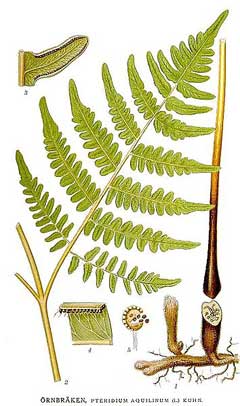
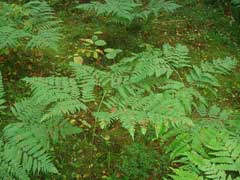
The plant is a course fern with long, creeping, woody, branched, hairy rhizomes and solitary fronds. The large, pinnately compound, 3 divided frounds are stout and erect to reclining, with a feltlike covering near the base. Form: Irregular or sprawling
Physical Characteristics

 Pteridium aquilinum is a FERN growing to 1.2 m (4ft) by 2 m (6ft 7in) at a fast rate.
See above for USDA hardiness. It is hardy to UK zone 4. The seeds ripen from July to August.
Suitable for: light (sandy), medium (loamy) and heavy (clay) soils. Suitable pH: mildly acid and neutral soils and can grow in very acid soils.
It can grow in semi-shade (light woodland) or no shade. It prefers dry or moist soil. The plant can tolerate maritime exposure.
UK Hardiness Map
US Hardiness Map
Synonyms
Pteris aquilina.
Plant Habitats
Woodland Garden Dappled Shade; Shady Edge; Meadow;
Edible Uses
Edible Parts: Leaves Root Shoots
Edible Uses: Sweetener
Root - cooked. It can be dried and ground into a powder[2, 13, 46, 55, 66, 94, 95, 102, 257]. The root is very fibrous so traditionally it was baked after being dried, the outer skin was peeled off and the roots pounded into a powder with sticks so that the inner fibres could be removed[173, 256]. The dried root will store for years[173]. The root contains 60% starch[74]. The dry weight content of starch is between 43 and 72%[173]. This starch can be extracted from the roots and is used in making dumplings which are eaten with soya flour and sugar as a delicacy[183]. The root has a somewhat constipating effect upon the body so is best eaten with foods that have a laxative quality[256]. Young shoots, harvested when still unfurling, can be eaten raw or cooked[2, 13, 55, 62, 94, 102, 183, 257]. They can be used like asparagus or like spinach[9, 257]. Somewhat flavourless, though they are considered to be a delicacy in Japan[4]. The fronds should be used when less than 20cm long, longer ones have a terrible taste[9, 213]. The shoots are somewhat bitter so they are often blanched for a few minutes in boiling water, then left to soak in cold water for two hours before being cooked[4, 9]. Although this might well improve the flavour, it will greatly reduce the nutritional value[K]. The shoots should be steeped in lye first[55]. Occasional use should cause no problems, but regular consumption is not advisable because the shoots might be carcinogenic[9, 65]. The plant yields an edible saccharine substance[55]. (from the cooking root??).
References More on Edible Uses
Medicinal Uses
Plants For A Future can not take any responsibility for any adverse effects from the use of plants. Always seek advice from a professional before using a plant medicinally.
Anthelmintic Antiemetic Antiseptic Diuretic Poultice Refrigerant Tonic
The young shoots are diuretic, refrigerant and vermifuge[4, 46, 94, 218]. They have been eaten as a treatment for cancer[257]. The leaves have been used in a steam bath as a treatment for arthritis[257]. A decoction of the plant as been used in the treatment of tuberculosis[257]. A poultice of the pounded fronds and leaves has been used to treat sores of any type and also to bind broken bones in place[257]. The root is antiemetic, antiseptic, appetizer and tonic[257]. A tincture of the root in wine is used in the treatment of rheumatism[218]. A tea made from the roots is used in the treatment of stomach cramps, chest pains, internal bleeding, diarrhoea, colds and also to expel worms[4, 46, 94, 222, 257]. The poulticed root is applied to sores, burns and caked breasts[222, 257].
References More on Medicinal Uses
The Bookshop: Edible Plant Books
Our Latest books on Perennial Plants For Food Forests and Permaculture Gardens in paperback or digital formats.

Edible Tropical Plants
Food Forest Plants for Hotter Conditions: 250+ Plants For Tropical Food Forests & Permaculture Gardens.
More

Edible Temperate Plants
Plants for Your Food Forest: 500 Plants for Temperate Food Forests & Permaculture Gardens.
More

More Books
PFAF have eight books available in paperback and digital formats. Browse the shop for more information.
Shop Now
Other Uses
Adhesive Basketry Biomass Compost Dye Hair Lining Mulch Packing Repellent Soap Soap making Stuffing Thatching Tinder
A glue can be made from the rootstock[74]. A brown dye is obtained from the fronds[6, 67, 141]. It is green according to another report[141]. The fibrous remnants from edible roots make a good tinder[99]. The rhizome lathers readily in water and can be used as a soap[74]. A decoction of the root has been used as a hair wash[257]. The roots have been rubbed into the scalp in order to promote hair growth[257]. The roots have been pounded to remove the bark, then split into flat bands and used as the black strands of cheap baskets[257]. The ashes of the plant are rich in potassium and could be used as a fertilizer[4]. They are also used in the manufacture of glass (when mixed with sand) and in making soap (when mixed with vegetable oil)[4, 74]. The roots contain up to 20% potash in early summer, but this reduces to about 5% in the autumn[4]. The whole plant is a very valuable addition to the compost heap, it is rich in potash and makes an excellent compost for tree seeds[67, 94]. Cut twice a year if you want the plants to continue growing, three cuts annually will weaken and eventually kill off the plants. The dried ferns produce a very durable thatch[4]. The leaves are used as a packing material for fruit, keeping it fresh and cool without imparting any colour or flavour[4, 66, 99]. They are also used as a lining for baskets, fruit drying racks etc and as a bedding[66, 99]. The leaves repel insects and can help to prevent rot in the fruits etc[99]. Dried bracken fronds are very useful in the garden as a mulch for somewhat tender plants. This will keep the soil warmer, protect from wind damage and also keep off some of the rain[4, K].
Special Uses
References More on Other Uses
Cultivation details
Landscape Uses:Border, Foundation, Rock garden, Woodland garden. Prefers a light, acid, deep sandy soil[1]. Dislikes shade according to some reports[13, 17] whilst another says that it tolerates full sun but prefers light shade[200]. Prefers a pH in the range 4 to 6[200]. Members of this genus are rarely if ever troubled by browsing deer[233]. This is an extremely invasive plant and is a noxious weed. It is one of the most widespread plants in the world, being found in all parts of the globe other than the extreme north and south[4]. Plants can be cut down twice a year to provide compost material, this will not kill the plants. If the plants are cut down three times a year this will gradually weaken and eventually kill them. Special Features:Attractive foliage, Not North American native, Invasive, All or parts of this plant are poisonous, There are no flowers or blooms.
References Carbon Farming Information and Carbon Sequestration Information
Temperature Converter
Type a value in the Celsius field to convert the value to Fahrenheit:
Fahrenheit:
The PFAF Bookshop
Plants For A Future have a number of books available in paperback and digital form. Book titles include Edible Plants, Edible Perennials, Edible Trees,Edible Shrubs, Woodland Gardening, and Temperate Food Forest Plants. Our new book is Food Forest Plants For Hotter Conditions (Tropical and Sub-Tropical).
Shop Now
Plant Propagation
Spores can be surface sown in the same way as other ferns but this plant really does not need any help in spreading itself about. Division is also possible but usually totally unnecessary.
Other Names
If available other names are mentioned here
Native Plant Search
Search over 900 plants ideal for food forests and permaculture gardens. Filter to search native plants to your area. The plants selected are the plants in our book 'Plants For Your Food Forest: 500 Plants for Temperate Food Forests and Permaculture Gardens, as well as plants chosen for our forthcoming related books for Tropical/Hot Wet Climates and Mediterranean/Hot Dry Climates. Native Plant Search
Found In
Countries where the plant has been found are listed here if the information is available
Weed Potential
Right plant wrong place. We are currently updating this section.
Please note that a plant may be invasive in one area but may not in your area so it’s worth checking.
Conservation Status
IUCN Red List of Threatened Plants Status :

Growth: S = slow M = medium F = fast. Soil: L = light (sandy) M = medium H = heavy (clay). pH: A = acid N = neutral B = basic (alkaline). Shade: F = full shade S = semi-shade N = no shade. Moisture: D = dry M = Moist We = wet Wa = water.

Expert comment
Author
(L.)Kuhn.
Botanical References
17200
Links / References
For a list of references used on this page please go here
Readers comment