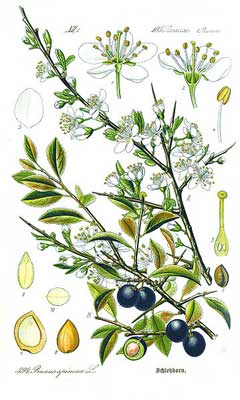
 |
|
http://commons.wikimedia.org/wiki/File:Illustration_Prunus_spinosa1.jpg |
 |
| http://commons.wikimedia.org/wiki/User:Llez |
Translate this page:
Summary
Bloom Color: White. Main Bloom Time: Mid spring. Form: Vase.
Physical Characteristics

 Prunus spinosa is a deciduous Shrub growing to 3 m (9ft 10in) at a medium rate.
See above for USDA hardiness. It is hardy to UK zone 4. It is in flower from March to April, and the seeds ripen in October. The species is hermaphrodite (has both male and female organs) and is pollinated by Insects.
It is noted for attracting wildlife.
Suitable for: light (sandy), medium (loamy) and heavy (clay) soils and prefers well-drained soil. Suitable pH: mildly acid, neutral and basic (mildly alkaline) soils and can grow in very alkaline soils.
It can grow in semi-shade (light woodland) or no shade. It prefers moist soil. The plant can tolerate maritime exposure.
UK Hardiness Map
US Hardiness Map
Synonyms
Prunus moldavica. Kotov. Prunus stepposa. Kotov.
Plant Habitats
Woodland Garden Sunny Edge; Dappled Shade; Hedge;
Edible Uses
Edible Parts: Flowers Fruit Seed
Edible Uses: Tea
Fruit - raw or cooked[2, 5, 7, 11, 12, 13, 34]. Exceedingly astringent, it is normally cooked but once the fruit has been frosted it loses some of its astringency and some people find they can enjoy it raw[183, K]. The fruit is more usually used in jellies, syrups, conserves etc and as a flavouring for sloe gin and other liqueurs[183]. Some fruits that we ate in December were fairly pleasant raw[K]. In France the unripe fruit is pickled like an olive[183]. The fruit is about 15mm in diameter and contains one large seed[200]. Seed - raw or cooked. Do not eat the seed if it is too bitter - see the notes above on toxicity. The leaves are used as a tea substitute[7, 183]. The dried fruits can be added to herbal teas[183]. The flowers are edible and can be crystallised or sugared[183].
References More on Edible Uses
Medicinal Uses
Plants For A Future can not take any responsibility for any adverse effects from the use of plants. Always seek advice from a professional before using a plant medicinally.
Antidiarrhoeal Antiflatulent Antispasmodic Aperient Astringent Depurative Diaphoretic Diuretic
Febrifuge Laxative Stomachic
The flowers, bark, leaves and fruits are aperient, astringent, depurative, diaphoretic, diuretic, febrifuge, laxative and stomachic[7, 9, 21]. An infusion of the flowers is used in the treatment of diarrhoea (especially for children), bladder and kidney disorders, stomach weakness et[9]. Although no specific mention has been seen for this species, all members of the genus contain amygdalin and prunasin, substances which break down in water to form hydrocyanic acid (cyanide or prussic acid). In small amounts this exceedingly poisonous compound stimulates respiration, improves digestion and gives a sense of well-being[238]. The German Commission E Monographs, a therapeutic guide to herbal medicine, approve Prunus spinosa Sloe - Blackthorn for inflammation of mouth and pharynx (see [302] for critics of commission E).
References More on Medicinal Uses
The Bookshop: Edible Plant Books
Our Latest books on Perennial Plants For Food Forests and Permaculture Gardens in paperback or digital formats.

Edible Tropical Plants
Food Forest Plants for Hotter Conditions: 250+ Plants For Tropical Food Forests & Permaculture Gardens.
More

Edible Temperate Plants
Plants for Your Food Forest: 500 Plants for Temperate Food Forests & Permaculture Gardens.
More

More Books
PFAF have eight books available in paperback and digital formats. Browse the shop for more information.
Shop Now
Other Uses
Cosmetic Dye Hedge Hedge Ink Pioneer Tannin Wood
The bark is a good source of tannin[7]. It is used to make an ink[66]. The juice of unripe fruits is used as a laundry mark[66], it is almost indelible[115]. The pulped ripe fruit is used cosmetically in making astringent face-masks[7]. A green dye can be obtained from the leaves[168]. A dark grey to green dye can be obtained from the fruit[168]. The bark, boiled in an alkali, produces a yellow dye[66]. The sloe is very resistant to maritime exposure and also suckers freely. It can be used as a hedge in exposed maritime positions. The hedge is stock-proof if it is well maintained[1, 29], though it is rather bare in the winter and, unless the hedge is rather wide, it is not a very good shelter at this time[K]. Because of its suckering habit, the plant is a natural pioneer species, invading cultivated fields and creating conditions conducive to the regeneration of woodland. Wood - very hard. Used for turnery, the teeth of rakes etc[1, 13, 46, 66]. Suitable branches are used for making walking sticks and are highly valued for this purpose because of their twisted and interesting shapes[7].
Special Uses
Attracts Wildlife Carbon Farming Food Forest Hedge Hedge
References More on Other Uses
Cultivation details
Agroforestry Services: Living fence Agroforestry Services: Windbreak Industrial Crop: Oil Management: Standard Regional Crop
Landscape Uses:Specimen. Requires a well-drained moisture retentive soil[11]. Succeeds in all soils except very acid peats[186]. Succeeds in light shade but fruits better in a sunny position[11, 200]. Thrives in a loamy soil, doing well on limestone[11]. Prefers some chalk in the soil but apt to become chlorotic if too much is present[1]. Thrives on chalk according to another report[182]. Plants are very resistant to maritime exposure[186]. An important food plant for the caterpillars of several species of butterfly[30], especially the larvae of the brown and black hairstreak butterflies[186]. A good bee plant. Plants are shallow-rooted and of a suckering habit, they can form dense impenetrable thickets which are ideal for nesting birds, especially nightingales[186]. Flowers are often damaged by late frosts[186]. Plants regenerate quickly after cutting or after fast moving forest fires, producing suckers from below ground level[186]. This species is notably resistant to honey fungus[88, 200]. Special Features:
All or parts of this plant are poisonous, Blooms are very showy. In garden design, as well as the above-ground architecture of a plant, root structure considerations help in choosing plants that work together for their optimal soil requirements including nutrients and water. The root pattern is flat with shallow roots spreading near the soil surface. The root pattern is suckering with new plants from runners away from the plant [2-1].
Carbon Farming
-
Agroforestry Services: Living fence
Simply managed rows of shrubs and trees.
-
Agroforestry Services: Windbreak
Linear plantings of trees and shrubs designed to enhance crop production, protect people and livestock and benefit soil and water conservation.
-
Industrial Crop: Oil
Materials, chemicals and energy include bioplastics, biomass, glycerin, soaps, lubricants, paints, biodiesel. Oilseed crop types.
-
Management: Standard
Plants grow to their standard height. Harvest fruit, seeds, or other products. Non-Destructive management systems.
-
Regional Crop
These crops have been domesticated and cultivated regionally but have not been adopted elsewhere and are typically not traded globally, Examples in this broad category include perennial cottons and many nuts and staple fruits.
References Carbon Farming Information and Carbon Sequestration Information
Temperature Converter
Type a value in the Celsius field to convert the value to Fahrenheit:
Fahrenheit:
The PFAF Bookshop
Plants For A Future have a number of books available in paperback and digital form. Book titles include Edible Plants, Edible Perennials, Edible Trees,Edible Shrubs, Woodland Gardening, and Temperate Food Forest Plants. Our new book is Food Forest Plants For Hotter Conditions (Tropical and Sub-Tropical).
Shop Now
Plant Propagation
Seed - requires 2 - 3 months cold stratification and is best sown in a cold frame as soon as it is ripe[200]. Sow stored seed in a cold frame as early in the year as possible[200]. Protect the seed from mice etc. The seed can be rather slow, sometimes taking 18 months to germinate[113]. Prick out the seedlings into individual pots when they are large enough to handle. Grow them on in a greenhouse or cold frame for their first winter and plant them out in late spring or early summer of the following year. Cuttings of half-ripe wood with a heel, July/August in a frame[11, 200]. Softwood cuttings from strongly growing plants in spring to early summer in a frame. Layering in spring. Division of suckers during the dormant season. They can be planted out direct into their permanent positions.
Other Names
If available other names are mentioned here
Native Plant Search
Search over 900 plants ideal for food forests and permaculture gardens. Filter to search native plants to your area. The plants selected are the plants in our book 'Plants For Your Food Forest: 500 Plants for Temperate Food Forests and Permaculture Gardens, as well as plants chosen for our forthcoming related books for Tropical/Hot Wet Climates and Mediterranean/Hot Dry Climates. Native Plant Search
Found In
Countries where the plant has been found are listed here if the information is available
Weed Potential
Right plant wrong place. We are currently updating this section.
Please note that a plant may be invasive in one area but may not in your area so it’s worth checking.
Conservation Status
IUCN Red List of Threatened Plants Status :

| Related Plants
|
| Latin Name | Common Name | Habit | Height | Hardiness | Growth | Soil | Shade | Moisture | Edible | Medicinal | Other |
| Prunus africana | Pygeum | Tree | 18.0 |
10-12
| F | LM | N | M | 0 | 5 | 2 |
| Prunus alabamensis | Alabama Cherry | Tree | 8.0 |
-
| | LMH | SN | M | 2 | 1 | 1 |
| Prunus alleghaniensis | Allegheny Plum, Davis' plum | Tree | 3.5 |
4-8
| F | LMH | SN | M | 3 | 1 | 2 |
| Prunus americana | American Plum, American Wild Plum, Wild Plum | Tree | 6.0 |
3-8
| M | LMH | SN | M | 3 | 2 | 3 |
| Prunus americana lanata | | Tree | 10.0 |
3-7
| | LMH | SN | M | 3 | 1 | 2 |
| Prunus andersonii | Desert Peach | Shrub | 1.8 |
-
| | LMH | SN | M | 2 | 2 | 1 |
| Prunus angustifolia | Chickasaw Plum, Watson's plum, Hally Jolivette Cherry | Tree | 3.0 |
5-9
| M | LMH | SN | M | 3 | 1 | 3 |
| Prunus angustifolia watsonii | Sand Plum | Shrub | 3.0 |
5-9
| | LMH | SN | M | 4 | 1 | 2 |
| Prunus apetala | Clove Cherry | Shrub | 7.0 |
-
| | LMH | SN | M | 2 | 1 | 1 |
| Prunus arabica | | Shrub | 0.0 |
-
| | LMH | SN | DM | 2 | 1 | 2 |
| Prunus armeniaca | Apricot | Tree | 9.0 |
5-7
| M | LM | SN | M | 4 | 3 | 4 |
| Prunus armeniaca mandschurica | Manchurian apricot | Tree | 6.0 |
3-9
| M | LM | SN | M | 4 | 3 | 3 |
| Prunus avium | Wild Cherry, Sweet cherry | Tree | 18.0 |
3-7
| F | LMH | SN | M | 4 | 2 | 4 |
| Prunus besseriana | Dwarf Almond | Tree | 0.0 |
-
| | LMH | SN | M | 2 | 1 | 2 |
| Prunus besseyi | Western Sand Cherry | Shrub | 1.2 |
3-6
| M | LMH | SN | M | 4 | 1 | 2 |
| Prunus bifrons | | Shrub | 1.8 |
-
| | LMH | SN | M | 2 | 1 | 1 |
| Prunus bokharensis | Bokhara Plum | Tree | 0.0 |
-
| | LMH | SN | M | 2 | 1 | 1 |
| Prunus brigantina | Briançon Apricot | Tree | 6.0 |
6-9
| | LMH | SN | DM | 4 | 1 | 2 |
| Prunus buergeriana | | Tree | 9.0 |
4-8
| | LMH | SN | M | 2 | 1 | 1 |
| Prunus campanulata | Taiwan Cherry | Tree | 7.0 |
7-9
| M | LMH | SN | M | 2 | 1 | 1 |
| Prunus canescens | Greyleaf Cherry | Shrub | 3.0 |
5-9
| | LMH | SN | M | 3 | 1 | 2 |
| Prunus capsica | | Tree | 0.0 |
-
| | LMH | SN | M | 2 | 1 | 1 |
| Prunus caroliniana | American Cherry Laurel, Carolina laurelcherry, Laurel Cherry, | Shrub | 12.0 |
7-10
| F | LMH | SN | DM | 2 | 1 | 3 |
| Prunus cerasifera | Cherry Plum, Myrobalan Plum, Newport Cherry Plum, Pissard Plum | Tree | 9.0 |
5-8
| M | LMH | SN | M | 4 | 1 | 3 |
| Prunus cerasifera divaricata | | Tree | 10.0 |
4-8
| | LMH | SN | M | 4 | 1 | 1 |
| Prunus cerasoides | Wild Himalayan Cherry | Tree | 30.0 |
7-10
| | LMH | SN | M | 2 | 2 | 2 |
| Prunus cerasus | Sour Cherry | Tree | 6.0 |
3-7
| | LMH | SN | M | 1 | 2 | 3 |
| Prunus cerasus austera | Morello Cherry | Tree | 9.0 |
3-7
| | LMH | SN | M | 3 | 1 | 3 |
| Prunus cerasus caproniana | Kentish Red Cherry | Tree | 9.0 |
3-7
| | LMH | SN | M | 3 | 1 | 3 |
| Prunus cerasus frutescens | Bush Sour Cherry | Tree | 1.0 |
3-7
| | LMH | SN | M | 3 | 1 | 3 |
|
|
Growth: S = slow M = medium F = fast. Soil: L = light (sandy) M = medium H = heavy (clay). pH: A = acid N = neutral B = basic (alkaline). Shade: F = full shade S = semi-shade N = no shade. Moisture: D = dry M = Moist We = wet Wa = water.

Expert comment
Author
L.
Botanical References
1117200
Links / References
For a list of references used on this page please go here
Readers comment