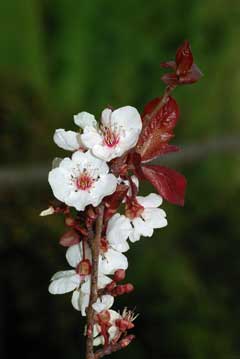
 |
|
http://commons.wikimedia.org/wiki/User:Alvesgaspar |
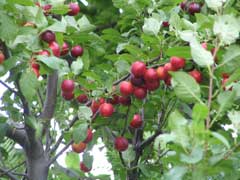 |
| http://commons.wikimedia.org/wiki/User:Bogdan |
Translate this page:
Summary
Bloom Color: Pink, White. Main Bloom Time: Early spring, Late spring, Mid spring. Form: Rounded, Vase.
Physical Characteristics

 Prunus cerasifera is a deciduous Tree growing to 9 m (29ft) by 9 m (29ft) at a medium rate.
See above for USDA hardiness. It is hardy to UK zone 4. It is in flower in March, and the seeds ripen from August to September. The species is hermaphrodite (has both male and female organs) and is pollinated by Bees.
Suitable for: light (sandy), medium (loamy) and heavy (clay) soils, prefers well-drained soil and can grow in heavy clay soil. Suitable pH: mildly acid, neutral and basic (mildly alkaline) soils. It can grow in semi-shade (light woodland) or no shade. It prefers moist soil. The plant can tolerates strong winds but not maritime exposure.
UK Hardiness Map
US Hardiness Map
Synonyms
P. domestica myrobalan.
Plant Habitats
Woodland Garden Secondary; Sunny Edge; Dappled Shade; Hedge;
Edible Uses
Edible Parts: Fruit Seed
Edible Uses:
Fruit - raw or cooked in pies, tarts, jams etc[2, 5, 12, 34, 183]. The size of a small plum with a thin skin and a nice sweet flavour[183]. The flesh is somewhat mealy but is also juicy[K]. The fruit can hang on the tree until October[K]. The fruit is about 30mm in diameter and contains one large seed[200]. Seed - raw or cooked. Do not eat the seed if it is too bitter - see the notes above on toxicity.
References More on Edible Uses
Medicinal Uses
Plants For A Future can not take any responsibility for any adverse effects from the use of plants. Always seek advice from a professional before using a plant medicinally.
Bach
The plant is used in Bach flower remedies - the keywords for prescribing it are 'Desperation', 'Fear of losing control of the mind' and 'Dread of doing some frightful thing'[209]. It is also one of the five ingredients in the 'Rescue remedy'[209]. Although no specific mention has been seen for this species, all members of the genus contain amygdalin and prunasin, substances which break down in water to form hydrocyanic acid (cyanide or prussic acid). In small amounts this exceedingly poisonous compound stimulates respiration, improves digestion and gives a sense of well-being[238].
References More on Medicinal Uses
The Bookshop: Edible Plant Books
Our Latest books on Perennial Plants For Food Forests and Permaculture Gardens in paperback or digital formats.

Edible Tropical Plants
Food Forest Plants for Hotter Conditions: 250+ Plants For Tropical Food Forests & Permaculture Gardens.
More

Edible Temperate Plants
Plants for Your Food Forest: 500 Plants for Temperate Food Forests & Permaculture Gardens.
More

More Books
PFAF have eight books available in paperback and digital formats. Browse the shop for more information.
Shop Now
Other Uses
Dye Hedge Hedge Rootstock Shelterbelt
A green dye can be obtained from the leaves[168]. A dark grey to green dye can be obtained from the fruit[168]. Makes quite a good windbreak hedge though it cannot stand too much exposure[1, 11, 29]. Often used as a rootstock for the cultivated plums, giving them a semi-dwarfing habit[61].
Special Uses
Food Forest Hedge Hedge
References More on Other Uses
Cultivation details
Landscape Uses:Specimen. Requires a well-drained moisture retentive soil[1, 11]. Succeeds in light shade but fruits better in a sunny position[11, 200]. Thrives in a loamy soil, doing well on limestone[11]. Grows well in heavy clay soils. Prefers some chalk in the soil but apt to become chlorotic if too much is present[1]. A very ornamental plant[1], it is sometimes cultivated for its edible fruit, unfortunately this is not often borne in large quantities in Britain[3, 17], but large crops are produced every 4 years or so[K]. There are some named varieties[183]. Included as a part of P. divaricata by some botanists[11] though others include P. divaricata as a sub-species under this species[200]. Most members of this genus are shallow-rooted and will produce suckers if the roots are damaged[238]. Plants in this genus are notably susceptible to honey fungus[200]. Special Features:Attractive foliage, Not North American native, All or parts of this plant are poisonous, Blooms are very showy. The plant is heat tolerant in zones 9 through 1. (Plant Hardiness Zones show how well plants withstand cold winter temperatures.
Plant Heat Zones show when plants would start suffering from the heat.
The Plant Heat Zone map is based on the number of "heat days" experienced in a given area where the temperature climbs to over 86 degrees F (30°C).
At this temperature, many plants begin to suffer physiological damage. Heat Zones range from 1 (no heat days) to 12 (210 or more heat days).
For example Heat Zone. 11-1 indicates that the plant is heat tolerant in zones 11 through 1.) For polyculture design as well as the above-ground architecture (form - tree, shrub etc. and size shown above) information on the habit and root pattern is also useful and given here if available. A sprouting standard sending up shoots from the base [1-2].
References Carbon Farming Information and Carbon Sequestration Information
Temperature Converter
Type a value in the Celsius field to convert the value to Fahrenheit:
Fahrenheit:
The PFAF Bookshop
Plants For A Future have a number of books available in paperback and digital form. Book titles include Edible Plants, Edible Perennials, Edible Trees,Edible Shrubs, Woodland Gardening, and Temperate Food Forest Plants. Our new book is Food Forest Plants For Hotter Conditions (Tropical and Sub-Tropical).
Shop Now
Plant Propagation
Seed - requires 2 - 3 months cold stratification and is best sown in a cold frame as soon as it is ripe[200]. Sow stored seed in a cold frame as early in the year as possible[200]. Protect the seed from mice etc. The seed can be rather slow, sometimes taking 18 months to germinate[113]. Prick out the seedlings into individual pots when they are large enough to handle. Grow them on in a greenhouse or cold frame for their first winter and plant them out in late spring or early summer of the following year. Cuttings of half-ripe wood with a heel, July/August in a frame. Softwood cuttings from strongly growing plants in spring to early summer in a frame. Layering in spring. Division of suckers in the dormant season. They can be planted out direct into their permanent positions.
Other Names
If available other names are mentioned here
Native Plant Search
Search over 900 plants ideal for food forests and permaculture gardens. Filter to search native plants to your area. The plants selected are the plants in our book 'Plants For Your Food Forest: 500 Plants for Temperate Food Forests and Permaculture Gardens, as well as plants chosen for our forthcoming related books for Tropical/Hot Wet Climates and Mediterranean/Hot Dry Climates. Native Plant Search
Found In
Countries where the plant has been found are listed here if the information is available
Weed Potential
Right plant wrong place. We are currently updating this section.
Please note that a plant may be invasive in one area but may not in your area so it’s worth checking.
Conservation Status
IUCN Red List of Threatened Plants Status :

Growth: S = slow M = medium F = fast. Soil: L = light (sandy) M = medium H = heavy (clay). pH: A = acid N = neutral B = basic (alkaline). Shade: F = full shade S = semi-shade N = no shade. Moisture: D = dry M = Moist We = wet Wa = water.

Expert comment
Author
Ehrh.
Botanical References
11200
Links / References
For a list of references used on this page please go here
Readers comment
© 2010, Plants For A Future. Plants For A Future is a charitable company limited by guarantee, registered in England and Wales. Charity No. 1057719, Company No. 3204567.