 |
|
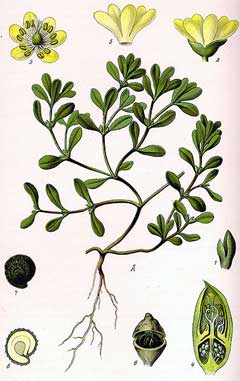
http://commons.wikimedia.org/wiki/File:Illustration_Portulaca_oleracea0.jpg |
 |
|
Translate this page:
Summary
Physical Characteristics

 Portulaca oleracea is a ANNUAL growing to 0.3 m (1ft) by 0.3 m (1ft in) at a fast rate.
See above for USDA hardiness. It is hardy to UK zone 4 and is frost tender. It is in flower from June to September, and the seeds ripen from July to September. The species is hermaphrodite (has both male and female organs) and is pollinated by Insects. The plant is self-fertile.
Suitable for: light (sandy) and medium (loamy) soils and prefers well-drained soil. Suitable pH: mildly acid, neutral and basic (mildly alkaline) soils. It cannot grow in the shade. It prefers moist soil.
UK Hardiness Map
US Hardiness Map
Synonyms
Plant Habitats
Cultivated Beds;
Edible Uses
Edible Parts: Leaves Seed
Edible Uses: Salt
Leaves and stems - raw or cooked[1, 4, 12, 27, 37]. The young leaves are a very acceptable addition to salads, their mucilaginous quality also making them a good substitute for okra as a thickener in soups[4, 183]. Older leaves are used as a potherb[4]. The leaves have a somewhat sour flavour[85]. A spicy and somewhat salty taste[9]. The leaves are a source of omega-3 fatty acids, though seed sources such as walnuts are magnitudes richer[222]. The leaves can be dried for later use[85]. They contain about 1.8% protein, 0.5% fat, 6.5% carbohydrate, 2.2% ash[179]. Another analysis gives the following figures per 100g ZMB. 245 - 296 calories, 17.6 - 34.5g protein, 2.4 - 5.3g fat, 35.5 - 63.2g carbohydrate, 8.5 - 14.6g fibre, 15.9 - 24.7g ash, 898 - 2078mg calcium, 320 - 774mg phosphorus, 11.2 - 46.7mg iron, 55mg sodium, 505 - 3120mg potassium, 10560 - 20000ug B-carotene equivalent, 0.23 - 0.48mg thiamine, 1.12 - 1.6mg riboflavin, 5.58 - 6.72mg niacin and 168 - 333mg ascorbic acid[218]. Seed - raw or cooked[62, 102, 159]. The seed can be ground into a powder and mixed with cereals for use in gruels, bread, pancakes etc[183, 193]. The seed is rather small and fiddly to utilize[85]. In arid areas of Australia the plants grow quite large and can produce 10, 000 seeds per plant, a person can harvest several pounds of seed in a day. The seeding plants are uprooted and placed in a pile on sheets or something similar, in a few days the seeds are shed and can be collected from the sheet[193]. In Britain, however, yields are likely to be very low, especially in cool or wet summers[K]. The seed contains (per 100g ZMB) 21g protein, 18.9g fat 3.4g ash[218]. Fatty acids of the seeds are 10.9% palmitic, 3.7% stearic, 1.3% behenic, 28.7% oleic, 38.9% linoleic and 9.9% linolenic[218]. The ash of burnt plants is used as a salt substitute[183].
References More on Edible Uses
| Composition
|
| Figures in grams (g) or miligrams (mg) per 100g of food.
|
|
|
Leaves (Dry weight)
|
|
- 270 Calories per 100g
- Water : 0%
- Protein: 26g; Fat: 4g; Carbohydrate: 50g; Fibre: 11.5g; Ash: 20g;
- Minerals - Calcium: 1500mg; Phosphorus: 550mg; Iron: 29mg; Magnesium: 0mg; Sodium: 55mg; Potassium: 1800mg; Zinc: 0mg;
- Vitamins - A: 15000mg; Thiamine (B1): 0.35mg; Riboflavin (B2): 1.4mg; Niacin: 6mg; B6: 0mg; C: 250mg;
- Reference: [ 218]
- Notes: The figures given here are the median of a very wide range quoted in the report.
|
|
Medicinal Uses
Plants For A Future can not take any responsibility for any adverse effects from the use of plants. Always seek advice from a professional before using a plant medicinally.
Antiscorbutic Depurative Diuretic Febrifuge Skin Tonic Vermifuge
The plant is antibacterial, antiscorbutic, depurative, diuretic and febrifuge[4, 7, 147, 152, 238]. The leaves are a rich source of omega-3 fatty acids, which is thought to be important in preventing heart attacks and strengthening the immune system[238]. Seed sources such as walnuts, however, are much richer sources[222]. The fresh juice is used in the treatment of strangury, coughs, sores etc[4, 7, 147, 152]. The leaves are poulticed and applied to burns[222], both they and the plant juice are particularly effective in the treatment of skin diseases and insect stings[7, 238]. A tea made from the leaves is used in the treatment of stomach aches and headaches[222]. The leaf juice is applied to earaches, it is also said to alleviate caterpillar stings[222]. The leaves can be harvested at any time before the plant flowers, they are used fresh or dried[238]. This remedy is not given to pregnant women or to patients with digestive problems[238]. The seeds are tonic and vermifuge[218, 240]. They are prescribed for dyspepsia and opacities of the cornea[218].
References More on Medicinal Uses
The Bookshop: Edible Plant Books
Our Latest books on Perennial Plants For Food Forests and Permaculture Gardens in paperback or digital formats.

Edible Tropical Plants
Food Forest Plants for Hotter Conditions: 250+ Plants For Tropical Food Forests & Permaculture Gardens.
More

Edible Temperate Plants
Plants for Your Food Forest: 500 Plants for Temperate Food Forests & Permaculture Gardens.
More

More Books
PFAF have eight books available in paperback and digital formats. Browse the shop for more information.
Shop Now
Other Uses
References More on Other Uses
Cultivation details
Requires a moist light rich well-drained soil in a sunny position[4, 37, 200]. Plants will not produce good quality leaves when growing in dry conditions[4]. A perennial plant in warmer climates than Britain, purslane is killed by frost but can be grown as a half-hardy annual in this country[1]. It can become an aggressive weed in areas where the climate suits it[274]. The flowers only open in full sunlight[244]. Purslane is occasionally cultivated for its edible leaves, there are some named varieties[183]. The plants take about six to eight weeks to produce a crop from seed and can then be harvested on a cut and come again principle, providing edible leaves for most of the summer[4].
References Carbon Farming Information and Carbon Sequestration Information
Temperature Converter
Type a value in the Celsius field to convert the value to Fahrenheit:
Fahrenheit:
The PFAF Bookshop
Plants For A Future have a number of books available in paperback and digital form. Book titles include Edible Plants, Edible Perennials, Edible Trees,Edible Shrubs, Woodland Gardening, and Temperate Food Forest Plants. Our new book is Food Forest Plants For Hotter Conditions (Tropical and Sub-Tropical).
Shop Now
Plant Propagation
Seed - for an early crop, the seed is best sown under protection in early spring and can then be planted out in late spring[4]. Outdoor sowings in situ take place from late spring to late summer, successional sowings being made every two to three weeks if a constant supply of the leaves is required[4].
Other Names
If available other names are mentioned here
Native Plant Search
Search over 900 plants ideal for food forests and permaculture gardens. Filter to search native plants to your area. The plants selected are the plants in our book 'Plants For Your Food Forest: 500 Plants for Temperate Food Forests and Permaculture Gardens, as well as plants chosen for our forthcoming related books for Tropical/Hot Wet Climates and Mediterranean/Hot Dry Climates. Native Plant Search
Found In
Countries where the plant has been found are listed here if the information is available
Weed Potential
Right plant wrong place. We are currently updating this section.
Please note that a plant may be invasive in one area but may not in your area so it’s worth checking.
Conservation Status
IUCN Red List of Threatened Plants Status :

| Related Plants
|
| Latin Name | Common Name | Habit | Height | Hardiness | Growth | Soil | Shade | Moisture | Edible | Medicinal | Other |
| Calandrinia balonensis | | Annual/Perennial | 0.1 |
-
| | L | N | DM | 2 | 0 | |
| Calandrinia ciliata | Redmaids, Fringed redmaids | Annual | 0.3 |
0-0
| | LM | N | DM | 2 | 0 | 0 |
| Calandrinia ciliata menziesii | Redmaids | Annual | 0.1 |
-
| | L | N | DM | 2 | 0 | |
| Calandrinia polyandra | Parakeelya | Annual/Perennial | 0.1 |
-
| | LM | N | DM | 2 | 0 | |
| Calandrinia remota | | Annual/Perennial | 0.1 |
-
| | L | N | DM | 2 | 0 | |
| Claytonia acutifolia | Bering Sea Spring Beauty | Perennial | 0.2 |
-
| | LM | N | M | 3 | 0 | |
| Claytonia caroliniana | Broad-Leaved Spring Beauty, Carolina springbeauty | Perennial | 0.1 |
5-9
| | LM | N | M | 3 | 0 | 1 |
| Claytonia exigua | Pale Spring Beauty, Serpentine springbeauty | Annual | 0.1 |
0-0
| | LMH | FSN | DM | 2 | 0 | |
| Claytonia lanceolata | Lanceleaf Spring Beauty, Idaho springbeauty, Pacific springbeauty, Peirson's springbeauty | Perennial | 0.2 |
4-8
| | LM | N | M | 3 | 0 | |
| Claytonia megarhiza | Alpine Spring Beauty | Perennial | 0.2 |
4-8
| | LM | N | M | 3 | 0 | |
| Claytonia perfoliata | Miner's Lettuce | Annual | 0.2 |
6-10
| | LMH | FSN | DM | 4 | 1 | 2 |
| Claytonia scammaniana | Scamman's Claytonia, Scamman's springbeauty | Perennial | 0.2 |
0-0
| | LM | N | M | 2 | 0 | |
| Claytonia sibirica | Pink Purslane, Siberian springbeauty | Annual/Perennial | 0.2 |
3-7
| | LMH | FSN | DM | 4 | 1 | 3 |
| Claytonia tuberosa | Tuberous Spring Beauty | Perennial | 0.2 |
4-8
| | LM | N | M | 3 | 0 | |
| Claytonia umbellata | Great Basin Spring Beauty | Perennial | 0.2 |
-
| | LM | N | M | 2 | 0 | |
| Claytonia virginica | Spring Beauty, Virginia springbeauty, Hammond's claytonia, Yellow Virginia springbeauty | Perennial | 0.2 |
5-7
| M | LM | S | M | 3 | 1 | |
| Lewisia brachycalyx | Shortsepal lewisia | Perennial | 0.2 |
4-8
| S | LM | N | M | 2 | 0 | |
| Lewisia columbiana | Columbian Bitterroot, Columbian lewisia, Wallowa lewisia | Perennial | 0.2 |
4-8
| S | LM | SN | M | 2 | 0 | |
| Lewisia pygmaea | Pigmy Bitterroot, Alpine lewisia | Perennial | 0.1 |
3-7
| | LM | N | M | 2 | 0 | |
| Lewisia rediviva | Bitter-Root | Perennial | 0.1 |
4-8
| | LM | N | M | 2 | 2 | |
| Montia fontana | Water Blinks, Annual water minerslettuce | Annual/Perennial | 0.5 |
0-0
| | LMH | SN | MWeWa | 2 | 0 | |
| Portulaca grandiflora | Rose Moss | Annual | 0.2 |
-
| | LM | N | DM | 2 | 2 | |
| Portulaca oleracea sativa | Golden Purslane | Annual | 0.3 |
-
| | LM | N | M | 4 | 3 | |
| Portulaca retusa | Little hogweed | Annual | 0.2 |
0-0
| | LM | N | DM | 2 | 0 | |
| Sesuvium portulacastrum | Sea Purslane, Shoreline seapurslane | Perennial | 0.2 |
8-10
| | LMH | SN | M | 3 | 2 | 3 |
| Talinum aurantiacum | Orange Flameflower | Perennial | 0.4 |
-
| | LMH | SN | M | 1 | 0 | |
|
Growth: S = slow M = medium F = fast. Soil: L = light (sandy) M = medium H = heavy (clay). pH: A = acid N = neutral B = basic (alkaline). Shade: F = full shade S = semi-shade N = no shade. Moisture: D = dry M = Moist We = wet Wa = water.

Expert comment
Author
L.
Botanical References
100
Links / References
For a list of references used on this page please go here
Readers comment