 |
|
biolib.de |
 |
| http://commons.wikimedia.org/wiki/User:BS_Thurner_Hof |
Translate this page:
Summary
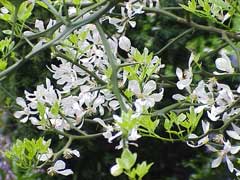
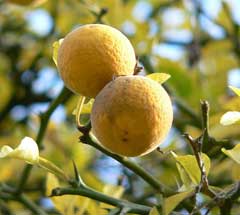
An attractive deciduous shrub growing up to six feet tall, this is the only fruit-bearing shrub of the orange family that is genuinely hardy in Britain. The species is unusual among citrus for having deciduous, compound leaves and pubescent (downy) fruit. The fruit, unfortunately, is inedible raw, though it can be used in conserves etc. This shrub is very sparsely leaved, much of the photosynthesis taking place in the young stems, but it has very large thorns which make it both attractive and a very useful barrier when grown as a hedge. It fruits best in a sunny position. A hybrid between this plant and the orange, called a 'Citrange', is hardy in south-west England where it bears somewhat sweeter fruits. A smaller cultivar "Flying Dragon" has twisted, contorted stems making an excellent barrier hedge. Poncirus trifoliata has some medicinal uses and is widely used in Oriental medicine as a treatment for allergic inflammation. Fragrant flowers and handsome autumn foliage. US Hardiness Zones: 6-9. Main Bloom Time: Early spring, Late spring, Mid spring. Form: Rounded.
Physical Characteristics

 Poncirus trifoliata is a deciduous Shrub growing to 3 m (9ft) by 3 m (9ft) at a slow rate.
See above for USDA hardiness. It is hardy to UK zone 5 and is not frost tender. It is in flower from April to May, and the seeds ripen from September to November. The species is hermaphrodite (has both male and female organs) and is pollinated by Insects. The plant is self-fertile.
Suitable for: light (sandy), medium (loamy) and heavy (clay) soils, prefers well-drained soil and can grow in nutritionally poor soil. Suitable pH: mildly acid, neutral and basic (mildly alkaline) soils and can grow in very acid and very alkaline soils.
It can grow in semi-shade (light woodland) or no shade. It prefers moist soil.
UK Hardiness Map
US Hardiness Map
Synonyms
Aegle sepiaria. Citrus trifoliata. Limonia trifoliata.
Plant Habitats
Woodland Garden Sunny Edge; Dappled Shade; Hedge;
Edible Uses
Edible Parts: Fruit Leaves
Edible Uses: Condiment
Fruit - cooked. A bitter and acrid flavour, but it can be used to make a marmalade[3, 11, 105]. The fruit is also used to make a refreshing drink[61, 183]. The freshly picked fruit yields little juice but if stored for 2 weeks it will yield about 20% juice[183], which is rich in vitamin C. Yields of up to 14 kilos of fruit per plant have been achieved in America[160]. The fruit is 2 - 3cm wide[188], though most of this is the skin[K]. The fruit peel can be used as a flavouring[183]. Young leaves - cooked[183].
References More on Edible Uses
Medicinal Uses
Plants For A Future can not take any responsibility for any adverse effects from the use of plants. Always seek advice from a professional before using a plant medicinally.
Antiemetic Antispasmodic Carminative Deobstruent Digestive Diuretic Expectorant Laxative
Odontalgic Stimulant Stomachic Vasoconstrictor Vitamin C
The thorns are used in the treatment of toothache[218]. The stem bark is used in the treatment of colds[218]. The fruits contain a number of medically active constituents including flavonoids, coumarins, monoterpenes and alkaloids[279]. The fruit, with the endocarp and seeds removed, is carminative, deobstruent and expectorant[176]. It is used in the treatment of dyspepsia, constipation and abdominal distension, stuffy sensation in the chest, prolapse of the uterus, rectum and stomach[176]. It is milder in effect than the immature fruit and is better used for removing stagnancy of food and vital energy in the spleen and stomach[176]. The unripe fruit is antidiarrheic, antiemetic, antispasmodic, deobstruent, digestive, diuretic, laxative, stimulant, stomachic and vasoconstrictor[147, 176, 178, 218]. It is used in the treatment of dyspepsia, constipation and abdominal distension, stuffy sensation in the chest, prolapse of the uterus, rectum and stomach, shock[176].
References More on Medicinal Uses
The Bookshop: Edible Plant Books
Our Latest books on Perennial Plants For Food Forests and Permaculture Gardens in paperback or digital formats.

Edible Tropical Plants
Food Forest Plants for Hotter Conditions: 250+ Plants For Tropical Food Forests & Permaculture Gardens.
More

Edible Temperate Plants
Plants for Your Food Forest: 500 Plants for Temperate Food Forests & Permaculture Gardens.
More

More Books
PFAF have eight books available in paperback and digital formats. Browse the shop for more information.
Shop Now
Other Uses
Hedge Hedge Rootstock
Used as a rootstock for Citrus species (oranges, lemons etc)[105, 160]. It confers an extra 3°c resistance to the cold[160]. The plant is very thorny and makes an excellent impenetrable barrier or hedge[3, 11, 29], though this barrier is not very dense[K]. The plants are very tolerant of pruning[182], they are best clipped in early summer shortly after flowering[200, 245].
Special Uses
Espalier Food Forest Hedge Hedge Scented Plants
References More on Other Uses
Cultivation details
Landscape Uses:Border, Espalier, Foundation, Hedge, Screen, Standard, Winter interest. An easily grown plant, it succeeds in an ordinary garden soil[1], preferably well-drained[182], but prefers a fertile light sandy soil in a sunny position[11, 200]. A plant is growing and fruiting well in light woodland shade at Cambridge Botanical Gardens[K]. Plants dislike soil cultivation close to their roots and so should either be well mulched to prevent weed growth, or hand weeded[202]. Succeeds in poor acid soils[229]. Plants also succeed in chalk-laden soils[245]. Hardy to about -15°c[184]. Plants have survived -30°c of frost without injury according to one report[11]. The bitter orange hybridizes with Citrus species and could possibly be used in breeding programmes to produce hardier forms of oranges, lemons etc[61, 160]. It could also be of value in conferring disease resistance, tolerance of poorer soils and dwarfing characteristics. The flowers are produced on the previous years wood[200]. The whole plant, but especially the flowers[202], is strongly aromatic[182]. A very ornamental plant[1, 11], the fruits are freely formed in south-western Britain[11, 59]. A hedge at Wisley in a semi-shaded position fruits heavily in most years[K]. Another report says that warm autumns are required if the plant is to fruit freely. Fertile seed is produced after warm summers[182]. Plants are relatively short-lived, deteriorating after about 25 years[202]. Special Features:
Not North American native, Naturalizing, Fragrant flowers, Attractive flowers or blooms.
References Carbon Farming Information and Carbon Sequestration Information
Temperature Converter
Type a value in the Celsius field to convert the value to Fahrenheit:
Fahrenheit:
The PFAF Bookshop
Plants For A Future have a number of books available in paperback and digital form. Book titles include Edible Plants, Edible Perennials, Edible Trees,Edible Shrubs, Woodland Gardening, and Temperate Food Forest Plants. Our new book is Food Forest Plants For Hotter Conditions (Tropical and Sub-Tropical).
Shop Now
Plant Propagation
Seed - best sown as soon as it is ripe in a cold frame[200]. Cold stratify stored seed for 4 weeks and sow early spring in a greenhouse[113]. Prick out the seedlings into individual pots when they are large enough to handle and grow them on in the greenhouse for at least their first winter. Plant them out into their permanent positions in early summer. Cuttings of half-ripe wood, June/July in a frame[1].
Other Names
If available other names are mentioned here
Native Plant Search
Search over 900 plants ideal for food forests and permaculture gardens. Filter to search native plants to your area. The plants selected are the plants in our book 'Plants For Your Food Forest: 500 Plants for Temperate Food Forests and Permaculture Gardens, as well as plants chosen for our forthcoming related books for Tropical/Hot Wet Climates and Mediterranean/Hot Dry Climates. Native Plant Search
Found In
Countries where the plant has been found are listed here if the information is available
North America,
Weed Potential
Right plant wrong place. We are currently updating this section.
Please note that a plant may be invasive in one area but may not in your area so it’s worth checking.
Conservation Status
IUCN Red List of Threatened Plants Status :

Growth: S = slow M = medium F = fast. Soil: L = light (sandy) M = medium H = heavy (clay). pH: A = acid N = neutral B = basic (alkaline). Shade: F = full shade S = semi-shade N = no shade. Moisture: D = dry M = Moist We = wet Wa = water.

Expert comment
Author
(L.)Raf.
Botanical References
11109200
Links / References
For a list of references used on this page please go here
Readers comment