 |
|
/www.flickr.com/photos/10348212@N07 |
 |
| flickr.com/photos/edibleoffice |
Translate this page:
Summary
Physical Characteristics

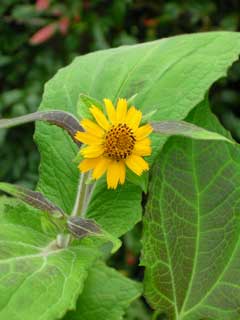
 Polymnia edulis is a PERENNIAL growing to 1 m (3ft 3in) by 0.6 m (2ft) at a fast rate.
See above for USDA hardiness. It is hardy to UK zone 8 and is frost tender. The species is hermaphrodite (has both male and female organs) and is pollinated by Insects.
Suitable for: light (sandy), medium (loamy) and heavy (clay) soils and can grow in nutritionally poor soil. Suitable pH: mildly acid, neutral and basic (mildly alkaline) soils. It cannot grow in the shade. It prefers moist soil.
UK Hardiness Map
US Hardiness Map
Synonyms
Polymnia sonchifolia. Smallanthus sonchifolius
Plant Habitats
Woodland Garden Sunny Edge; Cultivated Beds;
Edible Uses
Edible Parts: Leaves Root
Edible Uses: Drink Sweetener
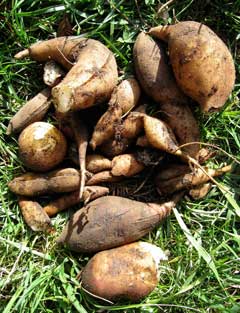
Root - raw or cooked[1, 22, 46, 61]. When first harvested, the root can taste somewhat starchy[K], but it soon becomes sweet, crisp and juicy and is delicious eaten raw[196, K]. The flavour is further improved by exposure to the sun although some of the crispness will be lost[97, 183, K]. The root can be eaten like a fruit or diced and added to salads[183]. The skin has a somewhat resinous taste so it is usually removed[196]. The cooked root retains is sweetness and crispness[196]. Individual roots can weigh up to 500g[196]. The nutritional value is low because the root contains a high quantity of inulin, a carbohydrate that the human body cannot utilize[196]. The grated pulp of the root is squeezed through a cloth to yield a sweet refreshing drink[183]. This juice can be concentrated to form dark brown blocks of sugar called 'chancaca' in S. America[183, 196]. Leaves and stems - cooked as a vegetable[183, 196]. They contain 11 - 17% protein, dry weight[196].
References More on Edible Uses
Medicinal Uses
Plants For A Future can not take any responsibility for any adverse effects from the use of plants. Always seek advice from a professional before using a plant medicinally.
None known
References More on Medicinal Uses
The Bookshop: Edible Plant Books
Our Latest books on Perennial Plants For Food Forests and Permaculture Gardens in paperback or digital formats.

Edible Tropical Plants
Food Forest Plants for Hotter Conditions: 250+ Plants For Tropical Food Forests & Permaculture Gardens.
More

Edible Temperate Plants
Plants for Your Food Forest: 500 Plants for Temperate Food Forests & Permaculture Gardens.
More

More Books
PFAF have eight books available in paperback and digital formats. Browse the shop for more information.
Shop Now
Other Uses
References More on Other Uses
Cultivation details
For best results, this plant requires a warm position in a deep rich soil[1], though it survives even when growing in poor soils[196]. Plants are fast-growing[196]. In S. America, they succeed in areas with annual rainfall varying from 900 - 3500mm[196], though are likely to succeed with less rain in temperate zones. The yacon is cultivated for its edible tuber in the Andes, and is sometimes used in sub-tropical summer bedding schemes in Britain, though it is not very hardy[1]. The top growth is killed back by frost but the tubers can tolerate at least light frosts[196]. Plants are unaffected by day-length and so can produce good yields of roots in temperate zones[196]. One report says that plants take 6 - 7 months to produce a crop from planting out[196], though on our Cornwall trial ground they have cropped quite well with a 5 month growing period[K]. The roots are brittle and must be harvested with care to avoid damage[196]. Yields of 38 tonnes per hectare have been recorded in South America[196], whilst yields of over 2 kilos per plant have been achieved outdoors in Cornwall[K]. The harvested roots can be stored for several months[196]. Plants have not been selected for flavour or yield, some roots can be exceedingly sweet whilst others are fairly bland[196]. Plants might be useful in agroforestry because they succeed under trees[196], though in the relatively sunless climes of Britain the plants are not likely to do well in the shade of trees[K].
References Carbon Farming Information and Carbon Sequestration Information
Temperature Converter
Type a value in the Celsius field to convert the value to Fahrenheit:
Fahrenheit:
The PFAF Bookshop
Plants For A Future have a number of books available in paperback and digital form. Book titles include Edible Plants, Edible Perennials, Edible Trees,Edible Shrubs, Woodland Gardening, and Temperate Food Forest Plants. Our new book is Food Forest Plants For Hotter Conditions (Tropical and Sub-Tropical).
Shop Now
Plant Propagation
Seed - sow mid winter in a warm greenhouse and only just cover the seed[1]. Prick out the seedlings into individual pots as soon as they are large enough to handle and plant them out after the last expected frosts. Consider giving them some protection such as a cloche until they are growing away well. Plants do not usually produce flowers in Britain and therefore seed has to be obtained from other countries[K]. Division in autumn. The plant forms 2 distinct types of tuber. Large tubers, usually on thin roots 2 - 5cm long, are used as storage organs and do not have the capacity to form new shoots. These are the tubers that are usually eaten. Smaller tubers are formed in a cluster around the stem. These form the shoots for the following year's growth and so are the ones that should be stored. Dig up the plants in the autumn once the top growth has been cut down by frost. Remove the large tubers for food, cut the main stems back to about 10cm long and store these stems with their cluster of small tubers in a cool frost-free place. Do not let them dry out. Pot them up in early spring in a greenhouse. When they come into active growth divide each cluster into individual shoots with their tubers attached and repot these. Plant them out in late spring after the last expected frosts[K]. Cuttings of basal shoots in early spring in a warm greenhouse[1]. Harvest the shoots with plenty of underground stem when they are about 8 - 10cm above the ground. Pot them up into individual pots and keep them in light shade in a cold frame or greenhouse until they are rooting well. Plant them out in the summer.
Other Names
If available other names are mentioned here
Native Plant Search
Search over 900 plants ideal for food forests and permaculture gardens. Filter to search native plants to your area. The plants selected are the plants in our book 'Plants For Your Food Forest: 500 Plants for Temperate Food Forests and Permaculture Gardens, as well as plants chosen for our forthcoming related books for Tropical/Hot Wet Climates and Mediterranean/Hot Dry Climates. Native Plant Search
Found In
Countries where the plant has been found are listed here if the information is available
Weed Potential
Right plant wrong place. We are currently updating this section.
Please note that a plant may be invasive in one area but may not in your area so it’s worth checking.
Conservation Status
IUCN Red List of Threatened Plants Status :

Growth: S = slow M = medium F = fast. Soil: L = light (sandy) M = medium H = heavy (clay). pH: A = acid N = neutral B = basic (alkaline). Shade: F = full shade S = semi-shade N = no shade. Moisture: D = dry M = Moist We = wet Wa = water.

Expert comment
Author
Wedd.
Botanical References
1
Links / References
For a list of references used on this page please go here
Readers comment