 |
|
http://commons.wikimedia.org/wiki/File:Koeh-106.jpg |
 |
| http://commons.wikimedia.org/wiki/User:Leo_Johannes |
Translate this page:
Summary
Bloom Color: Yellow. Main Bloom Time: Early spring, Late spring, Mid spring. Form: Oval, Pyramidal.
Physical Characteristics

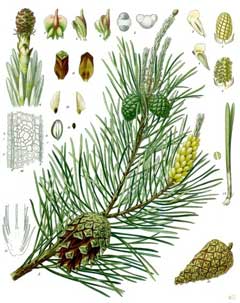
 Pinus sylvestris is an evergreen Tree growing to 25 m (82ft) by 10 m (32ft) at a fast rate.
See above for USDA hardiness. It is hardy to UK zone 2. It is in leaf all year, in flower in May, and the seeds ripen from March to June. The species is monoecious (individual flowers are either male or female, but both sexes can be found on the same plant) and is pollinated by Wind. The plant is not self-fertile.
It is noted for attracting wildlife.
Suitable for: light (sandy) and medium (loamy) soils, prefers well-drained soil and can grow in nutritionally poor soil. Suitable pH: mildly acid, neutral and basic (mildly alkaline) soils and can grow in very acid and very alkaline soils.
It can grow in semi-shade (light woodland) or no shade. It prefers dry moist or wet soil and can tolerate drought. The plant can tolerate maritime exposure.
It can tolerate atmospheric pollution.
UK Hardiness Map
US Hardiness Map
Synonyms
P. rubra. Mill.
Plant Habitats
Woodland Garden Canopy; Bog Garden;
Edible Uses
Edible Parts: Inner bark
Edible Uses: Condiment
Inner bark - dried and ground into a powder and used in making bread[2, 66, 105, 177]. It is often mixed with oatmeal[115]. A famine food, it is only used when all else fails[115]. A vanillin flavouring is obtained as a by-product of other resins that are released from the pulpwood[200].
References More on Edible Uses
Medicinal Uses
Plants For A Future can not take any responsibility for any adverse effects from the use of plants. Always seek advice from a professional before using a plant medicinally.
Antirheumatic Antiseptic Aromatherapy Bach Balsamic Diuretic Expectorant
Scot's pine has quite a wide range of medicinal uses, being valued especially for its antiseptic action and beneficial effect upon the respiratory system. It should not be used by people who are prone to allergic skin reactions whilst the essential oil should not be used internally unless under professional supervision[254]. The turpentine obtained from the resin is antirheumatic, antiseptic, balsamic, diuretic, expectorant, rubefacient and vermifuge[4, 13, 46]. It is a valuable remedy in the treatment of kidney, bladder and rheumatic affections, and also in diseases of the mucous membranes and the treatment of respiratory complaints[4]. Externally it is used in the form of liniment plasters and inhalers[4]. The leaves and young shoots are antiseptic, diuretic and expectorant[9]. They are harvested in the spring and dried for later use[9]. They are used internally for their mildly antiseptic effect within the chest and are also used to treat rheumatism and arthritis[254]. They can be added to the bath water for treating fatigue, nervous exhaustion, sleeplessness, skin irritations[9]. They can also be used as an inhalant in the treatment of various chest complaints[9]. The essential oil from the leaves is used in the treatment of asthma, bronchitis and other respiratory infections, and also for digestive disorders such as wind[254]. An essential oil obtained from the seed has diuretic and respiratory-stimulant properties[254]. The seeds are used in the treatment of bronchitis, tuberculosis and bladder infections[254]. A decoction of the seeds can be applied externally to help suppress excessive vaginal discharge[254]. The plant is used in Bach flower remedies - the keywords for prescribing it are 'Self-reproach', 'Guilt feelings' and 'Despondency'[209]. The essential oil is used in aromatherapy. Its keyword is 'Invigorating'[210].
References More on Medicinal Uses
The Bookshop: Edible Plant Books
Our Latest books on Perennial Plants For Food Forests and Permaculture Gardens in paperback or digital formats.
Edible Tropical Plants
Food Forest Plants for Hotter Conditions: 250+ Plants For Tropical Food Forests & Permaculture Gardens.
More
Edible Temperate Plants
Plants for Your Food Forest: 500 Plants for Temperate Food Forests & Permaculture Gardens.
More
More Books
PFAF have eight books available in paperback and digital formats. Browse the shop for more information.
Shop Now
Other Uses
Dye Essential Fibre Fuel Herbicide Lighting Packing Resin Shelterbelt Wood
A tan or green dye is obtained from the needles[168]. The needles contain a substance called terpene, this is released when rain washes over the needles and it has a negative effect on the germination of some plants, including wheat[201]. A reddish yellow dye is obtained from the cones[6]. This tree yields resin and turpentine[64, 66, 100, 171]. Oleo-resins are present in the tissues of all species of pines, but these are often not present in sufficient quantity to make their extraction economically worthwhile[64]. The resins are obtained by tapping the trunk, or by destructive distillation of the wood[4, 64]. In general, trees from warmer areas of distribution give the higher yields[64]. Turpentine consists of an average of 20% of the oleo-resin[64] and is separated by distillation[4, 64]. Turpentine has a wide range of uses including as a solvent for waxes etc, for making varnish, medicinal etc[4]. Rosin is the substance left after turpentine is removed. This is used by violinists on their bows and also in making sealing wax, varnish etc[4]. Pitch can also be obtained from the resin and is used for waterproofing, as a wood preservative etc. An essential oil obtained from the leaves is used in perfumery and medicinally[46, 61]. A fibre from the inner bark is used to make ropes[115]. The roots are very resinous and burn well. They can be used as a candle substitute[115]. The leaves are used as a packing material[46]. The fibrous material is stripped out of the leaves and is used to fill pillows, cushions and as a packing material[7]. Trees are very wind resistant and quite fast growing. They can be planted as a shelterbelt, succeeding in maritime exposure[75, 200]. Wood - light, soft, not strong, elastic, durable, rich in resin. Used in construction, furniture, paper manufacture etc.[13, 46, 100]. A good fuel but it is somewhat smokey[6, 66, 115].
Special Uses
Attracts Wildlife Carbon Farming Food Forest Scented Plants
References More on Other Uses
Cultivation details
Industrial Crop: Hydrocarbon Management: Standard Regional Timber
Landscape Uses:Christmas tree, Specimen. Thrives in a light well-drained sandy or gravelly loam[1, 11]. Trees grow well on poor dry sandy soils[11, 81]. Fairly shade tolerant[186]. Prefers a light acid soil, becoming chlorotic at a pH higher than 6.5[186]. Trees can succeed for many years on shallow soils over chalk[185]. Tolerates chalk for a while, but trees are then short-lived[81]. Tolerates some water-logging[186]. Dislikes poorly drained moorland soils[1]. Established plants tolerate drought[186]. Very wind resistant[49, 75], tolerating maritime exposure[166]. Tolerates atmospheric pollution[226]. Fairly long-lived, to 200 years or more and quite fast growing[185], but trees are very slow growing in wet soils[81]. Young trees can make new growth of 1 metre a year though growth slows down rapidly by the time the tree is 18 metres tall[185]. This species is extensively used in cool temperate forestry as a timber tree[200]. Plants are strongly outbreeding, self-fertilized seed usually grows poorly[200]. They hybridize freely with other members of this genus[200]. Cones take two seasons to ripen[7]. Plants are easily killed by fire and cannot regenerate from the roots[186]. A good food plant for the caterpillars of several species of butterflies[30]. This tree has over 50 species of associated insects[81]. Leaf secretions inhibit the germination of seeds, thereby reducing the amount of plants that can grow under the trees[18]. There are several named forms selected for their ornamental value[188]. Plants in this genus are notably susceptible to honey fungus[200]. Special Features:
Not North American native, Naturalizing, Inconspicuous flowers or blooms.
Carbon Farming
-
Industrial Crop: Hydrocarbon
Materials, chemicals and energy include bioplastics, rubber, biomass products gasoline, jet fuel, diesel, butane, propane, biogas. Plants are usually resprouting plants and saps.
-
Management: Standard
Plants grow to their standard height. Harvest fruit, seeds, or other products. Non-Destructive management systems.
-
Regional Timber
These crops have been domesticated and cultivated regionally but have not been adopted elsewhere and are typically not traded globally.
References Carbon Farming Information and Carbon Sequestration Information
Temperature Converter
Type a value in the Celsius field to convert the value to Fahrenheit:
Fahrenheit:
The PFAF Bookshop
Plants For A Future have a number of books available in paperback and digital form. Book titles include Edible Plants, Edible Perennials, Edible Trees,Edible Shrubs, Woodland Gardening, and Temperate Food Forest Plants. Our new book is Food Forest Plants For Hotter Conditions (Tropical and Sub-Tropical).
Shop Now
Plant Propagation
It is best to sow the seed in individual pots in a cold frame as soon as it is ripe if this is possible otherwise in late winter. A short stratification of 6 weeks at 4°c can improve the germination of stored seed[80]. Plant seedlings out into their permanent positions as soon as possible and protect them for their first winter or two[11]. Plants have a very sparse root system and the sooner they are planted into their permanent positions the better they will grow[K]. Trees should be planted into their permanent positions when they are quite small, between 30 and 90cm[200]. We actually plant them out when they are about 5 - 10cm tall. So long as they are given a very good weed-excluding mulch they establish very well[K]. Larger trees will check badly and hardly put on any growth for several years. This also badly affects root development and wind resistance[200]. Cuttings. This method only works when taken from very young trees less than 10 years old. Use single leaf fascicles with the base of the short shoot. Disbudding the shoots some weeks before taking the cuttings can help. Cuttings are normally slow to grow away[81].
Other Names
If available other names are mentioned here
Native Plant Search
Search over 900 plants ideal for food forests and permaculture gardens. Filter to search native plants to your area. The plants selected are the plants in our book 'Plants For Your Food Forest: 500 Plants for Temperate Food Forests and Permaculture Gardens, as well as plants chosen for our forthcoming related books for Tropical/Hot Wet Climates and Mediterranean/Hot Dry Climates. Native Plant Search
Found In
Countries where the plant has been found are listed here if the information is available
Weed Potential
Right plant wrong place. We are currently updating this section.
Please note that a plant may be invasive in one area but may not in your area so it’s worth checking.
Conservation Status
IUCN Red List of Threatened Plants Status :

| Related Plants
|
| Latin Name | Common Name | Habit | Height | Hardiness | Growth | Soil | Shade | Moisture | Edible | Medicinal | Other |
| Acinos alpinus | Alpine Calamint | Perennial | 0.5 |
4-8
| | LMH | N | DM | 1 | 1 | |
| Carpinus betulus | Hornbeam, European hornbeam, Common Hornbeam, European Hornbeam | Tree | 25.0 |
5-7
| M | LMH | FSN | M | 0 | 2 | 3 |
| Carpinus caroliniana | American Hornbeam, Blue Beech, Ironwood, American Hornbeam | Tree | 12.0 |
3-9
| S | LMH | SN | M | 1 | 1 | 2 |
| Carpinus cordata | | Tree | 15.0 |
4-8
| S | LMH | SN | M | 0 | 0 | 2 |
| Carpinus laxiflora | | Tree | 15.0 |
4-8
| | LMH | SN | M | 0 | 0 | 2 |
| Lupinus albus | White Lupin | Annual | 1.2 |
0-0
| | LM | N | M | 4 | 1 | 4 |
| Lupinus albus graecus | | Annual | 1.0 |
0-0
| | LMH | N | DM | 4 | 0 | 3 |
| Lupinus angustifolius | Blue Lupin, Narrowleaf lupine | Annual | 1.0 |
7-9
| | LM | N | M | 4 | 0 | 4 |
| Lupinus arboreus | Tree Lupin, Yellow bush lupine | Shrub | 1.5 |
7-10
| F | LM | N | DM | 0 | 0 | 5 |
| Lupinus hirsutus | | Annual | 0.0 |
0-0
| | LMH | N | M | 2 | 0 | 3 |
| Lupinus littoralis | Seashore Lupine | Perennial | 0.5 |
6-9
| | LMH | N | M | 2 | 0 | 3 |
| Lupinus luteus | Yellow Lupin, European yellow lupine | Annual | 0.6 |
5-9
| | LM | N | M | 3 | 0 | 3 |
| Lupinus mutabilis | Pearl Lupin, Tarwi | Annual | 1.5 |
8-11
| | LMH | N | M | 5 | 0 | 4 |
| Lupinus nootkatensis | Blue Lupine, Nootka lupine | Perennial | 0.7 |
4-8
| | LMH | N | M | 3 | 0 | 3 |
| Lupinus perennis | Sundial Lupine | Perennial | 0.6 |
4-8
| | LM | N | DM | 3 | 1 | 3 |
| Lupinus polyphyllus | Big-Leaf Lupin, Lupine | Perennial | 1.5 |
5-9
| M | LMH | N | M | 1 | 1 | 4 |
| Lupinus tauris | | Shrub | 0.0 |
0-0
| | LM | N | DM | 0 | 0 | 3 |
| Lupinus termis | White Lupin | Annual | 1.0 |
0-0
| | LMH | N | M | 2 | 0 | 3 |
| Phyllocladus alpinus | Alpine Celery Pine | Shrub | 9.0 |
7-10
| S | LMH | SN | M | 0 | 0 | 1 |
| Pinus albicaulis | White-Bark Pine | Tree | 20.0 |
4-8
| S | LM | N | DM | 4 | 2 | 3 |
| Pinus aristata | Bristle-Cone Pine | Tree | 12.0 |
3-10
| S | LM | N | DM | 2 | 2 | 2 |
| Pinus armandii | Chinese White Pine, Armand pine | Tree | 15.0 |
6-9
| M | LM | N | DM | 4 | 2 | 2 |
| Pinus ayacahuite | Mexican White Pine | Tree | 55.0 |
6-9
| | LM | N | DM | 2 | 2 | 3 |
| Pinus banksiana | Jack Pine | Tree | 12.0 |
2-7
| F | LM | N | DM | 2 | 2 | 3 |
| Pinus brutia | Calabrian pine, Turkish pine | Tree | 30.0 |
7-11
| F | LMH | N | DM | 2 | 3 | 3 |
| Pinus bungeana | Lace-Bark Pine, Bunge's pine | Tree | 10.0 |
4-7
| S | LM | N | DM | 3 | 2 | 3 |
| Pinus californiarum | | Tree | 10.0 |
8-11
| | LM | N | DM | 1 | 2 | 3 |
| Pinus caribaea | Caribbean Pine. Caribbean pitch pine | Tree | 30.0 |
10-12
| F | LM | N | DM | 2 | 2 | 3 |
| Pinus cembra | Swiss Stone Pine, Swiss Pine, Arolla Pine | Tree | 15.0 |
3-9
| S | LMH | SN | DM | 4 | 2 | 3 |
| Pinus cembra sibirica | Siberian Pine | Tree | 30.0 |
1-6
| S | LM | N | DM | 4 | 2 | 3 |
|
|
Growth: S = slow M = medium F = fast. Soil: L = light (sandy) M = medium H = heavy (clay). pH: A = acid N = neutral B = basic (alkaline). Shade: F = full shade S = semi-shade N = no shade. Moisture: D = dry M = Moist We = wet Wa = water.

Expert comment
Author
L.
Botanical References
1117200
Links / References
For a list of references used on this page please go here
Readers comment