 |
|
http://commons.wikimedia.org/wiki/User:Traumrune |
 |
| http://commons.wikimedia.org/wiki/User:Llez |
Translate this page:
Summary
Physical Characteristics

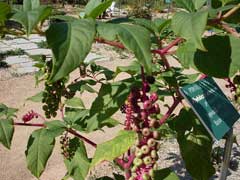
 Phytolacca americana is a PERENNIAL growing to 2 m (6ft) by 1.5 m (5ft) at a fast rate.
See above for USDA hardiness. It is hardy to UK zone 4 and is not frost tender. It is in flower from August to September, and the seeds ripen from September to November. The species is hermaphrodite (has both male and female organs).
Suitable for: light (sandy), medium (loamy) and heavy (clay) soils. Suitable pH: mildly acid, neutral and basic (mildly alkaline) soils. It can grow in semi-shade (light woodland) or no shade. It prefers moist soil.
UK Hardiness Map
US Hardiness Map
Synonyms
P. decandra.
Plant Habitats
Woodland Garden Sunny Edge; Dappled Shade; Cultivated Beds;
Edible Uses
Edible Parts: Fruit Leaves Shoots
Edible Uses: Colouring
Leaves - they must be cooked and even then it is best to change the water once[1, 2, 4, 33, 95]. They are used like spinach[183]. Only the young leaves should be used since they become toxic with age[102]. Caution is advised, see the notes above on toxicity. Young shoots - cooked[20, 33, 62, 102]. An asparagus substitute[183], they are delicious[159]. The shoots are sometimes blanched before using, or forced in cellars to provide an early crop[183]. The tender clear inner portion of the stem can be rolled in cornmeal and fried[183]. Although cultivated on a small scale in N. America for its shoots, caution is advised, see notes above. A nutritional analysis is available[218]. Fruit - cooked and used in pies[159, 213]. Poisonous raw, causing vomiting and diarrhoea. Even the cooked fruits should be viewed with caution. The fruit is a berry about 12mm in diameter[200]. A red dye is obtained from the fruit and used as a food colouring[183].
References More on Edible Uses
| Composition
|
| Figures in grams (g) or miligrams (mg) per 100g of food.
|
|
|
Shoots (Dry weight)
|
|
- 274 Calories per 100g
- Water : 0%
- Protein: 31g; Fat: 4.8g; Carbohydrate: 44g; Fibre: 0g; Ash: 20.2g;
- Minerals - Calcium: 631mg; Phosphorus: 524mg; Iron: 20.2mg; Magnesium: 0mg; Sodium: 0mg; Potassium: 0mg; Zinc: 0mg;
- Vitamins - A: 62mg; Thiamine (B1): 0.95mg; Riboflavin (B2): 3.93mg; Niacin: 14.3mg; B6: 0mg; C: 1619mg;
- Reference: [ 218]
- Notes:
|
|
Medicinal Uses
Plants For A Future can not take any responsibility for any adverse effects from the use of plants. Always seek advice from a professional before using a plant medicinally.
Alterative Anodyne Antiinflammatory Antirheumatic Antiviral Cancer Cathartic Dysentery
Expectorant Homeopathy Hypnotic Narcotic Purgative
Pokeweed has a long history of medicinal use, being employed traditionally in the treatment of diseases related to a compromised immune system. The plant has an interesting chemistry and it is currently (1995) being investigated as a potential anti-AIDS drug[238]. It contains potent anti-inflammatory agents, antiviral proteins and substances that affect cell division[238]. These compounds are toxic to many disease-causing organisms, including the water snails that cause schistosomiasis[238]. All parts of the plant are toxic, an excess causing diarrhoea and vomiting[238]. This remedy should be used with caution and preferably under the supervision of a qualified practitioner. It should not be prescribed for pregnant women[238]. The root is alterative, anodyne, anti-inflammatory, cathartic, expectorant, hypnotic, narcotic and purgative[4, 21, 46, 61, 165, 192, 238]. The dried root is used as an anodyne and anti-inflammatory[213]. The root is taken internally in the treatment of auto-immune diseases (especially rheumatoid arthritis), tonsillitis, mumps, glandular fever and other complaints involving swollen glands, chronic catarrh, bronchitis etc[238]. The fresh root is used as a poultice on bruises, rheumatic pains etc, whilst a wash made from the roots is applied to swellings and sprains[222]. The root is best harvested in the autumn and can be dried for later use[238]. The fruit has a similar but milder action to the roots[238].The juice is used in the treatment of cancer, haemorrhoids and tremors[213]. A poultice made from the fruit is applied to sore breasts[222]. A tea made from the fruit is used in the treatment of rheumatism, dysentery etc[222]. The plant has an unusually high potassium content and the ashes, which contain over 45% caustic potash, have been used as a salve for ulcers and cancerous growths[232]. The leaves are cathartic, emetic and expectorant[222]. A homeopathic remedy is made from the fresh root[232]. Its main action is on the throat, breast, muscular tissues and the joints[232].
References More on Medicinal Uses
The Bookshop: Edible Plant Books
Our Latest books on Perennial Plants For Food Forests and Permaculture Gardens in paperback or digital formats.

Edible Tropical Plants
Food Forest Plants for Hotter Conditions: 250+ Plants For Tropical Food Forests & Permaculture Gardens.
More

Edible Temperate Plants
Plants for Your Food Forest: 500 Plants for Temperate Food Forests & Permaculture Gardens.
More

More Books
PFAF have eight books available in paperback and digital formats. Browse the shop for more information.
Shop Now
Other Uses
Ink Insecticide Soap
A red ink and a dye are obtained from the fruit[46, 50, 57, 100, 102, 159, 169]. A beautiful colour, though it is not very permanent[4]. It makes a good body paint, washing off easily when no longer required, though the slightly toxic nature of the berries should be remembered[K]. The rootstock is rich in saponins and can be used as a soap substitute[169]. Cut the root into small pieces and simmer it in boiling water to obtain the soap. The plant is currently (1980) being evaluated for its snail-killing properties[213].
Special Uses
Food Forest
References More on Other Uses
Cultivation details
An easily grown plant, succeeding in most soils[1], though preferring a moisture retentive soil in full sun or partial shade[111, 200]. Plants can be grown in quite coarse grass, which can be cut annually in the autumn[233]. Succeeds in an open woodland garden[200], growing well under trees[20]. Whilst the dormant plant is hardy in much of Britain, the young growth in spring can be damaged by late frosts. A very ornamental plant[1], it often self sows when in a suitable position[200]. Cultivated as a dye plant[50] and on a small scale for its edible young shoots, there is at least one named form. 'White Stem' has white stems and the berries yield a golden-peach dye instead of purple. It is not yet known (1992) if it will breed true from seed[183]. This plant is an alternative host to a number of viral diseases that affect members of the Amaryllidaceae, Liliaceae (broad view, including plants recently [1992] moved into separate families) and Solanaceae[200]. Plants seem to be immune to the predations of rabbits[233]. The plant is heat tolerant in zones 9 through 5. (Plant Hardiness Zones show how well plants withstand cold winter temperatures.
Plant Heat Zones show when plants would start suffering from the heat.
The Plant Heat Zone map is based on the number of "heat days" experienced in a given area where the temperature climbs to over 86 degrees F (30°C).
At this temperature, many plants begin to suffer physiological damage. Heat Zones range from 1 (no heat days) to 12 (210 or more heat days).
For example Heat Zone. 11-1 indicates that the plant is heat tolerant in zones 11 through 1.) For polyculture design as well as the above-ground architecture (form - tree, shrub etc. and size shown above) information on the habit and root pattern is also useful and given here if available. The plant growth habit is a clumper with limited spread [1-2].
References Carbon Farming Information and Carbon Sequestration Information
Temperature Converter
Type a value in the Celsius field to convert the value to Fahrenheit:
Fahrenheit:
The PFAF Bookshop
Plants For A Future have a number of books available in paperback and digital form. Book titles include Edible Plants, Edible Perennials, Edible Trees,Edible Shrubs, Woodland Gardening, and Temperate Food Forest Plants. Our new book is Food Forest Plants For Hotter Conditions (Tropical and Sub-Tropical).
Shop Now
Plant Propagation
Seed - sow autumn or spring in a cold frame[200]. When they are large enough to handle, prick the seedlings out into individual pots and grow them on in the greenhouse for their first winter. Plant them out into their permanent positions in late spring or early summer, after the last expected frosts. If you have sufficient seed, it might be worthwhile trying an outdoor sowing in a seed bed in early spring. Grow the plants on in the seedbed for their first year and plant them out the following spring. Division in March or October. Use a sharp spade or knife to divide the rootstock, making sure that each section has at least one growth bud. Very easy, larger divisions can be planted out direct into their permanent positions. We have found that it is better to pot up the smaller divisions and grow them on in light shade in a cold frame until they are well established before planting them out in late spring or early summer.
Other Names
If available other names are mentioned here
Native Plant Search
Search over 900 plants ideal for food forests and permaculture gardens. Filter to search native plants to your area. The plants selected are the plants in our book 'Plants For Your Food Forest: 500 Plants for Temperate Food Forests and Permaculture Gardens, as well as plants chosen for our forthcoming related books for Tropical/Hot Wet Climates and Mediterranean/Hot Dry Climates. Native Plant Search
Found In
Countries where the plant has been found are listed here if the information is available
Weed Potential
Right plant wrong place. We are currently updating this section.
Please note that a plant may be invasive in one area but may not in your area so it’s worth checking.
Conservation Status
IUCN Red List of Threatened Plants Status :

Growth: S = slow M = medium F = fast. Soil: L = light (sandy) M = medium H = heavy (clay). pH: A = acid N = neutral B = basic (alkaline). Shade: F = full shade S = semi-shade N = no shade. Moisture: D = dry M = Moist We = wet Wa = water.

Expert comment
Author
L.
Botanical References
43200274
Links / References
For a list of references used on this page please go here
Readers comment