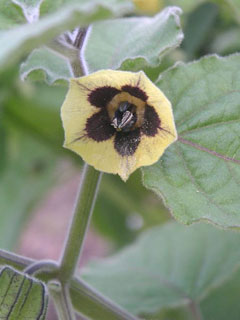
 |
|
http://commons.wikimedia.org/wiki/User:Carstor |
 |
| http://commons.wikimedia.org/wiki/File:Physalis_Nahaufnahme.JPG |
Translate this page:
Summary
Physical Characteristics

 Physalis peruviana is a PERENNIAL growing to 1.2 m (4ft).
See above for USDA hardiness. It is hardy to UK zone 8 and is frost tender. It is in flower from July to October, and the seeds ripen from August to November. The species is hermaphrodite (has both male and female organs) and is pollinated by Bees, wind.
Suitable for: light (sandy), medium (loamy) and heavy (clay) soils, prefers well-drained soil and can grow in nutritionally poor soil. Suitable pH: mildly acid, neutral and basic (mildly alkaline) soils and can grow in very acid and very alkaline soils.
It can grow in semi-shade (light woodland) or no shade. It prefers moist soil.
UK Hardiness Map
US Hardiness Map
Synonyms
Plant Habitats
Woodland Garden Sunny Edge; Cultivated Beds; South Wall. By. West Wall. By.
Edible Uses
Edible Parts: Fruit
Edible Uses:
Fruit - raw or cooked in pies, cakes, jellies, compotes, jams etc[1, 2, 3, 34, 183]. A delicious bitter-sweet flavour, it has smaller but sweeter fruits than the cultivar 'Edulis'[K]. The dried fruit can be used as a raisin substitute, though it is not so sweet[183]. The plant conveniently wraps up each fruit in its own 'paper bag' (botanically, the calyx) to protect it from pests and the elements. This calyx is toxic and should not be eaten. The fruit is rich in vitamin A (3000 I.U. of carotene per 100g), vitamin C and some of the B complex (thiamine, niacin and B12)[196]. The protein and phosphorus levels are exceptionally high for a fruit[196]. The fruit is a berry about 2cm in diameter[200]. The dried fruit is said to be a substitute for yeast[183]. If picked carefully with the calyx intact, the fruit can be stored for 3 months or more[196]. The fruit is about 2cm in diameter[196].
References More on Edible Uses
Medicinal Uses
Plants For A Future can not take any responsibility for any adverse effects from the use of plants. Always seek advice from a professional before using a plant medicinally.
Diuretic Vermifuge Vitamin C
The leaf juice has been used in the treatment of worms and bowel complaints[240]. The plant is diuretic[240].
References More on Medicinal Uses
The Bookshop: Edible Plant Books
Our Latest books on Perennial Plants For Food Forests and Permaculture Gardens in paperback or digital formats.
Edible Tropical Plants
Food Forest Plants for Hotter Conditions: 250+ Plants For Tropical Food Forests & Permaculture Gardens.
More
Edible Temperate Plants
Plants for Your Food Forest: 500 Plants for Temperate Food Forests & Permaculture Gardens.
More
More Books
PFAF have eight books available in paperback and digital formats. Browse the shop for more information.
Shop Now
Other Uses
References More on Other Uses
Cultivation details
Succeeds in a sheltered position in any well-drained soil in full sun or light shade[196, 200]. Prefers a rich loam[38] but tolerates poor soils[196]. If the soil is too rich it encourages leaf production at the expense of fruiting[196]. Plants tolerate a pH in the range 4.5 to 8.2[196]. The Cape Gooseberry is an evergreen shrub in its native environment. It is not very cold-hardy in Britain, however, though it can succeed outdoors as a herbaceous perennial in the mildest areas of the country or when grown in favoured positions such as the foot of a sunny wall. Some cultivars will tolerate temperatures down to about -10° when grown in this way[K]. It would be wise to apply a good protective mulch to the roots in late autumn after the top growth has been cut back by frosts. In most areas of Britain, however, it needs to be grown as an annual in much the same way as tomatoes. The plant is usually naturally bushy, but it can be useful to pinch out the growing tip whilst the shoots are less than 30cm tall in order to encourage side shoots[K]. This species is often cultivated for its edible fruit in warm temperate and tropical zones, there are some named varieties[3, 183]. 'Edulis' is the most common cultivar in Britain, it has considerably larger fruits than the species but these do not have quite such a good flavour[K]. Yields of 20 tonnes per hectare are common in S. America, 33 tonnes has been achieved[196].
References Carbon Farming Information and Carbon Sequestration Information
Temperature Converter
Type a value in the Celsius field to convert the value to Fahrenheit:
Fahrenheit:
The PFAF Bookshop
Plants For A Future have a number of books available in paperback and digital form. Book titles include Edible Plants, Edible Perennials, Edible Trees,Edible Shrubs, Woodland Gardening, and Temperate Food Forest Plants. Our new book is Food Forest Plants For Hotter Conditions (Tropical and Sub-Tropical).
Shop Now
Plant Propagation
Seed - sow March/April in a greenhouse only just covering the seed. Germination usually takes place quickly and freely. Prick out the seedlings into individual pots of fairly rich soil when they are large enough to handle and plant them out after the last expected frosts. Consider giving them some protection such as a cloche until they are growing away well. Diurnal temperature fluctuations assist germination[170]. Division in spring[111]. This is best done without digging up the plant. Remove young shoots that are growing out from the side of the clump, making sure that some of the below ground shoot is also removed. It is best if this has some roots on, but the shoot should form new roots fairly quickly if it is potted up and kept for a few weeks in a shady but humid part of the greenhouse[K].
Other Names
If available other names are mentioned here
Native Plant Search
Search over 900 plants ideal for food forests and permaculture gardens. Filter to search native plants to your area. The plants selected are the plants in our book 'Plants For Your Food Forest: 500 Plants for Temperate Food Forests and Permaculture Gardens, as well as plants chosen for our forthcoming related books for Tropical/Hot Wet Climates and Mediterranean/Hot Dry Climates. Native Plant Search
Found In
Countries where the plant has been found are listed here if the information is available
Weed Potential
Right plant wrong place. We are currently updating this section.
Please note that a plant may be invasive in one area but may not in your area so it’s worth checking.
Conservation Status
IUCN Red List of Threatened Plants Status :

| Related Plants
|
| Latin Name | Common Name | Habit | Height | Hardiness | Growth | Soil | Shade | Moisture | Edible | Medicinal | Other |
| Physalis acutifolia | Sharp-Leaf Ground Cherry | Annual | 0.0 |
0-0
| | LMH | SN | M | 2 | 0 | 0 |
| Physalis alkekengi | Winter Cherry, Strawberry groundcherry,Ground Cherry, Chinese Lantern | Perennial | 0.3 |
6-9
| F | LMH | SN | M | 2 | 2 | |
| Physalis alkekengi franchetii | Winter Cherry | Perennial | 0.5 |
5-9
| | LMH | SN | M | 2 | 2 | 2 |
| Physalis angulata | Cutleaf Ground Cherry | Annual | 0.8 |
0-0
| | LMH | SN | M | 3 | 1 | 0 |
| Physalis angustifolia | Coastal groundcherry | Perennial | 0.0 |
0-0
| | LMH | N | M | 2 | 0 | |
| Physalis arenicola | Cypresshead groundcherry | Perennial | 0.0 |
0-0
| | LMH | N | M | 2 | 0 | |
| Physalis carpenteri | Carpenter's groundcherry | Annual | 0.0 |
0-0
| | LMH | N | M | 2 | 0 | |
| Physalis caudella | Southwestern groundcherry | Perennial | 0.0 |
0-0
| | LMH | N | M | 2 | 0 | |
| Physalis crassifolia | Yellow nightshade groundcherry | Perennial | 0.3 |
0-0
| | LMH | N | DM | 2 | 0 | |
| Physalis foetens | | Annual | 0.6 |
-
| | LMH | N | M | 2 | 0 | |
| Physalis foetens neomexicana | | Annual | 0.6 |
-
| | LMH | N | DM | 2 | 0 | |
| Physalis greenei | | Annual | 0.3 |
-
| | LMH | N | DM | 2 | 0 | |
| Physalis hederaefolia cordifolia | Ground Cherry | Perennial | 0.3 |
-
| | LMH | SN | DM | 2 | 0 | |
| Physalis heterophylla | Clammy Ground Cherry, Rowell's groundcherry | Perennial | 0.9 |
7-10
| | LMH | SN | DM | 3 | 1 | 0 |
| Physalis ixocarpa | Tomatillo | Annual | 1.2 |
7-10
| | LMH | SN | DM | 4 | 0 | |
| Physalis lanceolata | Ground Cherry, Sword groundcherry | Perennial | 0.4 |
0-0
| | LMH | SN | DM | 2 | 1 | |
| Physalis latiphysa | Broadleaf groundcherry | | 0.0 |
0-0
| | LMH | N | M | 2 | 0 | |
| Physalis macrophysa | Bladder Ground Cherry, Longleaf groundcherry | Perennial | 1.5 |
0-0
| | LMH | N | M | 2 | 0 | |
| Physalis minima | Sunberry, Pygmy groundcherry | Annual | 0.5 |
0-0
| | LMH | SN | DM | 3 | 1 | |
| Physalis missouriensis | Missouri groundcherry | Annual | 1.0 |
0-0
| | LMH | N | M | 2 | 0 | |
| Physalis obscura | | Annual | 1.0 |
-
| | LMH | SN | M | 2 | 0 | |
| Physalis philadelphica | Wild Tomatillo, Mexican groundcherry | Annual | 0.6 |
6-9
| | LMH | SN | M | 4 | 1 | |
| Physalis pruinosa | Strawberry Tomato | Annual | 0.6 |
4-8
| | LMH | SN | DM | 3 | 0 | |
| Physalis pubescens | Ground Cherry, Husk tomato | Annual | 0.5 |
10-12
| | LMH | SN | DM | 4 | 1 | 0 |
| Physalis pumila | Prairie Ground Cherry, Dwarf groundcherry | Perennial | 0.3 |
0-0
| | LMH | N | M | 2 | 0 | |
| Physalis subglabrata | Longleaf groundcherry | Perennial | 1.5 |
4-8
| | LMH | SN | DM | 2 | 0 | |
| Physalis variovestita | Field groundcherry | | 0.0 |
0-0
| | LMH | N | M | 2 | 0 | |
| Physalis virginiana | Virginia Ground Cherry | Perennial | 0.6 |
6-9
| | LMH | SN | M | 2 | 1 | 0 |
| Physalis virginiana sonorae | | Perennial | 0.0 |
-
| | LMH | SN | DM | 2 | 0 | |
|
|
Growth: S = slow M = medium F = fast. Soil: L = light (sandy) M = medium H = heavy (clay). pH: A = acid N = neutral B = basic (alkaline). Shade: F = full shade S = semi-shade N = no shade. Moisture: D = dry M = Moist We = wet Wa = water.

Expert comment
Author
L.
Botanical References
170200
Links / References
For a list of references used on this page please go here
A special thanks to Ken Fern for some of the information used on this page.
Readers comment