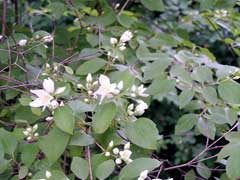
 |
|
http://commons.wikimedia.org/wiki/User:Val%C3%A9rie75 |
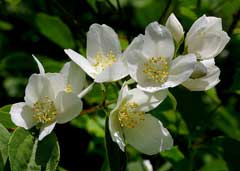 |
| www.flickr.com/photos/jim-sf |
Translate this page:
Summary
Physical Characteristics

 Philadelphus lewisii is a deciduous Shrub growing to 3.6 m (11ft 10in).
See above for USDA hardiness. It is hardy to UK zone 5. It is in flower from June to July. The species is hermaphrodite (has both male and female organs) and is pollinated by Bees.
Suitable for: light (sandy), medium (loamy) and heavy (clay) soils and can grow in heavy clay and nutritionally poor soils. Suitable pH: mildly acid, neutral and basic (mildly alkaline) soils and can grow in very alkaline soils.
It can grow in semi-shade (light woodland) or no shade. It prefers moist soil.
UK Hardiness Map
US Hardiness Map
Synonyms
Plant Habitats
Woodland Garden Sunny Edge; Dappled Shade;
Edible Uses
References More on Edible Uses
Medicinal Uses
Plants For A Future can not take any responsibility for any adverse effects from the use of plants. Always seek advice from a professional before using a plant medicinally.
Antihaemorrhoidal Antirheumatic Eczema Poultice Skin
The dried powdered leaves, or the powdered wood, has been mixed with pitch or oil and used as a rub on sores and swollen joints[257]. A poultice of the bruised leaves has been used to treat infected breasts[257]. A strained decoction of the branches, sometimes with the flowers, has been used as a soaking solution in the treatment of sore chests, eczema and bleeding haemorrhoids[257].
References More on Medicinal Uses
The Bookshop: Edible Plant Books
Our Latest books on Perennial Plants For Food Forests and Permaculture Gardens in paperback or digital formats.

Edible Tropical Plants
Food Forest Plants for Hotter Conditions: 250+ Plants For Tropical Food Forests & Permaculture Gardens.
More

Edible Temperate Plants
Plants for Your Food Forest: 500 Plants for Temperate Food Forests & Permaculture Gardens.
More

More Books
PFAF have eight books available in paperback and digital formats. Browse the shop for more information.
Shop Now
Other Uses
Soap Wood
The leaves and flowers are rich in saponins, when crushed and mixed with water they produce a lather that is an effective cleaner, used on the body, clothes etc[99, 169, 257]. You can wash your hands by merely picking a couple of leaves or a bunch of blossom, wetting your hands and then rubbing the plant material vigorously as if it was a bar of soap[K]. This soap is a very gentle cleaner that does not remove the body's natural oils, but does remove dirt. It is not very effective against oil[K]. An infusion of the bark can also be used[99, 169]. The stems can be used in making fine coiled baskets[257]. Wood - strong, very hard. Used for tool handles[99].
Special Uses
Food Forest Scented Plants
References More on Other Uses
Cultivation details
An easily grown plant, succeeding in any moderately fertile soil, and also in thin soils over chalk[200]. Tolerates poor soils[200]. Grows well in heavy clay soils. Succeeds in semi-shade but prefers a position in full sun where it will flower more freely[182, 200]. Plants are hardy to about -15°c. Some named forms have been developed for their ornamental value[182]. Plants are very tolerant of pruning, one third of the stems can be cut down to the ground each year in order to promote fresh growth and heavier flowering[202]. A very ornamental plant with aromatic flowers[182, 200]. This plant is the State flower of Idaho[212].
References Carbon Farming Information and Carbon Sequestration Information
Temperature Converter
Type a value in the Celsius field to convert the value to Fahrenheit:
Fahrenheit:
The PFAF Bookshop
Plants For A Future have a number of books available in paperback and digital form. Book titles include Edible Plants, Edible Perennials, Edible Trees,Edible Shrubs, Woodland Gardening, and Temperate Food Forest Plants. Our new book is Food Forest Plants For Hotter Conditions (Tropical and Sub-Tropical).
Shop Now
Plant Propagation
Seed - best if given 1 months cold stratification[113]. Sow February in a light position in a cold frame. When they are large enough to handle, prick the seedlings out into individual pots and grow them on in the greenhouse for their first winter. Plant them out into their permanent positions in late spring or early summer, after the last expected frosts. Cuttings of half-ripe wood, 7 - 10cm long side-shoots, July/August in a shaded frame. Plant out in spring. High percentage[78]. Cuttings of mature wood of the current year's growth, 15 - 25cm with a heel, December in a sheltered bed outdoors. Fair to good percentage[78]. Layering in summer. Very easy.
Other Names
If available other names are mentioned here
Native Plant Search
Search over 900 plants ideal for food forests and permaculture gardens. Filter to search native plants to your area. The plants selected are the plants in our book 'Plants For Your Food Forest: 500 Plants for Temperate Food Forests and Permaculture Gardens, as well as plants chosen for our forthcoming related books for Tropical/Hot Wet Climates and Mediterranean/Hot Dry Climates. Native Plant Search
Found In
Countries where the plant has been found are listed here if the information is available
Weed Potential
Right plant wrong place. We are currently updating this section.
Please note that a plant may be invasive in one area but may not in your area so it’s worth checking.
Conservation Status
IUCN Red List of Threatened Plants Status :

Growth: S = slow M = medium F = fast. Soil: L = light (sandy) M = medium H = heavy (clay). pH: A = acid N = neutral B = basic (alkaline). Shade: F = full shade S = semi-shade N = no shade. Moisture: D = dry M = Moist We = wet Wa = water.

Expert comment
Author
Pursh.
Botanical References
1160200
Links / References
For a list of references used on this page please go here
Readers comment