 |
|
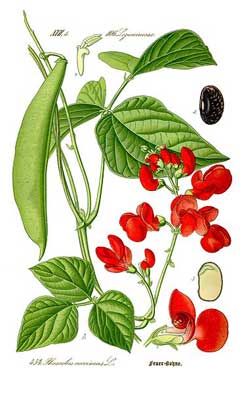
http://commons.wikimedia.org/wiki/File:Illustration_Phaseolus_coccineus0_clean.jpg |
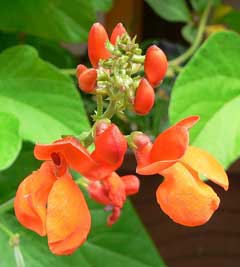 |
| http://commons.wikimedia.org/wiki/User:EvaK |
Translate this page:
Summary
Physical Characteristics

 Phaseolus coccineus is a ANNUAL/PERENNIAL growing to 3 m (9ft) by 1 m (3ft 3in) at a fast rate.
See above for USDA hardiness. It is hardy to UK zone 10 and is frost tender. It is in leaf from May to October, in flower from July to September, and the seeds ripen from August to October. The species is hermaphrodite (has both male and female organs) and is pollinated by Bees. The plant is self-fertile.
It can fix Nitrogen.
Suitable for: light (sandy), medium (loamy) and heavy (clay) soils and prefers well-drained soil. Suitable pH: neutral and basic (mildly alkaline) soils. It cannot grow in the shade. It prefers moist soil.
UK Hardiness Map
US Hardiness Map
Synonyms
P. multiflorus.
Plant Habitats
Cultivated Beds;
Edible Uses
Edible Parts: Flowers Leaves Root Seed Seedpod
Edible Uses:
Immature seedpods - raw or cooked[1, 2, 37, 46]. They have a pleasant mild flavour and are widely used as a vegetable in many areas of the world. They can be added to salads, cooked as a vegetable or added to soups, stews etc[183]. The immature seed is used like shelled beans as a vegetable[183]. The protein-rich mature seeds can be dried and stored for future use. They need to be thoroughly cooked before being eaten in order to destroy a toxic principle. They are soaked for 12 hours prior to use and are eaten boiled or added to soups etc. The seed can also be ground into a powder and added to cereal flours for making protein-enriched bread etc[183]. Flowers - raw. A bean-like taste[177, 183]. Young leaves - cooked and used as a potherb[183]. Root - cooked. Rich in starch[183]. Another report says that the root is poisonous[2]. Carbon Farming - Staple Crop: protein.
References More on Edible Uses
Medicinal Uses
Plants For A Future can not take any responsibility for any adverse effects from the use of plants. Always seek advice from a professional before using a plant medicinally.
None known
References More on Medicinal Uses
The Bookshop: Edible Plant Books
Our Latest books on Perennial Plants For Food Forests and Permaculture Gardens in paperback or digital formats.
Edible Tropical Plants
Food Forest Plants for Hotter Conditions: 250+ Plants For Tropical Food Forests & Permaculture Gardens.
More
Edible Temperate Plants
Plants for Your Food Forest: 500 Plants for Temperate Food Forests & Permaculture Gardens.
More
More Books
PFAF have eight books available in paperback and digital formats. Browse the shop for more information.
Shop Now
Other Uses
References More on Other Uses
Cultivation details
Agroforestry Services: Nitrogen Management: Standard Minor Global Crop Staple Crop: Protein
As an annual suites hardiness zones 1-12. Heat zone: 12-1. As a perennial hardiness zones 10-12. Requires a warm sheltered sunny position in a rich well-drained soil with plenty of moisture in the growing season[1, 16, 37, 200]. Dislikes heavy, wet or acid soils[16]. Prefers a pH in the range 6 to 7[200]. The runner bean is commonly cultivated in many parts of the world for its edible seeds and immature seedpods, there are many named varieties[183]. Most varieties are climbing plants but some dwarf forms have been developed[200]. Plants are perennials but are often grown as annuals, especially in the temperate zone. Plants flower under long day conditions, which is ideal for temperate regions[200]. When grown for their edible pods, the immature pods should be harvested regularly in order to promote extra flower production and therefore higher yields[200]. The perennial roots will survive mild winters outdoors in many parts of the country, especially if given a protective mulch in late autumn, they will then give an earlier but lighter crop the following year. They can also be dug up in late autumn and stored like dahlias in a cool but frost free place over winter and replanted in the following spring. The plants might need some protection from slugs since these creatures adore the young shoots in the spring[K]. Runner beans grow well with carrots, cauliflowers, cucumbers, cabbage, leek and celeriac[18, 20]. They are inhibited by alliums and fennel growing nearby[18, 20]. This species has a symbiotic relationship with certain soil bacteria, these bacteria form nodules on the roots and fix atmospheric nitrogen. Some of this nitrogen is utilized by the growing plant but some can also be used by other plants growing nearby[200]. Carbon Farming - Cultivation: regional crop. Management: standard. Phaseolus coccineus ssp.polyanthus (Cache Bean) is also worth considering as a carbon farming plant. It is similar to Phaseolus coccineus but more suited to tropical highlands and semi-arid conditions.
Carbon Farming
-
Agroforestry Services: Nitrogen
Plants that contribute to nitrogen fixation include the legume family – Fabaceae.
-
Management: Standard
Plants grow to their standard height. Harvest fruit, seeds, or other products. Non-Destructive management systems.
-
Minor Global Crop
These crops are already grown or traded around the world, but on a smaller scale than the global perennial staple and industrial crops, The annual value of a minor global crop is under $1 billion US. Examples include shea, carob, Brazil nuts and fibers such as ramie and sisal.
-
Staple Crop: Protein
(16+ percent protein, 0-15 percent oil). Annuals include beans, chickpeas, lentils, cowpeas, and pigeon peas. Perennials include perennial beans, nuts, leaf protein concentrates, and edible milks.
References Carbon Farming Information and Carbon Sequestration Information
Temperature Converter
Type a value in the Celsius field to convert the value to Fahrenheit:
Fahrenheit:
The PFAF Bookshop
Plants For A Future have a number of books available in paperback and digital form. Book titles include Edible Plants, Edible Perennials, Edible Trees,Edible Shrubs, Woodland Gardening, and Temperate Food Forest Plants. Our new book is Food Forest Plants For Hotter Conditions (Tropical and Sub-Tropical).
Shop Now
Plant Propagation
Pre-soak the seed for 12 hours in warm water and sow in mid spring in a greenhouse. Germination should take place within 10 days. When they are large enough to handle, prick the seedlings out into individual pots and plant them out after the last expected frosts. The seed can also be sown in situ in late spring though it may not ripen its seed in a cool summer.
Other Names
If available other names are mentioned here
Runner Bean, Scarlet Runner Bean, Scarlet Conqueror, Fire Bean, Mammoth, Red Giant. Phaseolus coccineus ssp.polyanthus (Cache Bean).
Native Plant Search
Search over 900 plants ideal for food forests and permaculture gardens. Filter to search native plants to your area. The plants selected are the plants in our book 'Plants For Your Food Forest: 500 Plants for Temperate Food Forests and Permaculture Gardens, as well as plants chosen for our forthcoming related books for Tropical/Hot Wet Climates and Mediterranean/Hot Dry Climates. Native Plant Search
Found In
Countries where the plant has been found are listed here if the information is available
Weed Potential
Right plant wrong place. We are currently updating this section.
Please note that a plant may be invasive in one area but may not in your area so it’s worth checking.
None Known
Conservation Status
IUCN Red List of Threatened Plants Status : This taxon has not yet been assessed

Growth: S = slow M = medium F = fast. Soil: L = light (sandy) M = medium H = heavy (clay). pH: A = acid N = neutral B = basic (alkaline). Shade: F = full shade S = semi-shade N = no shade. Moisture: D = dry M = Moist We = wet Wa = water.

Expert comment
Author
L.
Botanical References
200
Links / References
For a list of references used on this page please go here
A special thanks to Ken Fern for some of the information used on this page.
Readers comment
© 2010, Plants For A Future. Plants For A Future is a charitable company limited by guarantee, registered in England and Wales. Charity No. 1057719, Company No. 3204567.