 |
|
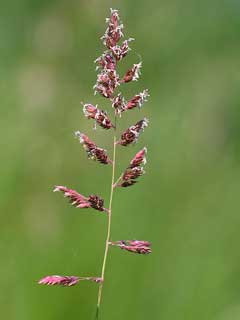
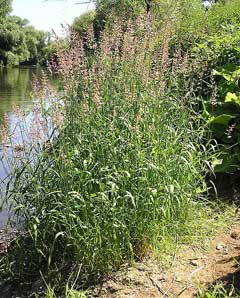
Phalaris arundinacea |
 |
| http://commons.wikimedia.org/wiki/User:Mbc |
Translate this page:
Summary
Bloom Color: White. Main Bloom Time: Early summer, Mid summer. Form: Spreading or horizontal, Upright or erect, Variable spread.
Physical Characteristics

 Phalaris arundinacea is a PERENNIAL growing to 1.5 m (5ft) by 3 m (9ft) at a fast rate.
See above for USDA hardiness. It is hardy to UK zone 4 and is not frost tender. It is in flower from July to September. The species is hermaphrodite (has both male and female organs) and is pollinated by Wind.
It is noted for attracting wildlife.
Suitable for: light (sandy), medium (loamy) and heavy (clay) soils. Suitable pH: mildly acid, neutral and basic (mildly alkaline) soils. It can grow in semi-shade (light woodland) or no shade. It prefers dry moist or wet soil.
UK Hardiness Map
US Hardiness Map
Synonyms
Plant Habitats
Ground Cover; Bog Garden;
Edible Uses
References More on Edible Uses
Medicinal Uses
Plants For A Future can not take any responsibility for any adverse effects from the use of plants. Always seek advice from a professional before using a plant medicinally.
None known
References More on Medicinal Uses
The Bookshop: Edible Plant Books
Our Latest books on Perennial Plants For Food Forests and Permaculture Gardens in paperback or digital formats.
Edible Tropical Plants
Food Forest Plants for Hotter Conditions: 250+ Plants For Tropical Food Forests & Permaculture Gardens.
More
Edible Temperate Plants
Plants for Your Food Forest: 500 Plants for Temperate Food Forests & Permaculture Gardens.
More
More Books
PFAF have eight books available in paperback and digital formats. Browse the shop for more information.
Shop Now
Other Uses
Biomass Fodder Pollution Weaving
Plants have a running root system and form an impenetrable ground cover. They should be mown 2 - 3 times in their first 2 - 3 years in order to encourage thick growth[200]. Plants are best spaced about 60cm apart each way[208]. The leaves have been woven into hats and mats[257]. his is one of the main species used in the reed bed system for the water purification treatment of grey water and for irrigation with pollution control sewage effluent from municipal and industrial sources[269]. One of the highest yielding fodder grasses with annual yields ranging from 8 - 20 tonnes per hectare, it has potential as a source of biomass[269].
Special Uses
Attracts Wildlife Carbon Farming Ground cover
References More on Other Uses
Cultivation details
Industrial Crop: Biomass Management: Hay New Crop Staple Crop: Protein
Landscape Uses:Border, Container, Erosion control, Foundation, Ground cover, Massing, Seashore, Specimen, Woodland garden. A very easy plant to grow, it succeeds in ordinary garden soil[187], though it grows best on moist sandy soils, rich in organic matter[269]. It also does well on fertile loams and clays[269]. Succeeds in most soils, whether dry or wet[200] and is moderately tolerant of drought[269]. It does not like saline soils[269]. The plant is reported to tolerate an annual precipitation in the range of 30 to 260cm, an annual temperature in the range of of 5 to 23°C and a pH of 4.5 to 8.2[269]. Plants can be very invasive, especially in moist conditions, there dense growth provides good cover for water fowl[200]. Plants are hardy to at least -20°c[187, 200]. This is one of the first grasses to come into growth in the spring[269]. There are many named forms, selected mainly for their ornamental value[200]. Special Features:
Attractive foliage, Invasive, Naturalizing, Wetlands plant, Suitable for dried flowers, Attractive flowers or blooms.
Carbon Farming
-
Industrial Crop: Biomass
Three broad categories: bamboos, resprouting woody plants, and giant grasses. uses include: protein, materials (paper, building materials, fibers, biochar etc.), chemicals (biobased chemicals), energy - biofuels
-
Management: Hay
Cut to the ground and harvested annually. Non-destructive management systems maintaining the soil organic carbon.
-
New Crop
Most new crops were important wild plants until recently, although some are the result of hybridization. They have been developed in the last few, decades. What they have in common is that they are currently cultivated by farmers. Examples include baobab, argan, and buffalo gourd.
-
Staple Crop: Protein
(16+ percent protein, 0-15 percent oil). Annuals include beans, chickpeas, lentils, cowpeas, and pigeon peas. Perennials include perennial beans, nuts, leaf protein concentrates, and edible milks.
References Carbon Farming Information and Carbon Sequestration Information
Temperature Converter
Type a value in the Celsius field to convert the value to Fahrenheit:
Fahrenheit:
The PFAF Bookshop
Plants For A Future have a number of books available in paperback and digital form. Book titles include Edible Plants, Edible Perennials, Edible Trees,Edible Shrubs, Woodland Gardening, and Temperate Food Forest Plants. Our new book is Food Forest Plants For Hotter Conditions (Tropical and Sub-Tropical).
Shop Now
Plant Propagation
Seed - sow spring in a cold frame and only just cover the seed. Germination should take place within 2 weeks. When they are large enough to handle, prick the seedlings out into individual pots and plant them out in the summer. Division in spring[200]. Very easy, larger divisions can be planted out direct into their permanent positions. We have found that it is better to pot up the smaller divisions and grow them on in light shade in a cold frame until they are well established before planting them out in late spring or early summer.
Other Names
If available other names are mentioned here
Native Plant Search
Search over 900 plants ideal for food forests and permaculture gardens. Filter to search native plants to your area. The plants selected are the plants in our book 'Plants For Your Food Forest: 500 Plants for Temperate Food Forests and Permaculture Gardens, as well as plants chosen for our forthcoming related books for Tropical/Hot Wet Climates and Mediterranean/Hot Dry Climates. Native Plant Search
Found In
Countries where the plant has been found are listed here if the information is available
Weed Potential
Right plant wrong place. We are currently updating this section.
Please note that a plant may be invasive in one area but may not in your area so it’s worth checking.
Conservation Status
IUCN Red List of Threatened Plants Status :

Growth: S = slow M = medium F = fast. Soil: L = light (sandy) M = medium H = heavy (clay). pH: A = acid N = neutral B = basic (alkaline). Shade: F = full shade S = semi-shade N = no shade. Moisture: D = dry M = Moist We = wet Wa = water.

Expert comment
Author
L.
Botanical References
17
Links / References
For a list of references used on this page please go here
Readers comment