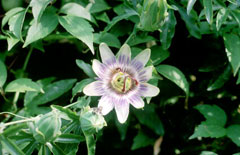
 |
|
(c) 2010 Ken Fern & Plants For A Future |
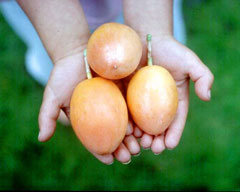 |
| (c) 2010 Ken Fern & Plants For A Future |
Translate this page:
Summary
Bloom Color: White. Main Bloom Time: Early fall, Late summer. Form: Spreading or horizontal, Variable height, Variable spread.
Physical Characteristics

 Passiflora caerulea is an evergreen Climber growing to 10 m (32ft) by 10 m (32ft) at a fast rate.
See above for USDA hardiness. It is hardy to UK zone 7 and is not frost tender. It is in leaf all year, in flower from June to September, and the seeds ripen from September to November. The species is hermaphrodite (has both male and female organs) and is pollinated by Bees.
Suitable for: light (sandy), medium (loamy) and heavy (clay) soils and prefers well-drained soil. Suitable pH: mildly acid, neutral and basic (mildly alkaline) soils. It cannot grow in the shade. It prefers moist soil.
UK Hardiness Map
US Hardiness Map
Synonyms
Plant Habitats
Woodland Garden Sunny Edge; Dappled Shade; South Wall. By. West Wall. By.
Edible Uses
Edible Parts: Flowers Fruit
Edible Uses:
Fruit - raw or cooked[2, 4, 105]. The unripe fruits are cooked[177], whilst the ripe fruits are eaten raw or made into a refreshing drink[183]. The flavour is not very desirable[3]. The fruit is about 6cm long and 4cm wide, it is partly hollow and contains a small amount of pleasant acid-tasting pulp surrounding a large quantity of seeds[K]. The flowers can be made into a syrup.
References More on Edible Uses
Medicinal Uses
Plants For A Future can not take any responsibility for any adverse effects from the use of plants. Always seek advice from a professional before using a plant medicinally.
None known
References More on Medicinal Uses
The Bookshop: Edible Plant Books
Our Latest books on Perennial Plants For Food Forests and Permaculture Gardens in paperback or digital formats.
Edible Tropical Plants
Food Forest Plants for Hotter Conditions: 250+ Plants For Tropical Food Forests & Permaculture Gardens.
More
Edible Temperate Plants
Plants for Your Food Forest: 500 Plants for Temperate Food Forests & Permaculture Gardens.
More
More Books
PFAF have eight books available in paperback and digital formats. Browse the shop for more information.
Shop Now
Other Uses
Rootstock
This plant can be used as a rootstock for some of the less hardy members of this genus, conferring on them an additional cold tolerance. Be careful that root suckers do not take over from the grafted plant[200].
Special Uses
Scented Plants
References More on Other Uses
Cultivation details
Landscape Uses:Arbor, container. Requires a well-drained soil with plenty of moisture in the growing season, otherwise it is not fussy[1, 200]. Dislikes highly alkaline soils[202]. Hardy to about -15°c, if plants are cut down to the ground by frost they can regenerate from the base[200]. Very fast growing[11]. Roots of outdoor grown plants should be restricted to encourage fruiting[1]. Plants produce tendrils and climb by attaching these to other plants. The plant has a very long flowering period, from early summer to early autumn, though individual flowers only live for about 48 hours[245]. The flowers are open all night and start to close in the morning[260]. The flowers are delicately scented[245]. The cultivar 'Constance Elliot' is more fragrant[245]. If fruit is required, especially when the plant is grown indoors, it is best to hand pollinate using pollen from a flower that has been open for 12 hours to pollinate a newly opened flower before midday[88, 200]. The flowers open in sunny weather and do not open on dull cloudy days[219]. Fruit is only formed after long hot summers in Britain[166]. Plants are very tolerant of pruning and can be cut back to ground level if required to rejuvenate the plant[202]. Any pruning is best carried out in the spring[219]. Plants in this genus are notably resistant to honey fungus[200]. Special Features:
Not North American native, Wetlands plant, Attracts butterflies, Attractive flowers or blooms.
References Carbon Farming Information and Carbon Sequestration Information
Temperature Converter
Type a value in the Celsius field to convert the value to Fahrenheit:
Fahrenheit:
The PFAF Bookshop
Plants For A Future have a number of books available in paperback and digital form. Book titles include Edible Plants, Edible Perennials, Edible Trees,Edible Shrubs, Woodland Gardening, and Temperate Food Forest Plants. Our new book is Food Forest Plants For Hotter Conditions (Tropical and Sub-Tropical).
Shop Now
Plant Propagation
Pre-soak the seed for 12 hours in warm water and then sow late winter or early spring in a warm greenhouse. If sown in January and grown on fast it can flower and fruit in its first year[88]. The seed germinates in 1 - 12 months at 20°c. Prick out the seedlings into individual pots when they are large enough to handle. It you are intending to grow the plants outdoors, it is probably best to keep them in the greenhouse for their first winter and plant them out into their permanent positions in late spring or early summer, after the last expected frosts. Mulch the roots well in late autumn to protect them from the cold. Cuttings of young shoots, 15cm with a heel, in spring[1]. Leaf bud cuttings in spring. Cuttings of fully mature wood in early summer. Takes 3 months. High percentage[3].
Other Names
If available other names are mentioned here
Native Plant Search
Search over 900 plants ideal for food forests and permaculture gardens. Filter to search native plants to your area. The plants selected are the plants in our book 'Plants For Your Food Forest: 500 Plants for Temperate Food Forests and Permaculture Gardens, as well as plants chosen for our forthcoming related books for Tropical/Hot Wet Climates and Mediterranean/Hot Dry Climates. Native Plant Search
Found In
Countries where the plant has been found are listed here if the information is available
Weed Potential
Right plant wrong place. We are currently updating this section.
Please note that a plant may be invasive in one area but may not in your area so it’s worth checking.
Conservation Status
IUCN Red List of Threatened Plants Status :

Growth: S = slow M = medium F = fast. Soil: L = light (sandy) M = medium H = heavy (clay). pH: A = acid N = neutral B = basic (alkaline). Shade: F = full shade S = semi-shade N = no shade. Moisture: D = dry M = Moist We = wet Wa = water.

Expert comment
Author
L.
Botanical References
11200
Links / References
For a list of references used on this page please go here
Readers comment