Plants For A Future Logo Full Contact Details
Registered Charity No. 1057719

Back to main Search Page

Oxalis tuberosa - Molina.

Oca

AuthorMolina. Botanical references200
FamilyOxalidaceae GenusOxalis
SynonymsOxalis crenata - Jacq.
Known Hazardswarning signThe leaves contain oxalic acid, which gives them their sharp flavour. Perfectly all right in small quantities, the leaves should not be eaten in large amounts since oxalic acid can bind up the body's supply of calcium leading to nutritional deficiency. The quantity of oxalic acid will be reduced if the leaves are cooked. People with a tendency to rheumatism, arthritis, gout, kidney stones or hyperacidity should take especial caution if including this plant in their diet since it can aggravate their condition[238].
RangeS. America - Colombia, Peru.
HabitatUnknown in a truly wild situation, though plants have been found growing at heights up to 4000 metres in the Andes[97].
Edibility Ratingapple iconapple iconapple iconapple iconapple icon 5 (1-5) Medicinal Rating 0 (1-5)

Physical Characteristics

icon of man icon of perennial/biennial/annual Perennial growing to 0.45m by 0.3m.
It is hardy to zone 7 and is frost tender. It is in flower from July to August. The flowers are hermaphrodite (have both male and female organs) and are pollinated by Insects.

The plant prefers light (sandy) and medium (loamy) soils and requires well-drained soil. The plant prefers acid, neutral and basic (alkaline) soils. It cannot grow in the shade. It requires moist soil.

Habitats

Cultivated Beds;

Edible Uses

Edible Parts: Flowers; Leaves; Root.

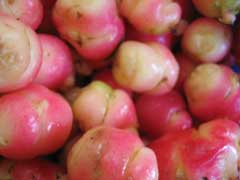
Tubers - raw or cooked[2, 103, 183]. An acid lemon flavour when first harvested, if left out in the sun the tubers turn sweet[183], so sweet in some varieties that they are said to resemble dried figs and are sold as fruits in local markets in S. America[34, 37, 97, 196]. The cooked root is delicious whether in its sweet or acid state, it can be boiled, baked etc in similar ways to potatoes[K]. The tubers tend to be rather smaller than potatoes, with good sized specimens reaching 8cm or more in length. The slightly waxy skin makes cleaning them very easy[K]. They contain about 70 - 80% moisture, 11 - 22% carbohydrate, 1% fat, 1% fibre and 1% ash[196]. The carbohydrate is rich in sugar and easy to digest[196]. Acid types are rich in oxalic acid (up to 500ppm) but sweet forms have much less oxalic acid than is found in potatoes[196]. Edible young leaves and flowers - raw or cooked[34, 37, 103]. Poor quality[33]. Use in moderation, see notes at top of sheet,

Medicinal Uses

Plants For A Future can not take any responsibility for any adverse effects from the use of plants. Always seek advice from a professional before using a plant medicinally.

None known

Other Uses

None known

Cultivation details

Prefers a light rich soil in a warm sunny position[1, 37, 196]. Tolerates a pH range from 5.3 to 7.8[196]. Plants succeed in areas with an average rainfall ranging from 570 - 2150mm per year[196]. Oka is widely cultivated in the Andes for its edible tubers, there are many named varieties[33, 97]. This species has an excellent potential as a major root crop in temperate zones, it has the potential to yield as highly as potatoes but does not have the susceptibility to pests and diseases that are a bugbane for potato growers[K]. Plants are slightly more hardy than the potato, tolerating light frosts but the top-growth being severely damaged or killed by temperatures much below freezing. The main drawback is that development of the tubers is initiated by the number of hours of daylight in a day. In Britain this means that tubers do not begin to form until after the 21st of September and, if there are early frosts in the autumn, yields will be low[37]. There are possibly some forms in southern Chile that are not sensitive to daylength, these will be more suitable to higher latitudes such as Britain[196]. It is said that the varieties with white tubers are bitter because they contain calcium oxylate crystals whilst those with tubers that are of other colours are sweet[97]. However, we are growing one variety with white tubers and it most certainly is not bitter[K]. Yields tend to average about 7 - 10 tonnes per hectare but experimentally yields of 40 tonnes per hectare have been achieved[196]. Earthing up the growing stems as they start to form tubers can increase yields significantly[196].

Propagation

Seed - best sown as soon as it is ripe in a cold frame. Prick out the seedlings into individual pots when they are large enough to handle and plant them out in late spring or early summer. Seed is not usually produced in Britain. Harvest the tubers in late autumn after the frosts have killed off top growth. Store in a cool dry frost free place and plant out in April. Basal cuttings in spring[196]. Harvest the shoots with plenty of underground stem when they are about 8 - 10cm above the ground. Pot them up into individual pots and keep them in light shade in a cold frame or greenhouse until they are rooting well. Plant them out in the summer.

Links

This plant is also mentioned in the following PFAF articles: Alternative Food Crops, Alternative Root Crops, The Potted Garden.

References

[K] Ken Fern
Notes from observations, tasting etc at Plants For A Future and on field trips.

[1] F. Chittendon. RHS Dictionary of Plants plus Supplement. 1956 Oxford University Press 1951
Comprehensive listing of species and how to grow them. Somewhat outdated, it has been replaces in 1992 by a new dictionary (see [200]).

[2] Hedrick. U. P. Sturtevant's Edible Plants of the World. Dover Publications 1972 ISBN 0-486-20459-6
Lots of entries, quite a lot of information in most entries and references.

[33] Organ. J. Rare Vegetables for Garden and Table. Faber 1960
Unusual vegetables that can be grown outdoors in Britain. A good guide.

[34] Harrison. S. Wallis. M. Masefield. G. The Oxford Book of Food Plants. Oxford University Press 1975
Good drawings of some of the more common food plants from around the world. Not much information though.

[37] Thompson. B. The Gardener's Assistant. Blackie and Son. 1878
Excellent general but extensive guide to gardening practices in the 19th century. A very good section on fruits and vegetables with many little known species.

[97] Towle. M. A. The Ethno-Botany of Pre-Columbian Peru. 0
A very interesting book covering quite a lot of information on plant uses in S. America although many of the plants are not suitable for temperate areas..

[103] Haywood. V. H. Flowering Plants of the World. Oxford University Press 0 ISBN 0-19-217674-9
Very readable and well illustrated, it lists plants by families giving the basic diagnostic features and some details of plant uses.

[183] Facciola. S. Cornucopia - A Source Book of Edible Plants. Kampong Publications 1990 ISBN 0-9628087-0-9
Excellent. Contains a very wide range of conventional and unconventional food plants (including tropical) and where they can be obtained (mainly N. American nurseries but also research institutes and a lot of other nurseries from around the world.

[196] Popenoe. H. et al Lost Crops of the Incas National Academy Press 1990 ISBN 0-309-04264-X
An excellent book. Very readable, with lots of information and good pictures of some lesser known food plants of S. America.

[200] Huxley. A. The New RHS Dictionary of Gardening. 1992. MacMillan Press 1992 ISBN 0-333-47494-5
Excellent and very comprehensive, though it contains a number of silly mistakes. Readable yet also very detailed.

[238] Bown. D. Encyclopaedia of Herbs and their Uses. Dorling Kindersley, London. 1995 ISBN 0-7513-020-31
A very well presented and informative book on herbs from around the globe. Plenty in it for both the casual reader and the serious student. Just one main quibble is the silly way of having two separate entries for each plant.

Readers Comments

Plants for a Future does not verify the accuracy of reader comments, use at your own risk. In particular Plants For A Future can not take any responsibility for any adverse effects from the use of plants. You should always consult a professional before using plants medicinally.

Oxalis tuberosa

John Ernest Berry III Fri, 04 Dec 1998 21:59:20

I was delighted to receive your most recent issue about Oca. Are you allowing it sufficient time to attain it's potential size? After growing it for three years, I find they certainly take the majority of the "normal" growing period, & then some, to fully achiev their true size!!!

I relish the certainly far from insipid flavour that it certainly does manifest. Most of the people who've been adventurous enough to sample these malformed tubers are rather taken aback by the acrid taste.

I love the "spud with an internal dolop of sour cream".

Oxalis tuberosa

A.Wigmore Sun Jan 27 20:16:18 2002

I grow various unusual tubers in my raised vegetable beds: oxalis tuberosa, tropaeolum tuberosum , apios americana, dioscorea batatas (that one does not do well, probably too cold without protection), yacon. I wonder if any or all of them will benefit from a load of compost, and whether it is good to grow them in the same place year after year?

Oxalis tuberosa

Susan Schofield Fri Nov 5 10:55:01 2004

At last I have found information on the New Zealand yam (oxalis tuberosa). After living in New Zealand for 30 years I became very fond of the "yam" but could not find a grower over here. We served these roasted with potatoes but I also cooked them in a little butter with honey. Does anyone know where I can buy them over here?

Oxalis tuberosa

Abayomi Thu Sep 14 2006

Does anyone know where I can buy seeds?

Oxalis tuberosa

Wed Nov 22 2006

Keep very well, and easy to grow. The best way to cook them is roasting, but they can be eaten raw, boiled, in stir fry, etc. Very versatilve and easy to grow vegetable.

Oxalis tuberosa

Mon Feb 5 2007

Incredibly productive plant in coastal British Columbia (zone 7-8); harvest in early February has yielded several dozen 6-8cm long tubers from a single plant (1 gallon size). And what an excellent food: flavour has a citrus sweetness, a much more intense and satisfying flavour than Jerusalem Artichoke.

Oxalis tuberosa

Denise Dellow Sun May 27 2007

Nz'er living in UK. Desperately seeking some tubers for my vegetable garden, and pleased to discover that it is not an entirely unknown vegetable here. Can you advise whether it is freely available to gardeners and where I can obtain some stock? For those still learning to eat them, try steamed with a dollop of honey and grated fresh ginger.

Alternative Food Crops

Gina Zapara Mon Sep 3 2007

I am looking form Oca (Oxalis tuberosa) If you have any to share or I will pay for it, please email me zeegina@hotmail.com

Oxalis tuberosa

Gina Z Wed Sep 5 2007

Does anyone have any see or roots stock for sale , would love to try growing in Hawaii

Oxalis tuberosa

Steve Sun Sep 16 2007

Oca tubers can be purchased from www.realseeds.co.uk

Oxalis tuberosa

Christophe Mouze Fri Dec 7 2007

We have been growing them for 4 years now in the west of Ireland with very good results. This year, we got 30 Kg of them on a 8 sqm bed, that's 37 tons / hectare. The secret of good yields is to leave them in the ground as late as possible (we only harvested them in December this year). They are delicious roasted. We can sell some seeds, contact christophe@yogaholidays.net

Oxalis tuberosa

christophemouze Sun Jan 20 2008

Growing and eating ocas

Oxalis tuberosa

Marlene Ansley Tue Aug 19 2008

My family lived in Georgia, USA and my mother used them as decorative flowers to border her flower gardens and shrubs. Had absolutely no idea they could be eaten. The leaves look like shamrocks and the little flowers are pink or sometimes white. WOW! I don't think my mother knew they were edible, I'm not sure where she got them from, she had a friend that was originally from Ireland, maybe she sent my mother some tubers and my mother planted them and enjoyed their flowers and leaves as a border. You learn something new everyday! anslatadams@yahoo.com

Oxalis tuberosa

paul johnstone Thu Oct 23 2008

try the real seed company in the u.k. who sell the tubers but have limited stock so try soon .

Oxalis tuberosa

Colleen Atkinson Wed Nov 26 2008

Marlene, The ones in your mothers garden are probably only the decorative type. Tuberosa is the yam producing plant and not the same as the floral variey which produces a clear tuber which i would not eat.

Oxalis tuberosa

Stuart Jeremy Oxley Fri Jan 16 2009

Real Seeds Unusual Veg inc Oca, Yacon & Ulluco. Lots of veg seeds too. A++

Oxalis tuberosa

Owen Smith Tue Jan 27 2009

I've managed to get some home grown Oca seed to germinate. For details see my blog

Radix Blog about my experiences of growing alternative root crops

Oxalis tuberosa

CarpeDiem Wed Feb 11 2009

Hello, everytime, I'm looking for different colors from andean plants. Oca, Ulluco and Mashua are some of my favorites. Sometimes it is very difficult to get them.

www.carpediem-living.de

Oxalis tuberosa

NIGEL MURISON Mon Mar 9 2009

I have oca tubers for sale.Postage to U.K. ONLY email nigelsgreennotebook@hotmail.com

Oxalis tuberosa

jono Fri Jun 26 2009

I have been growing Oca in Sydney Australia for four years. Summer is too hot so this year I am growing over the autumn/winter period. As we live in the inner city I am growing in pots and experimenting with bark to mound around the plants. I have found a mix of compost (30%) and sand (70%) to be the most successful as a base. For cooking my favourite is rolled in olive oil, sprinkled with chilli and roasted.

Alternative Root Crops

julie curtain Tue Dec 1 2009

Hi there I Live in Western Australia and want to purchase some Oxalis tuberosa and find it difficult to track down. Do youkno where I could get some tubers to grow. thanks kindly Julie. curtianc@westnetcom.au

Oxalis tuberosa

Ian Pearson Wed Dec 2 2009

I have a blog recording my experience with bi-croping / companion planting Oca in the UK

Growing Oca

Oxalis tuberosa

Lucy Hayward Tue Jan 12 2010

Does anyone know where I can buy some Oca tubers to grow? Realseeds don't have any this year. Please could you let me know - many thanks Lucy. lukeandlucy@yahoo.co.uk

Oxalis tuberosa

CarpeDiem Thu Jan 14 2010

Since last year I have a platform for andean tubers. On this platform I list people who change andean tubers and I also colect informations and shops in differnt countrys and list them. Now it is a little project, but the platform and infromation growsare growing.

http://www.carpediem-living.de Platform for andean plants

Add a comment/link:

Enter your comment about this page here.
Note: please don't expect a quick reply to comments/questions posted here? We don't have the resources to answer questions ourselves. You can ask questions on our mailing list.

Subject: Oxalis tuberosa


LinksTo add a link to another website with useful info add the details here.
Name of Site:
URL for Site:
Details:

Your Name:
email address:
Email addressed added here will not be displayed on the website or be passed to third parties.
They are used incase we need to get in touch with you.
To prevent spam all comments are moderated, comments with spam or swearing are blocked.

Discussion Monitor

To have posts to this page mailed to you enter your email address here:

email address: 

(Your email address will not appear on the webpage or be passed on to third parties).

All the information contained in these pages is Copyright (C) Plants For A Future, 1996-2008.

Plants For A Future is a charitable company limited by guarantee, registered in England and Wales. Charity No. 1057719, Company No. 3204567, 

HTML version prepared by Rich Morris - Home Page

Creative Commons License This work is licensed under a Creative Commons License. You can copy, distribute, display this works and to make derivative works but: Attribution is required, and it's Share Alike (GNUish/copyleft) i.e. has an identical license. We also ask that you let us know (webmaster@pfaf.org) if you link to, redistribute, make a derived work or do anything groovy with this information.