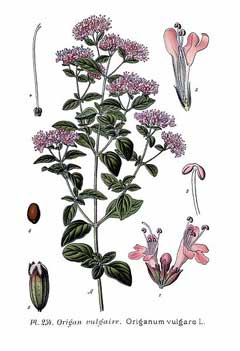
 |
|
http://commons.wikimedia.org/wiki/File:254_Origanum_vulgare_L.jpg |
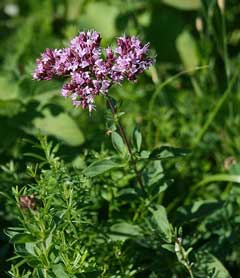 |
| http://commons.wikimedia.org/wiki/User:Franz_Xaver |
Translate this page:
Summary
Bloom Color: Pink, White. Main Bloom Time: Late Spring, Early Summer, Late summer, Midsummer. Form: Spreading or horizontal.
Physical Characteristics

 Origanum vulgare is a PERENNIAL growing to 0.6 m (2ft) by 0.8 m (2ft 7in) at a medium rate.
See above for USDA hardiness. It is hardy to UK zone 5 and is not frost tender. It is in flower from July to September, and the seeds ripen from August to October. The species is hermaphrodite (has both male and female organs) and is pollinated by Bees, Lepidoptera (Moths & Butterflies).
It is noted for attracting wildlife.
Suitable for: light (sandy), medium (loamy) and heavy (clay) soils, prefers well-drained soil and can grow in nutritionally poor soil. Suitable pH: mildly acid, neutral and basic (mildly alkaline) soils. It can grow in semi-shade (light woodland) or no shade. It prefers dry or moist soil. The plant can tolerates strong winds but not maritime exposure.
UK Hardiness Map
US Hardiness Map
Synonyms
Plant Habitats
Ground Cover; Meadow; Cultivated Beds;
Edible Uses
Edible Parts: Flowers Leaves Stem
Edible Uses: Condiment Tea
Leaves - raw or cooked as a potherb[5, 52, 183]. Oregano is an important flavouring herb in Mediterranean cookery, and is often used dried rather than fresh[238]. The leaves are used as a flavouring for salad dressings, vegetables and legumes, and are frequently included in strongly flavoured dishes with chillies, garlic, onions etc[2, 13, 21, 27, 183, 238]. A nutritional analysis is available[218]. Flowers, usually appear in late spring, are edible. Much of the commercially available dried oregano does not come from this plant but from a number of different, often unrelated plants[238]. These include Lippia graveolens, L. palmeri and Origanum syriacum[238]. A herb tea is made from the dried leaves and flowering stems[183, 207, 238].
References More on Edible Uses
| Composition
|
| Figures in grams (g) or miligrams (mg) per 100g of food.
|
|
|
Leaves (Dry weight)
|
|
- 306 Calories per 100g
- Water : 7.2%
- Protein: 11g; Fat: 10.2g; Carbohydrate: 64.4g; Fibre: 15g; Ash: 7.2g;
- Minerals - Calcium: 1576mg; Phosphorus: 200mg; Iron: 44mg; Magnesium: 270mg; Sodium: 15mg; Potassium: 1669mg; Zinc: 4.4mg;
- Vitamins - A: 6903mg; Thiamine (B1): 0.34mg; Riboflavin (B2): 0mg; Niacin: 6.2mg; B6: 0mg; C: 0mg;
- Reference: [ 218]
- Notes:
|
|
Medicinal Uses
Plants For A Future can not take any responsibility for any adverse effects from the use of plants. Always seek advice from a professional before using a plant medicinally.
Antirheumatic Antiseptic Antispasmodic Aromatherapy Carminative Cholagogue Diaphoretic Emmenagogue
Expectorant Odontalgic Parasiticide Stimulant Stomachic Tonic
Oregano has been used as a culinary and medicinal herb for thousands of years. It has a beneficial effect upon the digestive and respiratory systems and is also used to promote menstruation[254]. It should not be used medicinally by pregnant women though it is perfectly safe in small amounts for culinary purposes[254]. The leaves and flowering stems are strongly antiseptic, antispasmodic, carminative, cholagogue, diaphoretic, emmenagogue, expectorant, stimulant, stomachic and mildly tonic[4, 7, 9, 21, 254]. The plant is taken internally in the treatment of colds, influenza, mild feverish illnesses, indigestion, stomach upsets and painful menstruation[238]. It is strongly sedative and should not be taken in large doses, though mild teas have a soothing effect and aid restful sleep[244]. It should not be prescribed for pregnant women[238]. Externally, oregano is used to treat bronchitis, asthma, arthritis and muscular pain[238]. The plant can be used fresh or dried - harvest the whole plant (but not the roots) in late summer to dry and store for winter use[244]. Oregano is often used in the form of an essential oil that is distilled from the flowering plant[4]. A few drops of the essential oil, put on cotton wool and placed in the hollow of an aching tooth, frequently relieves the pain of toothache[4, 207]. This plant is one of the best natural antiseptics because of its high thymol content[7]. The essential oil is used in aromatherapy to treat the same kinds of complaints that the herb is used for[238].
References More on Medicinal Uses
Now available: PLANTS FOR YOUR FOOD FOREST: 500 Plants for Temperate Food Forests and Permaculture Gardens.
An important new book from PFAF. It focuses on the attributes of plants suitable for food forests, what each can contribute to a food forest ecosystem, including carbon sequestration, and the kinds of foods they yield. The book suggests that community and small-scale food forests can provide a real alternative to intensive industrialised agriculture, and help to combat the many inter-related environmental crises that threaten the very future of life on Earth.
Read More
Other Uses
Dye Essential Parasiticide Repellent Strewing
An essential oil from the plant is used as a food flavouring, in soaps and perfumery[115, 171]. The herb contains 0.15 - 0.4% essential oil[218] and makes good herbal pillows and baths[244]. The plant was formerly used as a strewing herb[201]. The essential oil has also been used to kill lice, though some caution is advised since it can cause skin irritations[238]. A red or purple dye is obtained from the flowering tops[4, 7, 13, 100], it is neither brilliant nor durable[115]. The plant repels ants[46]. The growing plant repels many insect pests so it is a good plant to grow in the vegetable area[201]. A useful ground cover for sunny positions, forming a slowly spreading clump[197, K]. Plants should be spaced about 30cm apart each way[208].
Special Uses
Attracts Wildlife Dynamic accumulator Food Forest Ground cover Scented Plants
References More on Other Uses
Cultivation details
Landscape Uses:Border, Container, Ground cover, Rock garden, Seashore. Requires a rather dry, warm, well-drained soil in full sun, but is not fussy as to soil type, thriving on chalk[1, 27]. Prefers slightly alkaline conditions[200]. Tolerates poor soils[24]. Dislikes wet soils[37]. Hardy to about -20°c[187]. Oregano has a long history of culinary and medicinal use and is often cultivated in modern gardens as a culinary herb, there are some named varieties[183, 187, 238, 244]. Plants growing near the sea have the most fragrance[7]. A good companion plant, improving the flavour of nearby plants[201]. The flowers are very attractive to bees and butterflies[5, 30]. A good companion for the cucumber family[14], it is beneficial to all nearby plants[20]. The whole plant has a sweet yet slightly peppery aroma[245]. Members of this genus are rarely if ever troubled by browsing deer[233]. Special Features:
Attractive foliage, Fragrant foliage, Not North American native, Attracts butterflies, Suitable for cut flowers, Suitable for dried flowers, Fragrant flowers. In garden design, as well as the above-ground architecture of a plant, root structure considerations help in choosing plants that work together for their optimal soil requirements including nutrients and water. The root pattern is rhizomatous with underground stems sending roots and shoots along their length [2-1].
References Carbon Farming Information and Carbon Sequestration Information
Temperature Converter
Type a value in the Celsius field to convert the value to Fahrenheit:
Fahrenheit:
The PFAF Bookshop
Plants For A Future have a number of books available in paperback and digital form. Book titles include Edible Plants, Edible Perennials, Edible Trees,Edible Shrubs, Woodland Gardening, and Temperate Food Forest Plants. Our new book is Food Forest Plants For Hotter Conditions (Tropical and Sub-Tropical).
Shop Now
Plant Propagation
Seed - sow early spring at 10 - 13°c and only just cover the seed. Germination usually takes place within 2 weeks. Prick out the seedlings into individual pots when they are large enough to handle and plant them out into their permanent positions in early summer. The seed can also be sown in situ in late spring. Division in March or October. Very easy, larger divisions can be planted out direct into their permanent positions. We have found that it is better to pot up the smaller divisions and grow them on in light shade in a cold frame until they are well established before planting them out in late spring or early summer. Basal cuttings of young barren shoots in June. Very easy. Harvest the shoots with plenty of underground stem when they are about 8 - 10cm above the ground. Pot them up into individual pots and keep them in light shade in a cold frame or greenhouse until they are rooting well. Plant them out in the summer.
Other Names
If available other names are mentioned here
Native Plant Search
Search over 900 plants ideal for food forests and permaculture gardens. Filter to search native plants to your area. The plants selected are the plants in our book 'Plants For Your Food Forest: 500 Plants for Temperate Food Forests and Permaculture Gardens, as well as plants chosen for our forthcoming related books for Tropical/Hot Wet Climates and Mediterranean/Hot Dry Climates. Native Plant Search
Found In
Countries where the plant has been found are listed here if the information is available
Weed Potential
Right plant wrong place. We are currently updating this section.
Please note that a plant may be invasive in one area but may not in your area so it’s worth checking.
Conservation Status
IUCN Red List of Threatened Plants Status :

Growth: S = slow M = medium F = fast. Soil: L = light (sandy) M = medium H = heavy (clay). pH: A = acid N = neutral B = basic (alkaline). Shade: F = full shade S = semi-shade N = no shade. Moisture: D = dry M = Moist We = wet Wa = water.

Expert comment
Author
L.
Botanical References
17200
Links / References
For a list of references used on this page please go here
Readers comment