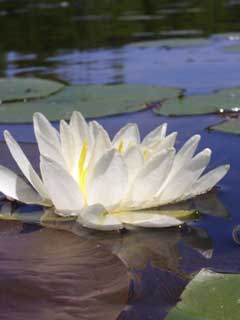
 |
|
http://commons.wikimedia.org/wiki/User:IvanTortuga |
 |
| biolib.de |
Translate this page:
Summary
Physical Characteristics
![]()
![]() Nymphaea odorata is a PERENNIAL.
Nymphaea odorata is a PERENNIAL.
See above for USDA hardiness. It is hardy to UK zone 5. It is in flower from July to August, and the seeds ripen from August to October. The species is hermaphrodite (has both male and female organs) and is pollinated by Flies, beetles. The plant is self-fertile.
Suitable for: light (sandy), medium (loamy) and heavy (clay) soils. Suitable pH: mildly acid, neutral and basic (mildly alkaline) soils. It cannot grow in the shade. It can grow in water.
UK Hardiness Map
US Hardiness Map
Synonyms
Plant Habitats
Pond;
Edible Uses
Edible Parts: Flowers Leaves Root Seed
Edible Uses:
Flower buds - cooked as a vegetable or pickled[55, 105, 177, 183]. Young flowers - raw[55]. Leaves - raw or cooked[207]. Used in soups and stews[55, 177, 183]. Root[105, 183]. Boiled or roasted[207]. Ripe seed - cooked or ground into a meal[207].
References More on Edible Uses
Medicinal Uses
Plants For A Future can not take any responsibility for any adverse effects from the use of plants. Always seek advice from a professional before using a plant medicinally.
Anodyne Antidiarrhoeal Antiseptic Astringent Cancer Demulcent Dysentery TB
The root is alterative, anodyne, antiseptic, astringent and demulcent[4, 21, 165, 238]. A tea made from the roots is used in the treatment of TB, chronic bronchial complaints, diarrhoea, dysentery, gastrointestinal inflammation, gonorrhoea, vaginal discharge, inflamed glands, mouth sores and to stop bleeding[222, 238]. A poultice made from the roots is used in the treatment of swellings, boils, tumours, inflamed skin, vaginitis etc[222, 238]. The roots are harvested in the autumn once the plant has died down, and are dried for later use[238]. A complete cure of uterine cancer by a decoction and uterine injection has been recorded[4].
References More on Medicinal Uses
The Bookshop: Edible Plant Books
Our Latest books on Perennial Plants For Food Forests and Permaculture Gardens in paperback or digital formats.
Edible Tropical Plants
Food Forest Plants for Hotter Conditions: 250+ Plants For Tropical Food Forests & Permaculture Gardens.
More
Edible Temperate Plants
Plants for Your Food Forest: 500 Plants for Temperate Food Forests & Permaculture Gardens.
More
More Books
PFAF have eight books available in paperback and digital formats. Browse the shop for more information.
Shop Now
Other Uses
References More on Other Uses
Cultivation details
A water plant requiring a rich soil and a sunny position in still or slowly flowing water that is at least 30cm deep[55, 200, 238]. An over-rich soil, or growing the plant in water that is too deep, inhibits flowering[238]. Prefers a pH between 6 and 7[200]. There are two basic types of plant in this genus (this species is a crawler):- 'crawlers' are species with horizontal roots that often spread freely, with new plants being formed at intervals along the root. These species are useful for naturalising, but they do not flower very freely in the cool summers of Britain[214]. 'clumpers' have vertical roots, they form slowly spreading clumps and produce offsets around the crown. These forms flower much more freely in Britain[214]. A very ornamental plant[1], the sweetly fragrant flowers are 12cm in diameter[222]. The flowers open in the morning, when they are at their most fragrant, and close in the afternoon[245].
References Carbon Farming Information and Carbon Sequestration Information
Temperature Converter
Type a value in the Celsius field to convert the value to Fahrenheit:
Fahrenheit:
The PFAF Bookshop
Plants For A Future have a number of books available in paperback and digital form. Book titles include Edible Plants, Edible Perennials, Edible Trees,Edible Shrubs, Woodland Gardening, and Temperate Food Forest Plants. Our new book is Food Forest Plants For Hotter Conditions (Tropical and Sub-Tropical).
Shop Now
Plant Propagation
Seed - sow as soon as it is ripe in a greenhouse in pots submerged under 25mm of water. Prick out into individual pots as soon as the first true leaf appears and grow them on in water in a greenhouse for at least two years before planting them out in late spring. The seed is collected by wrapping the developing seed head in a muslin bag to avoid the seed being lost. Harvest it 10 days after it sinks below the soil surface or as soon as it reappears[200]. Division in May. Each portion must have at least one eye. Submerge in pots in shallow water until established[56].
Other Names
If available other names are mentioned here
Native Plant Search
Search over 900 plants ideal for food forests and permaculture gardens. Filter to search native plants to your area. The plants selected are the plants in our book 'Plants For Your Food Forest: 500 Plants for Temperate Food Forests and Permaculture Gardens, as well as plants chosen for our forthcoming related books for Tropical/Hot Wet Climates and Mediterranean/Hot Dry Climates. Native Plant Search
Found In
Countries where the plant has been found are listed here if the information is available
Weed Potential
Right plant wrong place. We are currently updating this section.
Please note that a plant may be invasive in one area but may not in your area so it’s worth checking.
Conservation Status
IUCN Red List of Threatened Plants Status :

Growth: S = slow M = medium F = fast. Soil: L = light (sandy) M = medium H = heavy (clay). pH: A = acid N = neutral B = basic (alkaline). Shade: F = full shade S = semi-shade N = no shade. Moisture: D = dry M = Moist We = wet Wa = water.

Expert comment
Author
Aiton.
Botanical References
60200270
Links / References
For a list of references used on this page please go here
Readers comment