Plants For A Future Logo Full Contact Details
Registered Charity No. 1057719

Back to main Search Page

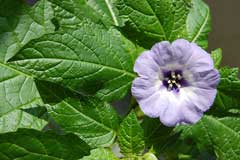
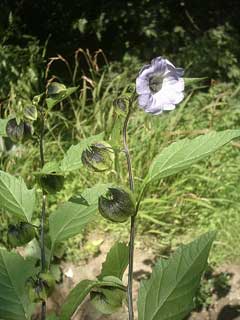
Nicandra physaloides - (L.)Gaertn.

Shoo Fly

Author(L.)Gaertn. Botanical references200
FamilySolanaceae GenusNicandra
Synonyms
Known Hazardswarning signAlthough no mention of toxicity has been seen for this species, it belongs to a family that contains many species of poisonous plants so some caution is advised. It is normally the leaves and the unripe fruits that are most likely to be suspect, this family also includes many food plants such as potatoes, tomatoes, peppers etc.
RangeS. America - Peru. Introduced and casual in Britain.
HabitatNaturalized in waste places and near dwellings in much of N. America[204].
Edibility Ratingapple icon 1 (1-5) Medicinal Ratingapple iconapple icon 2 (1-5)

Physical Characteristics

icon of man icon of perennial/biennial/annual Annual growing to 1.2m at a fast rate.
It is hardy to zone 8. It is in flower from July to September. The flowers are hermaphrodite (have both male and female organs)

The plant prefers light (sandy), medium (loamy) and heavy (clay) soils and requires well-drained soil. The plant prefers acid, neutral and basic (alkaline) soils. It cannot grow in the shade. It requires moist soil.

Habitats

Cultivated Beds;

Edible Uses

Edible Parts: Fruit; Leaves.

Fruit[177]. No more details are given. The fruit is a berry about 15mm in diameter[200]. Young leaves - boiled[177]. Some caution is advised, see the notes above on toxicity.

Medicinal Uses

Plants For A Future can not take any responsibility for any adverse effects from the use of plants. Always seek advice from a professional before using a plant medicinally.

Analgesic; Anthelmintic; Antibacterial; Antiinflammatory; Diuretic; Febrifuge; Mydriatic.

The plant is diuretic[240]. There is no evidence to suggest that the plant is purgative, though an alkaloid with mydriatic action is present[240]. The seeds are used in Tibetan medicine, they are said to have an acrid taste and a cooling, very poisonous potency[241]. Analgesic, anthelmintic, antibacterial, anti-inflammatory and febrifuge, regular use increases bodily vigour[241]. They are used in the treatment of contagious disorders, toothache, intestinal pain from worms and impotence[241]. A decoction of the seeds is used in the treatment of fevers[272].

Other Uses

Repellent.

The plant is thought to repel flies[188].

Cultivation details

Succeeds in ordinary garden soil[1], but prefers a rich well-drained soil in a sunny position[200]. Plants withstand poor weather conditions well and do not usually require staking[200]. Plants are fast-growing[188] and often self-sow freely[200]. Individual flowers only live for one day, but the plant produces a succession of flowers from summer to early autumn[188].

Propagation

Seed - sow in situ in late spring, preferably after the last expected frosts[200]. Young seedlings can be transplanted. The seed can remain dormant for several decades[200].

Links

References

[1] F. Chittendon. RHS Dictionary of Plants plus Supplement. 1956 Oxford University Press 1951
Comprehensive listing of species and how to grow them. Somewhat outdated, it has been replaces in 1992 by a new dictionary (see [200]).

[177] Kunkel. G. Plants for Human Consumption. Koeltz Scientific Books 1984 ISBN 3874292169
An excellent book for the dedicated. A comprehensive listing of latin names with a brief list of edible parts.

[188] Brickell. C. The RHS Gardener's Encyclopedia of Plants and Flowers Dorling Kindersley Publishers Ltd. 1990 ISBN 0-86318-386-7
Excellent range of photographs, some cultivation details but very little information on plant uses.

[200] Huxley. A. The New RHS Dictionary of Gardening. 1992. MacMillan Press 1992 ISBN 0-333-47494-5
Excellent and very comprehensive, though it contains a number of silly mistakes. Readable yet also very detailed.

[204] Livingstone. B. Flora of Canada National Museums of Canada 1978 ISBN 0-660-00025-3
In 4 volumes, it does not deal with plant uses but gives descriptions and habitats.

[240] Chopra. R. N., Nayar. S. L. and Chopra. I. C. Glossary of Indian Medicinal Plants (Including the Supplement). Council of Scientific and Industrial Research, New Delhi. 1986
Very terse details of medicinal uses of plants with a wide range of references and details of research into the plants chemistry. Not for the casual reader.

[241] Tsarong. Tsewang. J. Tibetan Medicinal Plants Tibetan Medical Publications, India 1994 ISBN 81-900489-0-2
A nice little pocket guide to the subject with photographs of 95 species and brief comments on their uses.

[272] Manandhar. N. P. Plants and People of Nepal Timber Press. Oregon. 2002 ISBN 0-88192-527-6
Excellent book, covering over 1,500 species of useful plants from Nepal together with information on the geography and peoples of Nepal. Good descriptions of the plants with terse notes on their uses.

Readers Comments

Plants for a Future does not verify the accuracy of reader comments, use at your own risk. In particular Plants For A Future can not take any responsibility for any adverse effects from the use of plants. You should always consult a professional before using plants medicinally.

Useful plants of Madagascar

Rich Tue Nov 16 11:22:24 1999

I've just got a lovley little book in French on the useful plants of Madegascar (Plantes utiles des hautes terres de Madagascar) by Jean-Marie Samyn. Its got descriptions, photos and uses of about 100 plants listed below. You can also see all the details online at Plantes utiles.

Abrus precatorius, Acacia dealbata, Acacia mearnsii, Agauria salicifolia, Agauria polyphylla, Ageratum conyzoides, Albizzia gummifera, Aloe capitata, Aloe todaro, Aloe macroclada, Anthocleista madagascariensis, Apholoia theaeformis, Brachylaena ramiflora, Buddleja madagascariensis, Caesalpinia sepiaria, Caesalpinia decapetala, Cassia laevigata, Cassia mimosoides, Cassia occidentalis, Catharanthus lanceus, Catharantus roseus, Centella asiatica, Clerodendrum emirnense, Clerodendrum putre, Commelina madagascarica, Crinum firmifolium, Crinum ligulatum, Crinum voyoni, Cussonia bojeri, Cynodon dactylon, Datura stramonium, Dodonae madagascariensis, Dodonae viscosa, Emilia citrina, Eugenia jambolana, Eugenia jambos, Euphorbia hirta, Euphorbia milii, Euphorbia primulaefolia, Evodia madagascariensis, Ficus baroni, Ficus apodocephala, Ficus pachyclada, Ficus roussonetiaefolia, Ficus trichosphaera, Ficus pyrifolia, Ficus melleri, Ficus soroceoides, Ficus claoxyloides, Ficus phanerophlebia, Ficus xiphocuspis, Floscopa glomerata, Gomphocarpus fruticosus, Gomphocarpus cornutus, Haronga madagascariensis, Hedychium coronarium, Helichrysum bracteiferum, Helichrysum cordifolium, Helichrysum gymnocephalum, Kalanchoe laxiflora, Kalanchoe prolifera, Kaliphora madagascariensis, Lantana camara, Leonotis nepetaefolia, Maesa lanceolata, Melia azedarach, Mimosa latispinosa, Mimosa pudica, Mussaenda arcuata, Nicandra physaloides, Pavonia urens, Phyllarthron madagascariense, Physalis peruviana, Phytolacca dodecandra, Psiadia altissima, Psorospermum androsacemifolium, Ricinus communis, Senecio faujasioides, Senecio longiscapus, Sida rhombifolia, Siegesbeckia orientalis, Solanum mauritianum, Solanum nigrum, Tachiadenus longiflorus, Trema orientalis, Trema affinis, Trema cummersonii, Trema grevei, Trema grisea, Trema guineensis, Trema treme, Trema velutina, Uapaca bojeri, Urena lobata, Vernonia appendiculata.

Nicandra physaloides

brian smith Tue Aug 24 12:20:44 2004

A rather unpleasant looking plant possible because of the colour of the flowers. Now that I know that it is not particulary toxic I will encourage it - it seems to have grown from wild bird food.

Nicandra physaloides

Barbara Carignan Sun Jul 30 2006

This beautiful little plant appeared out of nowhere last year. I was so impressed with it that I saved the seeds and planted them this year. I like to think it was a gift from my daughter who had just recently passed in September. It blossomed way into October until frost time. I had never seen this plant in Maine before.

Nicandra physaloides

Barbara Carignan Tue Aug 1 2006

I would like to add to my comments from 7/29 about this "shoo fly" plant. My plants seem to attract the flys, and there are tiny black dots on all the leaves. The spots were all there right from the start, so it's not from disease. Other than these two factors, everything else matches out per- fectly with your pictures and descriptions of Nicandra physaloides. Do you have any answers for me about my plants? As I stated before, I saved the seeds from one lone beautiful plant last year. The flowers were larger on that one, however. I live in southern Maine.

Nicandra physaloides

Thu Oct 26 2006

This beautiful plant appeared in my new vegetable bed in Nottingham,UK, in july 2006. I thought it was a species of Physalis but couldn't identify it. A member of the Royal Horticultural Society advisory team told me it was Nicandra physaloides. I'm a little disappointed that it's not a tomatillo, but I'm still hoping that one of the fruits will ripen sufficiently to harvest seed before the frost sets in. Does anyone know if the fruits taste nice and whether they will turn yellow like a tomatillo when ripe? The most advance fruit on my plant is purple.

Nicandra physaloides

Ajna Fern. Plants For A Future Mon Oct 30 2006

The fruit on this plant is not worth eating. It is mainly seeds inside a dry skin and is also likely to be slightly toxic.

Nicandra physaloides

L Heasman Tue Dec 19 2006

I grew this plant on my allotment in Romsey, Hampshire along with my broccoli this year and it would appear that it kept away most of the white fly compared with my neighbours plot where the cabbages were severly attacked. My wife had a solitary Nicandra in a large pot outside of our French doors this summer. It was noticeable how the flies coming into the house increased when we pulled the plant up in September. Perhaps there is something in the 'Shoo-fly' name after all.

Nicandra physaloides

Carol Higgins Tue Mar 18 2008

In his Journal Thoreau wrote " In north part of Rochester (Ma) went into old uninhabited house once belonging to John Shearman an old deserted house" dated 1753..."In the cellar grew rhe apple Peru Nicandra Physaloides--then in bloom" Wondering why in cellar in deserted house. Have read it won't grow/bloom in shade C Higgins

Nicandra physaloides

G. Kerr Sun Aug 23 2009

This lovely plant has just appeared in a pot growing a hydrangea, also in a potato bed on my allotment. I also thought it must be a type of Physalis. Glad to know what it is and will try to save seeds. I think i got it in a bunch of wild flowers bought at a carboot sale. I live in Suffolk, coastal, U.K. G. Kerr

Nicandra physaloides

R Crookston Wed Sep 9 2009

To the web site editor I have found many references to the toxicity of this plant and strongly urge you to update your references as I fear some may be tempted to try eating the fruiting body or leaves. R Crookston

Flowers of India

Add a comment/link:

Enter your comment about this page here.
Note: please don't expect a quick reply to comments/questions posted here? We don't have the resources to answer questions ourselves. You can ask questions on our mailing list.

Subject: Nicandra physaloides


LinksTo add a link to another website with useful info add the details here.
Name of Site:
URL for Site:
Details:

Your Name:
email address:
Email addressed added here will not be displayed on the website or be passed to third parties.
They are used incase we need to get in touch with you.
To prevent spam all comments are moderated, comments with spam or swearing are blocked.

Discussion Monitor

To have posts to this page mailed to you enter your email address here:

email address: 

(Your email address will not appear on the webpage or be passed on to third parties).

All the information contained in these pages is Copyright (C) Plants For A Future, 1996-2008.

Plants For A Future is a charitable company limited by guarantee, registered in England and Wales. Charity No. 1057719, Company No. 3204567, 

HTML version prepared by Rich Morris - Home Page

Creative Commons License This work is licensed under a Creative Commons License. You can copy, distribute, display this works and to make derivative works but: Attribution is required, and it's Share Alike (GNUish/copyleft) i.e. has an identical license. We also ask that you let us know (webmaster@pfaf.org) if you link to, redistribute, make a derived work or do anything groovy with this information.