 |
|
http://commons.wikimedia.org/wiki/User:Murderbike |
 |
| www.flickr.com/photos/23326361@N04 |
Translate this page:
Summary
Bloom Color: Green. Main Bloom Time: Early spring, Late spring, Mid spring. Form: Rounded, Vase.
Physical Characteristics

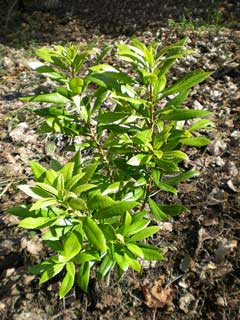
 Myrica californica is an evergreen Shrub growing to 4 m (13ft 1in) at a medium rate.
See above for USDA hardiness. It is hardy to UK zone 7. It is in leaf all year, in flower in May, and the seeds ripen from September to October. The species is monoecious (individual flowers are either male or female, but both sexes can be found on the same plant) and is pollinated by Wind.
It can fix Nitrogen.
Suitable for: light (sandy), medium (loamy) and heavy (clay) soils and prefers well-drained soil. Suitable pH: mildly acid and neutral soils and can grow in very acid soils.
It can grow in semi-shade (light woodland) or no shade. It prefers moist soil. The plant can tolerates strong winds but not maritime exposure.
UK Hardiness Map
US Hardiness Map
Synonyms
Plant Habitats
Woodland Garden Sunny Edge; Dappled Shade;
Edible Uses
Edible Parts: Fruit
Edible Uses:
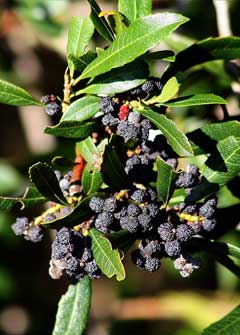
Fruit - raw or cooked[105, 177]. The fruit is about 6mm in diameter with a large seed[200]. There is very little edible flesh and the flavour of this is poor[200, K].
References More on Edible Uses
Medicinal Uses
Plants For A Future can not take any responsibility for any adverse effects from the use of plants. Always seek advice from a professional before using a plant medicinally.
Stomachic
The bark and root bark is used in the treatment of gastrointestinal disorders and infections[238].
References More on Medicinal Uses
The Bookshop: Edible Plant Books
Our Latest books on Perennial Plants For Food Forests and Permaculture Gardens in paperback or digital formats.

Edible Tropical Plants
Food Forest Plants for Hotter Conditions: 250+ Plants For Tropical Food Forests & Permaculture Gardens.
More

Edible Temperate Plants
Plants for Your Food Forest: 500 Plants for Temperate Food Forests & Permaculture Gardens.
More

More Books
PFAF have eight books available in paperback and digital formats. Browse the shop for more information.
Shop Now
Other Uses
Dye Wax Wood
A wax covering on the fruit is extracted by scalding the fruit with boiling water and immersing them for a few minutes, the wax floats to the surface and is then skimmed off. The fruit is then boiled in water to extract the wax from the pulp and once more the wax is skimmed off. It is then strained through a muslin cloth and can be used to make aromatic candles[106, 245]. Candles made from this wax are quite brittle but are less greasy in warm weather[213]. They are slightly aromatic and do not smoke when put out, making them much more pleasant to use that wax or tallow candles[213]. The wax is also used in making soaps[213]. To date (07/12/95) plants growing on our Cornish trial grounds have fruited freely but have not produced much wax. They produced somewhat more after the hot summer of 1995, but there was still not enough to make extraction worthwhile[K]. A grey-brown and a maroon-purple dye are obtained from the fresh or dried berries[168]. Wood - heavy, very hard, strong, brittle, close grained[82].
Special Uses
Food Forest Nitrogen Fixer Scented Plants
References More on Other Uses
Cultivation details
Landscape Uses:Border, Hedge, Screen, Seashore, Specimen. Prefers a moist soil[200]. Grows well in an open position in a well-drained soil in sun or light shade[200]. Thrives in any ordinary garden soil according to one report[11] whilst another says that it thrives in an acid soil[182]. Prefers a lime-free loamy or peaty soil[1]. Plants can be cut back to the ground in severe winters in many parts of Britain[1, 11], but they are well suited to the milder parts of the country[11, 59] where they are fast-growing and produce fruit within 5 years from seed[K]. They succeed and fruit well on a south facing wall at Kew[K]. Plants in this genus are notably resistant to honey fungus[200]. The fruit is covered with a deposit of wax that has a balsamic odour[245]. Many species in this genus have a symbiotic relationship with certain soil micro-organisms, these form nodules on the roots of the plants and fix atmospheric nitrogen. Some of this nitrogen is utilized by the growing plant but some can also be used by other plants growing nearby[200]. Special Features:Attracts birds, North American native, Fragrant foliage, Attracts butterflies, Inconspicuous flowers or blooms.
References Carbon Farming Information and Carbon Sequestration Information
Temperature Converter
Type a value in the Celsius field to convert the value to Fahrenheit:
Fahrenheit:
The PFAF Bookshop
Plants For A Future have a number of books available in paperback and digital form. Book titles include Edible Plants, Edible Perennials, Edible Trees,Edible Shrubs, Woodland Gardening, and Temperate Food Forest Plants. Our new book is Food Forest Plants For Hotter Conditions (Tropical and Sub-Tropical).
Shop Now
Plant Propagation
Seed - best sown as soon as it is ripe in the autumn in a cold frame[78]. Stored seed germinates more freely if given a 3 month cold stratification and then sown in a cold frame[78]. Germination is usually good[78]. Prick out the seedlings into individual pots when they are large enough to handle and grow them on in the cold frame for the first winter. Plant out in late spring or early summer[K]. Cuttings of half-ripe wood, 5 - 8cm with a heel, July/August in a frame. Pot up and overwinter in a cold frame then plant out in late spring or early summer. Fair to good percentage[78]. Layering in spring[200].
Other Names
If available other names are mentioned here
Native Plant Search
Search over 900 plants ideal for food forests and permaculture gardens. Filter to search native plants to your area. The plants selected are the plants in our book 'Plants For Your Food Forest: 500 Plants for Temperate Food Forests and Permaculture Gardens, as well as plants chosen for our forthcoming related books for Tropical/Hot Wet Climates and Mediterranean/Hot Dry Climates. Native Plant Search
Found In
Countries where the plant has been found are listed here if the information is available
Australia, Canada, North America, USA,
Weed Potential
Right plant wrong place. We are currently updating this section.
Please note that a plant may be invasive in one area but may not in your area so it’s worth checking.
Conservation Status
IUCN Red List of Threatened Plants Status :

Growth: S = slow M = medium F = fast. Soil: L = light (sandy) M = medium H = heavy (clay). pH: A = acid N = neutral B = basic (alkaline). Shade: F = full shade S = semi-shade N = no shade. Moisture: D = dry M = Moist We = wet Wa = water.

Expert comment
Author
Cham.
Botanical References
1160200
Links / References
For a list of references used on this page please go here
Readers comment