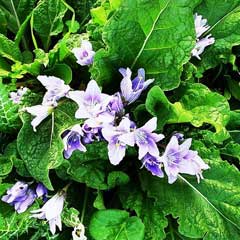
 |
|
http://commons.wikimedia.org/wiki/User:Esculapio |
 |
| http://commons.wikimedia.org/wiki/User:Llez |
Translate this page:
Summary
Physical Characteristics

 Mandragora officinarum is a PERENNIAL growing to 0.1 m (0ft 4in) by 0.3 m (1ft).
See above for USDA hardiness. It is hardy to UK zone 7 and is not frost tender. It is in leaf from March to July, in flower from March to April, and the seeds ripen from July to August. The species is hermaphrodite (has both male and female organs) and is pollinated by Insects. The plant is self-fertile.
Suitable for: light (sandy) and medium (loamy) soils and prefers well-drained soil. Suitable pH: mildly acid and neutral soils. It can grow in semi-shade (light woodland) or no shade. It prefers dry or moist soil.
UK Hardiness Map
US Hardiness Map
Synonyms
Atropa acaulis Stokes. Atropa mandragora L.
Plant Habitats
Woodland Garden Sunny Edge; Dappled Shade; Cultivated Beds;
Edible Uses
Edible Parts: Fruit
Edible Uses:
Fruit - raw or cooked. A delicacy[89]. The fruit is about the size of a small apple, with a strong apple-like scent[4]. Caution is advised in the use of this fruit, it is quite possibly poisonous[K].
References More on Edible Uses
Medicinal Uses
Plants For A Future can not take any responsibility for any adverse effects from the use of plants. Always seek advice from a professional before using a plant medicinally.
Cathartic Emetic Hallucinogenic Narcotic
Mandrake has a long history of medicinal use, though superstition has played a large part in the uses it has been applied to. It is rarely prescribed in modern herbalism[238], though it contains hyoscine which is the standard pre-operative medication given to soothe patients and reduce bronchial secretions[244]. It is also used to treat travel sickness[244]. The fresh or dried root contains highly poisonous alkaloids and is cathartic, strongly emetic, hallucinogenic and narcotic[4, 21, 46, 192, 244]. In sufficient quantities it induces a state of oblivion and was used as an anaesthetic for operations in early surgery[238]. It was much used in the past for its anodyne and soporific properties[4]. In the past, juice from the finely grated root was applied externally to relieve rheumatic pains, ulcers and scrofulous tumours[244]. It was also used internally to treat melancholy, convulsions and mania[244]. When taken internally in large doses, however, it is said to excite delirium and madness[4]. The root should be used with caution, and only under the supervision of a qualified practitioner[21, 238]. See the notes above on toxicity. The leaves are harmless and cooling. They have been used for ointments and other external applications to ulcers etc[4].
References More on Medicinal Uses
The Bookshop: Edible Plant Books
Our Latest books on Perennial Plants For Food Forests and Permaculture Gardens in paperback or digital formats.

Edible Tropical Plants
Food Forest Plants for Hotter Conditions: 250+ Plants For Tropical Food Forests & Permaculture Gardens.
More

Edible Temperate Plants
Plants for Your Food Forest: 500 Plants for Temperate Food Forests & Permaculture Gardens.
More

More Books
PFAF have eight books available in paperback and digital formats. Browse the shop for more information.
Shop Now
Other Uses
References More on Other Uses
Cultivation details
Prefers a deep humus-rich light soil and a sheltered position in full sun[238]. It also tolerates some shade[200]. Prefers a circumneutral soil[200] and dislikes chalk or gravel[4]. Plants are liable to rot in wet or ill-draining soils[4]. Plants are hardy to about -15°c[187]. The roots are somewhat carrot-shaped and can be up to 1.2 metres long[4]. Plants are intolerant of root disturbance and should be put out into their permanent positions as soon as possible[188]. The root often divides into two and is vaguely suggestive of the human body. In the past it was frequently made into amulets which were believed to bring good fortune, cure sterility etc[244]. There is a superstition that if a person pulls up this root they will be condemned to hell[244]. Therefore in the past people have tied the roots to the bodies of animals and then used these animals in order to pull the roots out of the soil.
References Carbon Farming Information and Carbon Sequestration Information
Temperature Converter
Type a value in the Celsius field to convert the value to Fahrenheit:
Fahrenheit:
The PFAF Bookshop
Plants For A Future have a number of books available in paperback and digital form. Book titles include Edible Plants, Edible Perennials, Edible Trees,Edible Shrubs, Woodland Gardening, and Temperate Food Forest Plants. Our new book is Food Forest Plants For Hotter Conditions (Tropical and Sub-Tropical).
Shop Now
Plant Propagation
Seed - best sown in a cold frame in the autumn[188]. The seed can also be sown in spring in a cold frame. When they are large enough to handle, prick the seedlings out into individual pots and grow them on in the greenhouse for at least their first winter. Plant them out into their permanent positions in late spring or early summer, after the last expected frosts. Root cuttings in winter[200]. Division. This can be rather difficult since the plants resent root disturbance.
Other Names
If available other names are mentioned here
Native Plant Search
Search over 900 plants ideal for food forests and permaculture gardens. Filter to search native plants to your area. The plants selected are the plants in our book 'Plants For Your Food Forest: 500 Plants for Temperate Food Forests and Permaculture Gardens, as well as plants chosen for our forthcoming related books for Tropical/Hot Wet Climates and Mediterranean/Hot Dry Climates. Native Plant Search
Found In
Countries where the plant has been found are listed here if the information is available
Weed Potential
Right plant wrong place. We are currently updating this section.
Please note that a plant may be invasive in one area but may not in your area so it’s worth checking.
Conservation Status
IUCN Red List of Threatened Plants Status :

Growth: S = slow M = medium F = fast. Soil: L = light (sandy) M = medium H = heavy (clay). pH: A = acid N = neutral B = basic (alkaline). Shade: F = full shade S = semi-shade N = no shade. Moisture: D = dry M = Moist We = wet Wa = water.

Expert comment
Author
L.
Botanical References
89200
Links / References
For a list of references used on this page please go here
Readers comment