 |
|
http://commons.wikimedia.org/wiki/User:Llez |
 |
| http://commons.wikimedia.org/wiki/User:Llez |
Translate this page:
Summary
Physical Characteristics

 Malus sylvestris is a deciduous Tree growing to 10 m (32ft 10in).
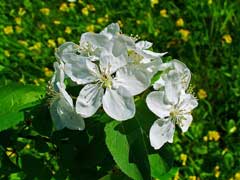
See above for USDA hardiness. It is hardy to UK zone 4 and is not frost tender. It is in flower in May, and the seeds ripen from September to October. The species is hermaphrodite (has both male and female organs) and is pollinated by Insects.
It is noted for attracting wildlife.
Suitable for: light (sandy), medium (loamy) and heavy (clay) soils, prefers well-drained soil and can grow in heavy clay soil. Suitable pH: mildly acid, neutral and basic (mildly alkaline) soils. It can grow in semi-shade (light woodland) or no shade. It prefers moist soil.
UK Hardiness Map
US Hardiness Map
Synonyms
M. acerba. M. communis sylvestris. Pyrus malus.
Plant Habitats
Woodland Garden Secondary; Sunny Edge; Dappled Shade;
Edible Uses
Edible Parts: Fruit Oil
Edible Uses: Oil Pectin Pectin Tea
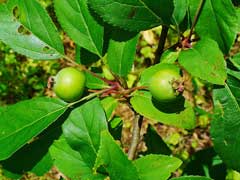
Fruit - raw or cooked[9, 15]. Used for jellies, preserves and juices[183]. The flavour improves considerably if the fruit is not harvested until it has been frosted[12]. The fruit is quite variable in size (it is about 2 - 4cm in diameter[200]) and quality. Whilst usually harsh and acid, some forms are quite sweet and can be eaten out of hand[K]. The fruit is rich in pectin and can be used in helping other fruits to set when making jam etc[61, 142]. Pectin is also said to protect the body against radiation[201]. An edible oil can be obtained from the seed[4]. It would only really be viable to use these seeds as an oil source if the fruit was being used for some purpose such as making cider and then the seeds could be extracted from the remaining pulp[K]. A very pleasant tea can be made from the leaves[7].
References More on Edible Uses
Medicinal Uses
Plants For A Future can not take any responsibility for any adverse effects from the use of plants. Always seek advice from a professional before using a plant medicinally.
Anthelmintic Antibacterial Astringent Hypnotic Laxative Refrigerant
The fruit is astringent and laxative[4, 9]. The crushed fruit pulp can be used as a poultice to heal inflammations or small flesh wounds[7]. The fruit is eaten to obviate constipation[240]. The bark, and especially the root bark, is anthelmintic, refrigerant and soporific[218, 240]. An infusion is used in the treatment of intermittent, remittent and bilious fevers[4, 240]. The leaves contain up to 2.4% of an antibacterial substance called 'florin'[240]. This inhibits the growth of a number of gram-positive and gram-negative bacteria in as low a concentration as 30 ppm[240].
References More on Medicinal Uses
The Bookshop: Edible Plant Books
Our Latest books on Perennial Plants For Food Forests and Permaculture Gardens in paperback or digital formats.

Edible Tropical Plants
Food Forest Plants for Hotter Conditions: 250+ Plants For Tropical Food Forests & Permaculture Gardens.
More

Edible Temperate Plants
Plants for Your Food Forest: 500 Plants for Temperate Food Forests & Permaculture Gardens.
More

More Books
PFAF have eight books available in paperback and digital formats. Browse the shop for more information.
Shop Now
Other Uses
Dye Fuel Oil Pectin Pectin
The fruit is a source of pectin[61, 142]. Pectin is used as a thickener in jams etc and as a culture medium in laboratories. A red to yellow dye is obtained from the bark[257]. The wood is an excellent fuel[67].
Special Uses
Attracts Wildlife
References More on Other Uses
Cultivation details
An easily grown plant, it succeeds in most fertile soils, including heavy ones, preferring a moisture retentive well-drained loamy soil[1, 98, 200]. Prefers a sunny position but succeeds in partial shade though it fruits less well in such a situation[186, 200]. Fairly tolerant of cutting, it succeeds in a mixed hedgerow[186]. A parent of the cultivated apple[11], it is often used as a rootstock[50]. The fruit is a good wildlife food source, especially for birds[200]. The plant has over 90 associated insect species[24]. Hybridizes freely with other members of this genus[200]. Plants in this genus are notably susceptible to honey fungus[200].
References Carbon Farming Information and Carbon Sequestration Information
Temperature Converter
Type a value in the Celsius field to convert the value to Fahrenheit:
Fahrenheit:
The PFAF Bookshop
Plants For A Future have a number of books available in paperback and digital form. Book titles include Edible Plants, Edible Perennials, Edible Trees,Edible Shrubs, Woodland Gardening, and Temperate Food Forest Plants. Our new book is Food Forest Plants For Hotter Conditions (Tropical and Sub-Tropical).
Shop Now
Plant Propagation
Seed - best sown as soon as it is ripe in the autumn in a cold frame. It usually germinates in late winter. Stored seed requires stratification for 3 months at 1°c and should be sown in a cold frame as soon as it is received[200]. It might not germinate for 12 months or more. Prick out the seedlings into individual pots as soon as they are large enough to handle. If given a rich compost they usually grow away quickly and can be large enough to plant out in late summer, though consider giving them some protection from the cold in their first winter. Otherwise, keep them in pots in a cold frame and plant them out in late spring of the following year. Cuttings of mature wood, November in a frame[11].
Other Names
If available other names are mentioned here
Native Plant Search
Search over 900 plants ideal for food forests and permaculture gardens. Filter to search native plants to your area. The plants selected are the plants in our book 'Plants For Your Food Forest: 500 Plants for Temperate Food Forests and Permaculture Gardens, as well as plants chosen for our forthcoming related books for Tropical/Hot Wet Climates and Mediterranean/Hot Dry Climates. Native Plant Search
Found In
Countries where the plant has been found are listed here if the information is available
Weed Potential
Right plant wrong place. We are currently updating this section.
Please note that a plant may be invasive in one area but may not in your area so it’s worth checking.
Conservation Status
IUCN Red List of Threatened Plants Status :

| Related Plants
|
| Latin Name | Common Name | Habit | Height | Hardiness | Growth | Soil | Shade | Moisture | Edible | Medicinal | Other |
| Malus angustifolia | Southern Crab, Southern crab apple | Tree | 7.0 |
3-8
| M | LMH | SN | M | 2 | 0 | 2 |
| Malus baccata | Chinese Crab, Siberian crab apple | Tree | 15.0 |
2-7
| M | LMH | SN | M | 2 | 1 | 2 |
| Malus baccata mandschurica | Manchurian Apple | Tree | 7.0 |
0-0
| | LMH | SN | M | 4 | 0 | 2 |
| Malus bracteata | | Tree | 7.0 |
5-9
| | LMH | SN | M | 2 | 0 | |
| Malus brevipes | | Tree | 3.0 |
4-8
| | LMH | SN | M | 2 | 0 | |
| Malus coronaria | Garland Crab, Sweet crab apple | Tree | 7.0 |
4-8
| | LMH | SN | MWe | 3 | 1 | 3 |
| Malus domestica | Apple | Tree | 9.0 |
3-8
| | LMH | SN | M | 5 | 2 | 4 |
| Malus florentina | Hawthorn-leaf crab apple | Tree | 8.0 |
4-8
| | LMH | SN | MWe | 2 | 0 | |
| Malus floribunda | Japanese Crab, Japanese flowering crab apple | Tree | 10.0 |
4-7
| M | LMH | SN | M | 3 | 0 | |
| Malus fusca | Oregon Crab, Oregon crab apple | Tree | 12.0 |
5-9
| S | LMH | SN | M | 3 | 2 | 2 |
| Malus glabrata | | Tree | 5.0 |
5-9
| | LMH | SN | M | 2 | 0 | |
| Malus glaucescens | | Tree | 5.0 |
4-8
| | LMH | SN | M | 2 | 0 | 1 |
| Malus halliana | Hall crab apple | Tree | 4.0 |
4-8
| | LMH | SN | M | 2 | 0 | |
| Malus halliana spontanea | | Tree | 4.0 |
4-8
| | LMH | SN | M | 2 | 0 | |
| Malus hupehensis | Chinese Crab, Chinese crab apple, Tea Crabapple, Flowering Tea Crabapple | Tree | 7.0 |
4-8
| M | LMH | SN | M | 2 | 0 | 2 |
| Malus ioensis | Prairie Crab, Prairie crab apple, Texas crab apple, Prairie Crabapple | Tree | 5.0 |
3-8
| S | LMH | SN | M | 2 | 0 | 2 |
| Malus ioensis palmeri | Prairie Crab | Tree | 5.0 |
-
| | LMH | SN | M | 2 | 0 | |
| Malus kansuensis | | Tree | 5.0 |
4-8
| | LMH | SN | M | 2 | 0 | |
| Malus lancifolia | | Tree | 6.0 |
4-8
| | LMH | SN | M | 2 | 0 | 1 |
| Malus praecox | | Tree | 0.0 |
-
| | LMH | SN | M | 2 | 0 | |
| Malus prattii | Pratt apple | Tree | 10.0 |
5-9
| | LMH | SN | M | 2 | 0 | |
| Malus prunifolia | Chinese Apple, Plumleaf crab apple | Tree | 8.0 |
3-7
| | LMH | SN | M | 4 | 0 | 1 |
| Malus prunifolia rinkii | Chinese Apple | Tree | 8.0 |
3-7
| | LMH | SN | M | 3 | 0 | |
| Malus pumila | Paradise Apple, Common Apple, Apple Tree | Tree | 7.0 |
3-9
| M | LMH | SN | M | 4 | 2 | 3 |
| Malus pumila nervosa | Crab Apple | Tree | 5.0 |
3-7
| | LMH | SN | M | 3 | 0 | 2 |
| Malus pumila paradisiaca | Paradise Apple | Tree | 5.0 |
3-7
| | LMH | SN | M | 3 | 0 | 2 |
| Malus sargentii | Sargent's apple, Sargent Crabapple | Shrub | 4.0 |
4-8
| S | LMH | SN | M | 2 | 0 | |
| Malus sieversii | Crabapple | Tree | 8.0 |
4-10
| | LMH | SN | M | 3 | 0 | 0 |
| Malus sikkimensis | | Tree | 7.0 |
5-9
| | LMH | SN | M | 2 | 0 | |
| Malus spectabilis | Chinese Flowering Apple, Asiatic apple | Tree | 9.0 |
4-8
| | LMH | SN | M | 3 | 0 | |
|
|
Growth: S = slow M = medium F = fast. Soil: L = light (sandy) M = medium H = heavy (clay). pH: A = acid N = neutral B = basic (alkaline). Shade: F = full shade S = semi-shade N = no shade. Moisture: D = dry M = Moist We = wet Wa = water.

Expert comment
Author
Mill.
Botanical References
1117200
Links / References
For a list of references used on this page please go here
Readers comment