 |
|
http://commons.wikimedia.org/wiki/User:Nino_Barbieri |
 |
| http://commons.wikimedia.org/wiki/User:Jeantosti |
Translate this page:
Summary
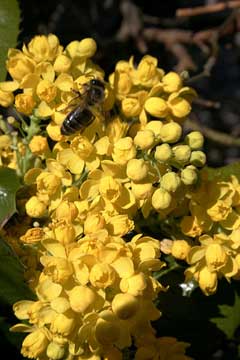
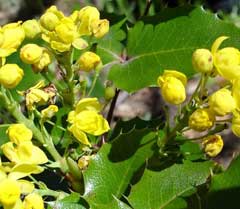
Mahonia aquifolium is a great plant for shade and works well in woodland gardens. The fruit is almost as large as a blackcurrant and is produced in large bunches so it is easy to harvest. It has medicinal and other uses. Cultivars have Royal Horticultural Society's Award of Garden Merit: M. × wagneri 'Pinnacle' (M. aquifolium × M. pinnata) and 'Apollo’. Bloom Color: Yellow. Main Bloom Time: Early spring to Mid spring. Evergreen, upright or spreading. Pinnately compound leaves with 5-11 shiny, green, holly like leaflets. Leathery, oblong leaflets flat to strongly wavy with sharp, spine-tipped teeth. Yellow flowers in dense racemes at branch tips. Sour Dark bluish berries covered with white film. Form: Upright or erect.
Physical Characteristics

 Mahonia aquifolium is an evergreen Shrub growing to 2 m (6ft) by 1.5 m (5ft) at a fast rate.
See above for USDA hardiness. It is hardy to UK zone 5. It is in leaf all year, in flower from January to May, and the seeds ripen from August to September. The species is hermaphrodite (has both male and female organs) and is pollinated by Insects. The plant is self-fertile.
Suitable for: light (sandy), medium (loamy) and heavy (clay) soils and can grow in heavy clay soil. Suitable pH: mildly acid, neutral and basic (mildly alkaline) soils. It can grow in full shade (deep woodland) semi-shade (light woodland) or no shade. It prefers dry or moist soil.
UK Hardiness Map
US Hardiness Map
Synonyms
Berberis aquifolium. Berberis fascicularis. Odostemon aquifolium.
Plant Habitats
Woodland Garden Sunny Edge; Dappled Shade; Shady Edge; not Deep Shade; Ground Cover; Hedge;
Edible Uses
Edible Parts: Flowers Fruit
Edible Uses: Drink
Fruit - raw or cooked[2, 3, 5, 95]. The fruit is almost as large as a blackcurrant and is produced in large bunches so it is easy to harvest[K]. It has an acid flavour, but it is rather nice raw and is especially good when added to a porridge or muesli[K]. Unfortunately, there is relatively little flesh and a lot of seeds, though some plants have larger and juicier fruits[K]. The cooked fruit tastes somewhat like blackcurrants[K]. The fruit can also be dried and stored for later use[257]. Flowers - raw. They can also be used to make a lemonade-like drink[183].
References More on Edible Uses
Medicinal Uses
Plants For A Future can not take any responsibility for any adverse effects from the use of plants. Always seek advice from a professional before using a plant medicinally.
Alterative Antibacterial Antipsoriatic Antiseborrheic Antitumor Blood tonic Cholagogue Diuretic
Dysentery Laxative Ophthalmic Tonic
Oregon grape was often used by several native North American Indian tribes to treat loss of appetite and debility[254]. Its current herbal use is mainly in the treatment of gastritis and general digestive weakness, to stimulate the kidney and gallbladder function and to reduce catarrhal problems[254, 257]. The root and root bark is alterative, blood tonic, cholagogue, diuretic, laxative and tonic[4, 21, 165, 257]. It improves the digestion and absorption and is taken internally in the treatment of psoriasis, syphilis, haemorrhages, stomach complaints and impure blood conditions[4, 238]. Externally, it has been used as a gargle for sore throats and as a wash for blurry or bloodshot eyes[257]. The roots are harvested in late autumn or early spring and dried for later use[238]. The fruit is an excellent gentle and safe laxative[257]. Berberine, universally present in rhizomes of Mahonia species, has marked antibacterial effects[218] and is used as a bitter tonic[213]. Since it is not appreciably absorbed by the body, it is used orally in the treatment of various enteric infections, especially bacterial dysentery[218]. It should not be used with Glycyrrhiza species (Liquorice) because this nullifies the effects of the berberine[218]. Berberine has also shown antitumour activity[218]. The root and root bark are best harvested in the autumn[213].
References More on Medicinal Uses
The Bookshop: Edible Plant Books
Our Latest books on Perennial Plants For Food Forests and Permaculture Gardens in paperback or digital formats.
Edible Tropical Plants
Food Forest Plants for Hotter Conditions: 250+ Plants For Tropical Food Forests & Permaculture Gardens.
More
Edible Temperate Plants
Plants for Your Food Forest: 500 Plants for Temperate Food Forests & Permaculture Gardens.
More
More Books
PFAF have eight books available in paperback and digital formats. Browse the shop for more information.
Shop Now
Other Uses
Dye Hedge Hedge
A yellow dye is obtained from the inner bark of the stem and roots[99, 101, 257]. It is green according to another report[168]. Dark green, violet and dark blue-purple dyes are obtained from the fruit[168]. A green dye is obtained from the leaves[168]. This species can be grown as a low hedge and does not need trimming. Because of its suckering habit, it also makes a good dense ground cover plant though it can be slow to become established[197, 200].
Special Uses
Food Forest Ground cover Hedge Hedge Scented Plants
References More on Other Uses
Cultivation details
Landscape Uses:Border, Foundation, Pest tolerant, Massing, Specimen, Woodland garden. A very easy plant to grow, thriving in any good garden soil[11, 200] and tolerating dense shade under trees[1, 28]. It grows well in heavy clay soils and also succeeds in dry soils if it is given a good mulch annually[197]. It dislikes exposure to strong winds[K]. Plants are hardy to about -20°c[184]. Very tolerant of pruning, plants can be cut back into old wood if they grow too large and straggly[238]. Spring is the best time to do this[238]. Suckers are fairly freely produced, with established plants forming dense thickets[200]. Most plants grown under this name are casual hybrids with M. repens[67]. This species is easily confused with M. pinnata[67], with which it also hybridizes[200]. The flowers are delicately scented[245]. A number of named forms have been developed for their ornamental value[182]. This species is notably resistant to honey fungus[88, 200]. This plant is the state flower of Oregon[95]. Special Features:
North American native, Fragrant flowers, Attractive flowers or blooms. The plant is heat tolerant in zones 9 through 6. (Plant Hardiness Zones show how well plants withstand cold winter temperatures.
Plant Heat Zones show when plants would start suffering from the heat.
The Plant Heat Zone map is based on the number of "heat days" experienced in a given area where the temperature climbs to over 86 degrees F (30°C).
At this temperature, many plants begin to suffer physiological damage. Heat Zones range from 1 (no heat days) to 12 (210 or more heat days).
For example Heat Zone. 11-1 indicates that the plant is heat tolerant in zones 11 through 1.) For polyculture design as well as the above-ground architecture (form - tree, shrub etc. and size shown above) information on the habit and root pattern is also useful and given here if available. An evergreen. The root pattern is flat with shallow roots forming a plate near the soil surface [1-2]. The root pattern is stoloniferous rooting from creeping stems above the ground [1-2].
References Carbon Farming Information and Carbon Sequestration Information
Temperature Converter
Type a value in the Celsius field to convert the value to Fahrenheit:
Fahrenheit:
The PFAF Bookshop
Plants For A Future have a number of books available in paperback and digital form. Book titles include Edible Plants, Edible Perennials, Edible Trees,Edible Shrubs, Woodland Gardening, and Temperate Food Forest Plants. Our new book is Food Forest Plants For Hotter Conditions (Tropical and Sub-Tropical).
Shop Now
Plant Propagation
Seed - best sown as soon as it is ripe in a cold frame[78]. It usually germinates in the spring[K]. 'Green' seed (harvested when the embryo has fully developed but before the seed case has dried) should be sown as soon as it is harvested and germinates within 6 weeks[K]. Stored seed should be sown as soon as possible in late winter or spring. 3 weeks cold stratification will improve its germination, which should take place in 3 - 6 months at 10°c. Prick out the seedlings when they are large enough to handle and grow them on in a cold frame for at least their first winter. Plant them out in late spring or early summer. Division of suckers in spring[78]. Whilst they can be placed direct into their permanent positions, better results are achieved if they are potted up and placed in a frame until established[11]. Leaf cuttings in the autumn.
Other Names
If available other names are mentioned here
Native Plant Search
Search over 900 plants ideal for food forests and permaculture gardens. Filter to search native plants to your area. The plants selected are the plants in our book 'Plants For Your Food Forest: 500 Plants for Temperate Food Forests and Permaculture Gardens, as well as plants chosen for our forthcoming related books for Tropical/Hot Wet Climates and Mediterranean/Hot Dry Climates. Native Plant Search
Found In
Countries where the plant has been found are listed here if the information is available
Weed Potential
Right plant wrong place. We are currently updating this section.
Please note that a plant may be invasive in one area but may not in your area so it’s worth checking.
Conservation Status
IUCN Red List of Threatened Plants Status :

| Related Plants
|
| Latin Name | Common Name | Habit | Height | Hardiness | Growth | Soil | Shade | Moisture | Edible | Medicinal | Other |
| Mahonia bealei | Beale's barberry, Leatherleaf Mahonia | Shrub | 2.0 |
5-8
| S | LMH | FSN | M | 3 | 2 | 0 |
| Mahonia confusa | | Shrub | 1.5 |
6-9
| | LMH | FS | M | 3 | 2 | |
| Mahonia flavida | | Shrub | 2.0 |
7-10
| | LMH | FSN | M | 2 | 0 | |
| Mahonia fortunei | Fortune's Mahonia | Shrub | 2.0 |
7-9
| S | LMH | FSN | M | 3 | 2 | |
| Mahonia fremontii | Mahonia, Fremont's mahonia | Shrub | 2.5 |
7-10
| S | LMH | N | DM | 3 | 2 | 2 |
| Mahonia ganpinensis | | Shrub | 0.0 |
-
| | LMH | SN | M | 1 | 2 | |
| Mahonia gracilipes | | Shrub | 1.5 |
6-9
| | LMH | FS | M | 2 | 2 | |
| Mahonia gracilis | Mexican Barberry | Shrub | 1.5 |
7-10
| | LMH | N | DM | 2 | 0 | |
| Mahonia haematocarpa | Mexican Barberry, Red barberry | Shrub | 3.6 |
7-10
| | LMH | N | DM | 3 | 2 | 2 |
| Mahonia japonica | | Shrub | 2.0 |
5-9
| | LMH | FSN | M | 3 | 2 | |
| Mahonia lomariifolia | Chinese hollygrape | Shrub | 5.0 |
8-9
| M | LMH | SN | M | 3 | 2 | 0 |
| Mahonia napaulensis | | Shrub | 2.5 |
5-9
| | LMH | SN | M | 3 | 2 | 1 |
| Mahonia nervosa | Oregon Grape, Cascade barberry | Shrub | 0.6 |
5-9
| S | LMH | FSN | DM | 3 | 2 | 3 |
| Mahonia nevinii | Nevin's barberry | Shrub | 2.4 |
7-10
| | LMH | N | DM | 3 | 2 | 2 |
| Mahonia pinnata | California Barberry, Wavyleaf barberry, Island barberry, Creeping Holly Grape | Shrub | 1.8 |
7-8
| F | LMH | SN | M | 3 | 2 | 2 |
| Mahonia pumila | Dwarf Barberry | Shrub | 0.3 |
6-9
| S | LM | SN | DM | 3 | 2 | 3 |
| Mahonia repens | Creeping Oregon Grape, Creeping barberry, Grape Oregon | Shrub | 0.3 |
4-8
| S | LMH | SN | DM | 3 | 3 | 4 |
| Mahonia swaseyi | Texas Mahonia, Texas barberry | Shrub | 2.5 |
7-10
| | LMH | N | DM | 3 | 2 | |
| Mahonia trifoliolata | Mexican Barberry, Algerita | Shrub | 2.0 |
6-9
| | LMH | N | DM | 3 | 2 | 4 |
| Mahonia x media | | Shrub | 2.0 |
6-9
| | LMH | FSN | M | 3 | 2 | 0 |
|
Growth: S = slow M = medium F = fast. Soil: L = light (sandy) M = medium H = heavy (clay). pH: A = acid N = neutral B = basic (alkaline). Shade: F = full shade S = semi-shade N = no shade. Moisture: D = dry M = Moist We = wet Wa = water.

Expert comment
Author
(Pursh.)Nutt.
Botanical References
11200
Links / References
For a list of references used on this page please go here
Readers comment
| Add a comment |
|
If you have important information about this plant that may help other users please add a comment or link below. Only comments or links that are felt to be directly relevant to a plant will be included. If you think a comment/link or information contained on this page is inaccurate or misleading we would welcome your feedback at [email protected]. If you have questions about a plant please use the Forum on this website as we do not have the resources to answer questions ourselves.
* Please note: the comments by website users are not necessarily those held by PFAF and may give misleading or inaccurate information.
To leave a comment please Register or login here All comments need to be approved so will not appear immediately.
|
Subject : Mahonia aquifolium
|
|
|
|