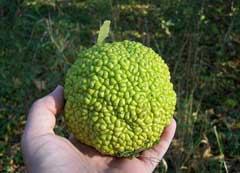
 |
|
http://commons.wikimedia.org/wiki/User:Bruce_Marlin |
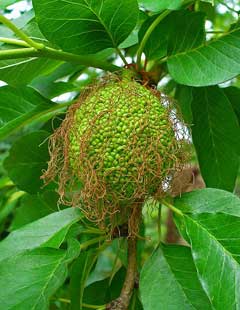 |
| http://commons.wikimedia.org/wiki/User:Llez |
Translate this page:
Summary
Bloom Color: White. Main Bloom Time: Early spring, Late spring, Mid spring. Form: Rounded, Spreading or horizontal.
Physical Characteristics

 Maclura pomifera is a deciduous Tree growing to 15 m (49ft) by 12 m (39ft) at a medium rate.
See above for USDA hardiness. It is hardy to UK zone 5 and is not frost tender. It is in flower from May to June, and the seeds ripen from September to December. The species is dioecious (individual flowers are either male or female, but only one sex is to be found on any one plant so both male and female plants must be grown if seed is required). . The plant is not self-fertile.
Suitable for: light (sandy), medium (loamy) and heavy (clay) soils, prefers well-drained soil and can grow in nutritionally poor soil. Suitable pH: mildly acid, neutral and basic (mildly alkaline) soils. It cannot grow in the shade. It prefers dry or moist soil. The plant can tolerate maritime exposure.
UK Hardiness Map
US Hardiness Map
Synonyms
M. aurantiaca. Toxylon pommifera.
Plant Habitats
Woodland Garden Canopy; Secondary; Sunny Edge; Hedge;
Edible Uses
One report suggests that the fruit is edible[74] but this is surely a mistake - although very large, the fruit is harsh, hard, dry and astringent. The fruit does, however, contain an anti-oxidant which can be used as a food preservative, especially for oils[61]. The heartwood and the root yield a non-toxic antibiotic that is useful as a food preservative[240].
References More on Edible Uses
Medicinal Uses
Plants For A Future can not take any responsibility for any adverse effects from the use of plants. Always seek advice from a professional before using a plant medicinally.
Cardiac Ophthalmic
A tea made from the roots has been used as a wash for sore eyes[222, 257]. The inedible fruits contain antioxidant and fungicidal compounds[222]. A 10% aqueous infusion and an extract diluted 1:1 have cardiovascular potentialities[240].
References More on Medicinal Uses
The Bookshop: Edible Plant Books
Our Latest books on Perennial Plants For Food Forests and Permaculture Gardens in paperback or digital formats.

Edible Tropical Plants
Food Forest Plants for Hotter Conditions: 250+ Plants For Tropical Food Forests & Permaculture Gardens.
More

Edible Temperate Plants
Plants for Your Food Forest: 500 Plants for Temperate Food Forests & Permaculture Gardens.
More

More Books
PFAF have eight books available in paperback and digital formats. Browse the shop for more information.
Shop Now
Other Uses
Dye Fodder Fuel Hedge Hedge Preservative Repellent Shelterbelt Tannin Wood
A yellow dye is obtained from the bark of the root and the wood[46, 57, 95, 149, 169, 257]. Green and orange can also be obtained from it[168]. The sap of the fruit is used as an insect repellent[95]. It is said to be effective against cockroaches[222]. The bark is a source of tannin[82, 149]. The plant is often grown as a hedge in N. America and Europe[1, 20, 50], it is very tolerant of severe pruning[200], makes an effective stock-proof barrier[200] and succeeds in maritime exposure[K]. A hedge in a very exposed position at Rosewarne in N. Cornwall has grown well (1989), though it is very bare in winter[K]. This species is also used in shelterbelt plantings[200]. Wood - coarse-grained, exceedingly hard, heavy, flexible, very strong, very durable, silky, lustrous. It weighs 48lb per cubic foot. One of the most durable woods in N. America, it is seldom used commercially, but is used locally for fence posts,piers, bows etc and makes an excellent fuel[46, 82, 95, 171, 200, 227, 229, 274].
Special Uses
Carbon Farming Hedge Hedge
References More on Other Uses
Cultivation details
Agroforestry Services: Living fence Fodder: Insect Industrial Crop: Biomass Industrial Crop: Dye Industrial Crop: Starch Management: Coppice Management: Standard Regional Crop Staple Crop: Protein-oil
Landscape Uses:Firewood, Pest tolerant, Aggressive surface roots possible. Prefers a well-drained soil in full sun[200]. Succeeds in poor soils and also in dry ones[20]. Plants are fairly tolerant of maritime exposure[K]. They dislike waterlogged soils[188]. Dormant mature plants are hardy to about -20°c though the young growth in spring can be cut back by late frosts[200] and young plants can be damaged in cold winters[188]. Plants require hot summers to fully ripen their wood if they are to thrive in areas with cold winters[188]. Plants are tolerant of severe pruning[200]. This species is notably resistant to honey fungus[200]. Dioecious. Male and female plants must be grown if seed is required. Special Features:North American native, All or parts of this plant are poisonous, Inconspicuous flowers or blooms.
Carbon Farming
-
Agroforestry Services: Living fence
Simply managed rows of shrubs and trees.
-
Fodder: Insect
Plants grown for useful fodder insects.
-
Industrial Crop: Biomass
Three broad categories: bamboos, resprouting woody plants, and giant grasses. uses include: protein, materials (paper, building materials, fibers, biochar etc.), chemicals (biobased chemicals), energy - biofuels
-
Industrial Crop: Dye
Botanical dyes replacing synthetic dyes (known as heavy polluters).
-
Industrial Crop: Starch
Materials and chemicals include bioplastics, paper, cardboard, solvents, paints, glues etc. Plants are usually pods, starchy fruits, nuts & seeds, starchy trunks.
-
Management: Coppice
Cut to the ground repeatedly - resprouting vigorously. Non-destructive management systems maintaining the soil organic carbon.
-
Management: Standard
Plants grow to their standard height. Harvest fruit, seeds, or other products. Non-Destructive management systems.
-
Regional Crop
These crops have been domesticated and cultivated regionally but have not been adopted elsewhere and are typically not traded globally, Examples in this broad category include perennial cottons and many nuts and staple fruits.
-
Staple Crop: Protein-oil
(16+ percent protein, 16+ percent oil). Annuals include soybeans, peanuts, sunflower seeds. Perennials include seeds, beans, nuts, and fruits such as almond, Brazil nut, pistachio, walnut, hazel, and safou.
References Carbon Farming Information and Carbon Sequestration Information
Temperature Converter
Type a value in the Celsius field to convert the value to Fahrenheit:
Fahrenheit:
The PFAF Bookshop
Plants For A Future have a number of books available in paperback and digital form. Book titles include Edible Plants, Edible Perennials, Edible Trees,Edible Shrubs, Woodland Gardening, and Temperate Food Forest Plants. Our new book is Food Forest Plants For Hotter Conditions (Tropical and Sub-Tropical).
Shop Now
Plant Propagation
Seed - best sown as soon as it is ripe in pots in a cold frame. Pre-soak stored seed for 48 hours in warm water and stratify for 2 months at 4°c then sow in a cold frame[113, 200]. Germination is normally good. When they are large enough to handle, prick the seedlings out into individual pots and grow them on in the greenhouse for their first winter. Plant them out into their permanent positions in late spring or early summer, after the last expected frosts. The seed stores for 3 years[113]. If growing larger quantities of plants, it is probably best to sow the seed in an open seed bed[200]. Grow the plants on for a couple of years in the seed bed before planting them out into their permanent positions. Cuttings of half-ripe wood, July/August in a frame[200]. Cuttings of mature wood, November to January in a frame[113]. Layering in summer[200]. Root cuttings 4cm long in December. Plant horizontally in pots in a greenhouse and plant out as soon as possible. Good percentage[78].
Other Names
If available other names are mentioned here
Native Plant Search
Search over 900 plants ideal for food forests and permaculture gardens. Filter to search native plants to your area. The plants selected are the plants in our book 'Plants For Your Food Forest: 500 Plants for Temperate Food Forests and Permaculture Gardens, as well as plants chosen for our forthcoming related books for Tropical/Hot Wet Climates and Mediterranean/Hot Dry Climates. Native Plant Search
Found In
Countries where the plant has been found are listed here if the information is available
Weed Potential
Right plant wrong place. We are currently updating this section.
Please note that a plant may be invasive in one area but may not in your area so it’s worth checking.
Conservation Status
IUCN Red List of Threatened Plants Status :

Growth: S = slow M = medium F = fast. Soil: L = light (sandy) M = medium H = heavy (clay). pH: A = acid N = neutral B = basic (alkaline). Shade: F = full shade S = semi-shade N = no shade. Moisture: D = dry M = Moist We = wet Wa = water.

Expert comment
Author
(Raf.)C.K.Schneid.
Botanical References
1160200
Links / References
For a list of references used on this page please go here
Readers comment