 |
|
http://commons.wikimedia.org/wiki/User:Dalgial |
 |
| http://commons.wikimedia.org/wiki/User:Dalgial |
Translate this page:
Summary
Lycium chinense is one of two species of boxthorn (also Lycium barbarum) from which the goji berry or wolfberry are harvested. Chinese boxthorn is a major Chinese tonic herb with a history of almost 2,000 years of medicinal use. The fruit is cooked in soups or dried for later use. Sweet with an aniseed-like flavour.
Physical Characteristics

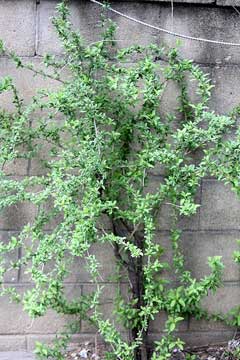
 Lycium chinense is a deciduous Shrub growing to 2.5 m (8ft) by 2 m (6ft) at a medium rate.
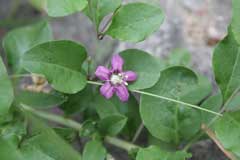
See above for USDA hardiness. It is hardy to UK zone 6. It is in flower from June to August. The species is hermaphrodite (has both male and female organs) and is pollinated by Bees.
Suitable for: light (sandy), medium (loamy) and heavy (clay) soils, prefers well-drained soil and can grow in nutritionally poor soil. Suitable pH: mildly acid, neutral and basic (mildly alkaline) soils. It cannot grow in the shade. It prefers moist soil. The plant can tolerate maritime exposure.
UK Hardiness Map
US Hardiness Map
Synonyms
Plant Habitats
Woodland Garden Sunny Edge; Dappled Shade; Hedge;
Edible Uses
Edible Parts: Fruit Leaves Seed Shoots
Edible Uses: Coffee Tea
Fruit - raw, cooked in soups etc or dried for later use[174, 178, 183]. Sweet with an aniseed-like flavour[183]. The fruit is an oblong berry about 15mm long by 8mm wid[266]. Only the fully ripe fruits should be eaten[K]. Leaves and young shoots - raw or cooked[61, 174, 178]. A peppermint-like flavour, the leaves are used in salads or used as a potherb[183]. Rich in vitamin A., the leaves also contain about 3.9% protein, 2.25% carbohydrate, 0.7% fat, 1.4% ash[179]. The roasted seed is a coffee substitute[183]. The dried leaves are a tea substitute[183].
References More on Edible Uses
| Composition
|
| Figures in grams (g) or miligrams (mg) per 100g of food.
|
|
|
Leaves (Dry weight)
|
|
- 279 Calories per 100g
- Water : 0%
- Protein: 39.4g; Fat: 5.8g; Carbohydrate: 38.5g; Fibre: 12.5g; Ash: 16.3g;
- Minerals - Calcium: 1423mg; Phosphorus: 414mg; Iron: 51.9mg; Magnesium: 0mg; Sodium: 1836mg; Potassium: 4981mg; Zinc: 0mg;
- Vitamins - A: 43mg; Thiamine (B1): 0.77mg; Riboflavin (B2): 2.98mg; Niacin: 7.69mg; B6: 0mg; C: 77mg;
- Reference: [ 218]
- Notes:
|
|
Medicinal Uses
Plants For A Future can not take any responsibility for any adverse effects from the use of plants. Always seek advice from a professional before using a plant medicinally.
Antibacterial Antipyretic Cancer Haemostatic Hepatic Hypoglycaemic Infertility Kidney
Ophthalmic Tonic Vasodilator
Chinese boxthorn is a major Chinese tonic herb with a history of almost 2,000 years of medicinal use[254]. Both the berries and the root are used and traditionally the plant is believed to promote long life[254]. The fruit is one of the most popular tonics used in Chinese herbal medicine[176, 218]. A decoction is used to clear the vision, strengthen the kidneys, restore semen and nourish the liver[147]. The fruit protects the liver from damage caused by exposure to toxins[254]. It is also used in the treatment of diabetes mellitus, vertigo, nocturnal emissions and aching back and legs[176]. The fruit of many members of this genus is a very rich source of vitamins and minerals, especially in vitamins A, C and E, flavanoids and other bio-active compounds. It is also a fairly good source of essential fatty acids, which is fairly unusual for a fruit. It is being investigated as a food that is capable of reducing the incidence of cancer and also as a means of halting or reversing the growth of cancers[214]. The seed is used as a haemostat for the control of bleeding, with a special action on the kidneys and sex organs[218]. The root bark is antibacterial, antipyretic, hepatic, hypoglycaemic and vasodilator[176]. It stimulates the parasympathetic nervous system, which controls involuntary bodily functions such as digestive secretions[254]. The root is used in the treatment of pulmonary tuberculosis and pneumonia in small children[147], chronic febrile disease, night sweats, cough and asthma, tuberculosis, hypertension and diabetes mellitus[176]. The root can be harvested at any time of the year but traditionally it is harvested in the spring and can be dried for later use[254]. The root bark contains betaine. This can increase the rate of growth of farm animals and increase the weight and amount of eggs, it is used in the treatment of achlorhydria, atherosclerosis and hepatic diseases[176]. Haemostatic[174].
References More on Medicinal Uses
The Bookshop: Edible Plant Books
Our Latest books on Perennial Plants For Food Forests and Permaculture Gardens in paperback or digital formats.

Edible Tropical Plants
Food Forest Plants for Hotter Conditions: 250+ Plants For Tropical Food Forests & Permaculture Gardens.
More

Edible Temperate Plants
Plants for Your Food Forest: 500 Plants for Temperate Food Forests & Permaculture Gardens.
More

More Books
PFAF have eight books available in paperback and digital formats. Browse the shop for more information.
Shop Now
Other Uses
Hedge Hedge Soil stabilization
Can be grown as an informal hedge, succeeding in maritime exposure[200]. Plants have an extensive root system and can be planted to stabilize banks[200].
Special Uses
Hedge Hedge
References More on Other Uses
Cultivation details
An easily grown plant, it does not require a rich soil, flowering and fruiting better in a well-drained soil of moderate quality[1, 11, 200]. Succeeds in impoverished soils[200]. Requires a sunny position[200]. Tolerates maritime exposure[200]. A very hardy plant, tolerating temperatures down to about -23°c[200]. This species is widely cultivated for its edible young shoots in China. There is much confusion between this species and the closely related L. barbarum. Most, if not all, of the plants being grown as L. chinense in Britain are in fact L.barbarum[11, 50, 200].
References Carbon Farming Information and Carbon Sequestration Information
Temperature Converter
Type a value in the Celsius field to convert the value to Fahrenheit:
Fahrenheit:
The PFAF Bookshop
Plants For A Future have a number of books available in paperback and digital form. Book titles include Edible Plants, Edible Perennials, Edible Trees,Edible Shrubs, Woodland Gardening, and Temperate Food Forest Plants. Our new book is Food Forest Plants For Hotter Conditions (Tropical and Sub-Tropical).
Shop Now
Plant Propagation
Seed - sow early spring in a greenhouse. Germination is usually good and fairly quick. Prick out the seedlings into individual pots when they are large enough to handle and grow them on in the greenhouse for their first winter. Plant out in late spring or early summer. Pinch out the shoot tips of the young plants in order to encourage bushy growth[78]. Cuttings of half-ripe wood, 5 - 10cm with a heel if possible, July/August in individual pots in a frame. Good percentage[78]. Cuttings of mature wood of the current season's growth, autumn to late winter in a cold frame. High percentage[78, 200]. Division of suckers in late winter. Very easy, the suckers can be planted out direct into their permanent positions. Layering.
Other Names
If available other names are mentioned here
Chinese wolfberry, Chu chi, Daun koki, Gau gei choi, Gouqi, Gugijanamu, Holly Willow, Kaokichai, Kaukichai, Kaukichoy, Kei-chi, Kou-chi, Kou-kay-choi, Kuko, Matrimony vine,
Native Plant Search
Search over 900 plants ideal for food forests and permaculture gardens. Filter to search native plants to your area. The plants selected are the plants in our book 'Plants For Your Food Forest: 500 Plants for Temperate Food Forests and Permaculture Gardens, as well as plants chosen for our forthcoming related books for Tropical/Hot Wet Climates and Mediterranean/Hot Dry Climates. Native Plant Search
Found In
Countries where the plant has been found are listed here if the information is available
Asia, Australia, Canada, China*, France, Hawaii, Indochina, Indonesia, Italy, Japan, Korea, Laos, Malaysia, Mediterranean, Nepal, North America, Pacific, Pakistan, Portugal, SE Asia, Singapore, Taiwan, Thailand, USA, Vietnam,
Weed Potential
Right plant wrong place. We are currently updating this section.
Please note that a plant may be invasive in one area but may not in your area so it’s worth checking.
Conservation Status
IUCN Red List of Threatened Plants Status :

| Related Plants
|
| Latin Name | Common Name | Habit | Height | Hardiness | Growth | Soil | Shade | Moisture | Edible | Medicinal | Other |
| Berberis lycium | | Shrub | 3.0 |
5-9
| M | LMH | SN | DM | 3 | 3 | 1 |
| Lycium afrum | | Shrub | 2.0 |
8-11
| | LMH | N | DM | 1 | 2 | 3 |
| Lycium andersonii | Wolfberry, Water jacket | Shrub | 0.0 |
0-0
| | LMH | N | DM | 1 | 2 | 2 |
| Lycium arabicum | | Shrub | 0.0 |
-
| | LMH | N | M | 1 | 2 | 2 |
| Lycium australe | | Shrub | 1.0 |
-
| | LMH | N | DM | 1 | 2 | 2 |
| Lycium barbarum | Goji, Box Thorn, Matrimony vine | Shrub | 2.5 |
6-9
| M | LMH | SN | M | 4 | 3 | 3 |
| Lycium berlandieri | Berlandier's wolfberry | Shrub | 0.0 |
0-0
| | LMH | N | DM | 1 | 2 | 2 |
| Lycium carolinianum | Christmas Berry, Carolina desert-thorn | Shrub | 1.5 |
7-10
| | LMH | N | M | 3 | 2 | 3 |
| Lycium europaeum | European tea-tree, Box thorn, | Shrub | 4.0 |
8-11
| | LMH | N | M | 3 | 2 | 3 |
| Lycium fremontii | Desert Thorn, Fremont's desert-thorn | Shrub | 3.0 |
0-0
| | LMH | N | DM | 1 | 2 | 2 |
| Lycium pallidum | Pale Wolfberry, Pale desert-thorn, Rabbit thorn | Shrub | 1.8 |
5-9
| | LMH | N | DM | 3 | 2 | 3 |
| Lycium ruthenicum | | Shrub | 2.0 |
5-9
| | LMH | N | DM | 3 | 2 | 3 |
| Lycium schweinfurthii | | Shrub | 2.0 |
-
| | LMH | N | DM | 2 | 2 | 2 |
| Lycium torreyi | Squawthorn, Torrey wolfberry | Shrub | 3.0 |
0-0
| | LMH | N | DM | 2 | 2 | 2 |
|
Growth: S = slow M = medium F = fast. Soil: L = light (sandy) M = medium H = heavy (clay). pH: A = acid N = neutral B = basic (alkaline). Shade: F = full shade S = semi-shade N = no shade. Moisture: D = dry M = Moist We = wet Wa = water.

Expert comment
Author
Mill.
Botanical References
1158200
Links / References
For a list of references used on this page please go here
Readers comment