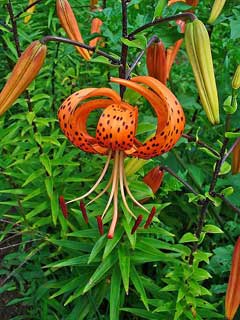
 |
|
http://commons.wikimedia.org/wiki/User:Llez |
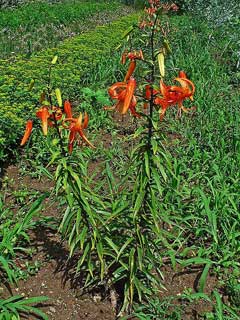 |
| http://commons.wikimedia.org/wiki/User:Llez |
Translate this page:
Summary
Bloom Color: Orange. Main Bloom Time: Early fall, Late summer. Form: Upright or erect.
Physical Characteristics

 Lilium lancifolium is a BULB growing to 1.2 m (4ft) by 0.3 m (1ft in) at a medium rate.
See above for USDA hardiness. It is hardy to UK zone 4. It is in flower from August to September, and the seeds ripen from September to October. The species is hermaphrodite (has both male and female organs) and is pollinated by Bees. The plant is not self-fertile.
Suitable for: light (sandy), medium (loamy) and heavy (clay) soils and prefers well-drained soil. Suitable pH: mildly acid, neutral and basic (mildly alkaline) soils. It can grow in semi-shade (light woodland) or no shade. It prefers moist soil.
UK Hardiness Map
US Hardiness Map
Synonyms
L. tigrinum.
Plant Habitats
Woodland Garden Sunny Edge; Dappled Shade; Shady Edge;
Edible Uses
Edible Parts: Flowers Root
Edible Uses:
Bulb - cooked[2, 4, 42, 47]. Somewhat bitterish[105]. Fairly pleasant, when properly cooked they are highly esteemed as a vegetable and somewhat resemble parsnips in flavour[183]. The bulbs are up to 8cm in diameter[266]. They are a good source of starch[105, 183]. The bulb can be dried and ground into powder. Flowers - raw or cooked. Used fresh or dried in salads, soups, rice dishes etc[183].
References More on Edible Uses
Medicinal Uses
Plants For A Future can not take any responsibility for any adverse effects from the use of plants. Always seek advice from a professional before using a plant medicinally.
Antiinflammatory Cardiac Carminative Diuretic Emmenagogue Emollient Expectorant Ophthalmic
Women's complaints
The bulb is antiinflammatory, diuretic, emmenagogue, emollient and expectorant[240, 279]. They are used to relieve heart diseases, pain in the cardiac region and angina pectoris[240]. They are used in Korea to treat coughs, sore throats, palpitations and boils[279]. The flowers are carminative[240]. They are used to strengthen the eye-lid muscles and are commended in the treatment of myopic astigmatism[240]. A tincture made from the flowering plant, harvested when in full flower, is used in the treatment of uterine neuralgia, congestion, irritation and the nausea of pregnancy[4]. It relieves the bearing-down pain accompanying uterine prolapse and is an important remedy in ovarian neuralgia[4].
References More on Medicinal Uses
The Bookshop: Edible Plant Books
Our Latest books on Perennial Plants For Food Forests and Permaculture Gardens in paperback or digital formats.
Edible Tropical Plants
Food Forest Plants for Hotter Conditions: 250+ Plants For Tropical Food Forests & Permaculture Gardens.
More
Edible Temperate Plants
Plants for Your Food Forest: 500 Plants for Temperate Food Forests & Permaculture Gardens.
More
More Books
PFAF have eight books available in paperback and digital formats. Browse the shop for more information.
Shop Now
Other Uses
References More on Other Uses
Cultivation details
Landscape Uses:Border, Container, Foundation, Massing, Seashore. Prefers an open free-draining humus-rich loamy soil with its roots in the shade and its head in the sun[200]. Prefers a lime-free soil according to some reports[28, 47, 143], whilst one says that it succeeds in a calcareous soil[1] and another that it succeeds in ordinary garden soil[1, 42]. Prefers a deep acid loam[47]. Likes a sunny position according to one report[143] whilst others say that it is best grown in open woodland or amongst dwarf evergreen shrubs[1]. Stem rooting, the bulbs should be planted 15 - 20cm deep[143]. Early to mid autumn is the best time to plant out the bulbs in cool temperate areas, in warmer areas they can be planted out as late as late autumn[200]. Plants grow well in northern gardens in Britain[90]. A sterile triploid species, probably of hybrid origin[90]. A very ornamental plant[1], it is cultivated for its edible bulb in Japan[2, 42, 163]. This species tolerates virus infections, but it can transmit them to other species in this genus and so is best grown away from any of the other species[47]. The plant should be protected against rabbits and slugs in early spring. If the shoot tip is eaten out the bulb will not grow in that year and will lose vigour[200]. The plant is heat tolerant in zones 8 through 1. (Plant Hardiness Zones show how well plants withstand cold winter temperatures.
Plant Heat Zones show when plants would start suffering from the heat.
The Plant Heat Zone map is based on the number of "heat days" experienced in a given area where the temperature climbs to over 86 degrees F (30°C).
At this temperature, many plants begin to suffer physiological damage. Heat Zones range from 1 (no heat days) to 12 (210 or more heat days).
For example Heat Zone. 11-1 indicates that the plant is heat tolerant in zones 11 through 1.) For polyculture design as well as the above-ground architecture (form - tree, shrub etc. and size shown above) information on the habit and root pattern is also useful and given here if available. The plant growth habit is a clumper with limited spread [1-2]. The root pattern is a bulb.
References Carbon Farming Information and Carbon Sequestration Information
Temperature Converter
Type a value in the Celsius field to convert the value to Fahrenheit:
Fahrenheit:
The PFAF Bookshop
Plants For A Future have a number of books available in paperback and digital form. Book titles include Edible Plants, Edible Perennials, Edible Trees,Edible Shrubs, Woodland Gardening, and Temperate Food Forest Plants. Our new book is Food Forest Plants For Hotter Conditions (Tropical and Sub-Tropical).
Shop Now
Plant Propagation
Seed - this species is completely sterile and does not produce seed. Division with care in the autumn once the leaves have died down. Replant immediately[200]. Bulb scales can be removed from the bulbs in early autumn. If they are kept in a warm dark place in a bag of moist peat, they will produce bulblets. These bulblets can be potted up and grown on in the greenhouse until they are large enough to plant out[200]. Bulbils - gather in late summer when they start to fall off the stems and pot up immediately. Grow on in a greenhouse until large enough to go outside[200]. Plants can flower in three years from bulbils[4].
Other Names
If available other names are mentioned here
Native Plant Search
Search over 900 plants ideal for food forests and permaculture gardens. Filter to search native plants to your area. The plants selected are the plants in our book 'Plants For Your Food Forest: 500 Plants for Temperate Food Forests and Permaculture Gardens, as well as plants chosen for our forthcoming related books for Tropical/Hot Wet Climates and Mediterranean/Hot Dry Climates. Native Plant Search
Found In
Countries where the plant has been found are listed here if the information is available
Weed Potential
Right plant wrong place. We are currently updating this section.
Please note that a plant may be invasive in one area but may not in your area so it’s worth checking.
Conservation Status
IUCN Red List of Threatened Plants Status :

Growth: S = slow M = medium F = fast. Soil: L = light (sandy) M = medium H = heavy (clay). pH: A = acid N = neutral B = basic (alkaline). Shade: F = full shade S = semi-shade N = no shade. Moisture: D = dry M = Moist We = wet Wa = water.

Expert comment
Author
Thunb.
Botanical References
200266
Links / References
For a list of references used on this page please go here
Readers comment
© 2010, Plants For A Future. Plants For A Future is a charitable company limited by guarantee, registered in England and Wales. Charity No. 1057719, Company No. 3204567.