 |
|
|
 |
| http://commons.wikimedia.org/wiki/User:Sten |
Translate this page:
Summary
Physical Characteristics

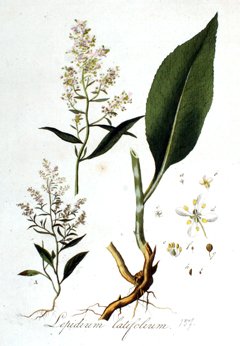
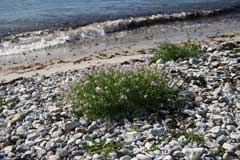
 Lepidium latifolium is a PERENNIAL growing to 1.2 m (4ft) by 1 m (3ft 3in).
See above for USDA hardiness. It is hardy to UK zone 6 and is not frost tender. It is in flower from June to July, and the seeds ripen from July to August. The species is hermaphrodite (has both male and female organs) and is pollinated by Insects.
Suitable for: light (sandy), medium (loamy) and heavy (clay) soils. Suitable pH: mildly acid, neutral and basic (mildly alkaline) soils and can grow in saline soils.
It can grow in semi-shade (light woodland) or no shade. It prefers moist soil. The plant can tolerate maritime exposure.
UK Hardiness Map
US Hardiness Map
Synonyms
Plant Habitats
Woodland Garden Sunny Edge; Dappled Shade; Meadow; Cultivated Beds;
Edible Uses
Edible Parts: Leaves Root
Edible Uses: Condiment
Young leaves - raw or cooked[2, 61, 74]. A very hot cress-like flavour[K]. The leaves are nice when used in small quantities as a flavouring in salads[K]. Some reports also suggest using them as a potherb[183], though they have always seemed to be too strong for us to want to try this[K]. The leaves are available very early in the year[K]. Root - it can be grated and made into a sauce which is used as a horseradish substitute[2, 5, 183]. It has a pungently hot flavour. Seed - used as a condiment[177, 183].
References More on Edible Uses
Medicinal Uses
Plants For A Future can not take any responsibility for any adverse effects from the use of plants. Always seek advice from a professional before using a plant medicinally.
Antiscorbutic Depurative Hepatic Kidney Resolvent Stomachic
The plant is antiscorbutic, depurative and stomachic[61, 240]. An infusion of the plant is used in the treatment of liver and kidney diseases, it increases cardiac amplitude, decreases frequency and regulates the rhythm[240]. It is also used as a resolvent in the treatment of skin diseases[240].
References More on Medicinal Uses
The Bookshop: Edible Plant Books
Our Latest books on Perennial Plants For Food Forests and Permaculture Gardens in paperback or digital formats.
Edible Tropical Plants
Food Forest Plants for Hotter Conditions: 250+ Plants For Tropical Food Forests & Permaculture Gardens.
More
Edible Temperate Plants
Plants for Your Food Forest: 500 Plants for Temperate Food Forests & Permaculture Gardens.
More
More Books
PFAF have eight books available in paperback and digital formats. Browse the shop for more information.
Shop Now
Other Uses
Insecticide
Used as an insecticide[100]. No further details are given, but it is likely to be a strong infusion of the leaves and stems that is used.
Special Uses
References More on Other Uses
Cultivation details
A very easily grown plant, it succeeds in most soils in sun or light shade. Plants have been surviving quite happily with us, and are still spreading freely, in dense grass that is rarely cut[K]. Dittander was formerly cultivated as a food condiment in Britain and in ancient Greece[17, 183]. It is a very invasive plant, capable of spreading more than a metre per year by means of its aggressive root system[K]. It produces new growth early in the year and so can be a useful salad ingredient in late winter[K].
References Carbon Farming Information and Carbon Sequestration Information
Temperature Converter
Type a value in the Celsius field to convert the value to Fahrenheit:
Fahrenheit:
The PFAF Bookshop
Plants For A Future have a number of books available in paperback and digital form. Book titles include Edible Plants, Edible Perennials, Edible Trees,Edible Shrubs, Woodland Gardening, and Temperate Food Forest Plants. Our new book is Food Forest Plants For Hotter Conditions (Tropical and Sub-Tropical).
Shop Now
Plant Propagation
Seed - sow spring in a cold frame. When they are large enough to handle, prick the seedlings out into individual pots and plant them out in the spring. Division in spring. Plant them out direct into their permanent positions. Division is very simple and succeeds at almost any time of the year[K].
Other Names
If available other names are mentioned here
Native Plant Search
Search over 900 plants ideal for food forests and permaculture gardens. Filter to search native plants to your area. The plants selected are the plants in our book 'Plants For Your Food Forest: 500 Plants for Temperate Food Forests and Permaculture Gardens, as well as plants chosen for our forthcoming related books for Tropical/Hot Wet Climates and Mediterranean/Hot Dry Climates. Native Plant Search
Found In
Countries where the plant has been found are listed here if the information is available
Weed Potential
Right plant wrong place. We are currently updating this section.
Please note that a plant may be invasive in one area but may not in your area so it’s worth checking.
Conservation Status
IUCN Red List of Threatened Plants Status :

Growth: S = slow M = medium F = fast. Soil: L = light (sandy) M = medium H = heavy (clay). pH: A = acid N = neutral B = basic (alkaline). Shade: F = full shade S = semi-shade N = no shade. Moisture: D = dry M = Moist We = wet Wa = water.

Expert comment
Author
L.
Botanical References
17
Links / References
For a list of references used on this page please go here
Readers comment
| Add a comment |
|
If you have important information about this plant that may help other users please add a comment or link below. Only comments or links that are felt to be directly relevant to a plant will be included. If you think a comment/link or information contained on this page is inaccurate or misleading we would welcome your feedback at [email protected]. If you have questions about a plant please use the Forum on this website as we do not have the resources to answer questions ourselves.
* Please note: the comments by website users are not necessarily those held by PFAF and may give misleading or inaccurate information.
To leave a comment please Register or login here All comments need to be approved so will not appear immediately.
|
Subject : Lepidium latifolium
|
|
|
|