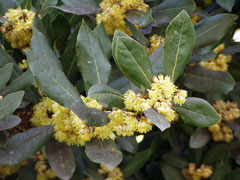
 |
|
http://commons.wikimedia.org/wiki/User:Tintazul |
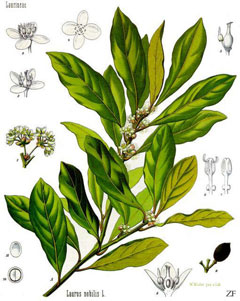 |
|
Translate this page:
Summary
Bloom Color: Yellow. Main Bloom Time: Early spring, Late spring, Mid spring. Form: Pyramidal, Rounded.
Physical Characteristics

 Laurus nobilis is an evergreen Tree growing to 12 m (39ft) by 10 m (32ft) at a slow rate.
See above for USDA hardiness. It is hardy to UK zone 8. It is in leaf all year, in flower from April to May. The species is dioecious (individual flowers are either male or female, but only one sex is to be found on any one plant so both male and female plants must be grown if seed is required). and is pollinated by Bees. The plant is not self-fertile.
Suitable for: light (sandy), medium (loamy) and heavy (clay) soils and prefers well-drained soil. Suitable pH: mildly acid, neutral and basic (mildly alkaline) soils. It can grow in semi-shade (light woodland) or no shade. It prefers dry or moist soil. The plant can tolerates strong winds but not maritime exposure.
UK Hardiness Map
US Hardiness Map
Synonyms
Plant Habitats
Woodland Garden Secondary; Sunny Edge; Dappled Shade; Shady Edge; Hedge; East Wall. By. South Wall. By. West Wall. By.
Edible Uses
Edible Parts: Fruit Leaves
Edible Uses: Condiment Tea
Leaves - fresh or dried[21]. A spicy, aromatic flavouring, bay leaves are commonly used as a flavouring for soups, stews etc[7, 11, 15, 34, 183] and form an essential ingredient of the herb mix 'Bouquet Garni'[201, 238]. The leaves can be used fresh or are harvested in the summer and dried. The flavour of freshly dried, crushed or shredded leaves is stronger than fresh leaves, but the leaves should not be stored for longer than a year since they will then lose their flavour[238]. The dried fruit is used as a flavouring[142, 177, 183]. The dried leaves are brewed into a herbal tea[183]. An essential oil obtained from the leaves is used as a food flavouring[183]. Yields can vary from 1 - 3% oil[7].
References More on Edible Uses
Medicinal Uses
Plants For A Future can not take any responsibility for any adverse effects from the use of plants. Always seek advice from a professional before using a plant medicinally.
Abortifacient Antirheumatic Antiseptic Appetizer Aromatic Astringent Cancer Carminative
Diaphoretic Digestive Diuretic Emetic Emmenagogue Narcotic Parasiticide
Stimulant Stomachic
The bay tree has a long history of folk use in the treatment of many ailments, particularly as an aid to digestion and in the treatment of bronchitis and influenza[244]. It has also been used to treat various types of cancer[218]. The fruits and leaves are not usually administered internally, other than as a stimulant in veterinary practice, but were formerly employed in the treatment of hysteria, amenorrhoea, flatulent colic etc[4]. Another report says that the leaves are used mainly to treat upper respiratory tract disorders and to ease arthritic aches and pains[254]. It is settling to the stomach and has a tonic effect, stimulating the appetite and the secretion of digestive juices[254]. The leaves are antiseptic, aromatic, astringent, carminative, diaphoretic, digestive, diuretic, emetic in large doses, emmenagogue, narcotic, parasiticide, stimulant and stomachic[4, 7, 21, 210, 218]. The fruit is antiseptic, aromatic, digestive, narcotic and stimulant[218]. An infusion has been used to improve the appetite and as an emmenagogue[4]. The fruit has also been used in making carminative medicines and was used in the past to promote abortion[4]. A fixed oil from the fruit is used externally to treat sprains, bruises etc, and is sometimes used as ear drops to relieve pain[4]. The essential oil from the leaves has narcotic, antibacterial and fungicidal properties[218].
References More on Medicinal Uses
The Bookshop: Edible Plant Books
Our Latest books on Perennial Plants For Food Forests and Permaculture Gardens in paperback or digital formats.
Edible Tropical Plants
Food Forest Plants for Hotter Conditions: 250+ Plants For Tropical Food Forests & Permaculture Gardens.
More
Edible Temperate Plants
Plants for Your Food Forest: 500 Plants for Temperate Food Forests & Permaculture Gardens.
More
More Books
PFAF have eight books available in paperback and digital formats. Browse the shop for more information.
Shop Now
Other Uses
Essential Hedge Hedge Parasiticide Repellent Strewing Wood
An essential oil from the fruit is used in soap making[7, 46, 61]. The plant is highly resistant to pests and diseases, it is said to protect neighbouring plants from insect and health problems[14]. The leaves are highly aromatic and can be used as an insect repellent, the dried leaves protect stored grain, beans etc from weevils[14]. It is also used as a strewing herb because of its aromatic smell and antiseptic properties[244]. Very tolerant of clipping[11, 200], it can be grown as a screen or hedge in areas suited to its outdoor cultivation[182, 200]. Wood - sweetly-scented, does not wear quickly. Used for marqueterie work, walking sticks and friction sticks for making fires[4, 89].
Special Uses
Food Forest Hedge Hedge Scented Plants
References More on Other Uses
Cultivation details
Landscape Uses:Border, Container, Screen, Standard, Specimen, Street tree. Succeeds in any soil of moderate fertility[1], preferring a moisture retentive well-drained fertile soil[200]. Succeeds in dry soils. Prefers full sun but succeeds in light shade[200]. Plants are fairly wind hardy, but they do not like extreme maritime exposure[166] or cold dry winds[202]. The plant is not fully hardy in all areas of Britain and may require protection in severe winters. When dormant it is reliably hardy to about -5°c, with occasional lows to -15°c, these lower temperatures may defoliate the tree but it usually recovers in late spring to summer[200]. Laurus nobilis angustifolia (Syn 'Salicifolia') is somewhat hardier and has the same aromatic qualities[182]. The bay tree is a very ornamental plant[1] that is often cultivated for its leaves which are used as a food flavouring. Some named forms exist[202]. When bruised, the leaves release a sweet aromatic scent[245]. The tree is highly resistant to pests and diseases[14, 201] and is also notably resistant to honey fungus[200]. This species has been held in high esteem since ancient times[244]. It was dedicated to Apollo, the god of light and was also a symbol of peace and victory[244]. It was used to make wreaths for emperors, generals and poets[11, 89, 244]. Dioecious. Male and female plants must be grown if seed is required. Special Features:Attractive foliage, Fragrant foliage, Not North American native. In garden design, as well as the above-ground architecture of a plant, root structure considerations help in choosing plants that work together for their optimal soil requirements including nutrients and water. The root pattern is branching: a heart root, dividing from the crown into several primary roots going down and out [2-1].
References Carbon Farming Information and Carbon Sequestration Information
Temperature Converter
Type a value in the Celsius field to convert the value to Fahrenheit:
Fahrenheit:
The PFAF Bookshop
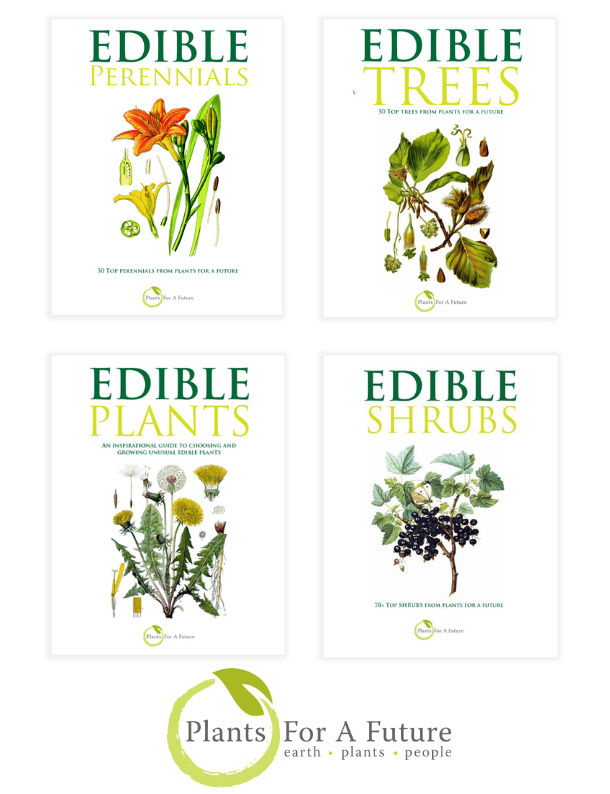
Plants For A Future have a number of books available in paperback and digital form. Book titles include Edible Plants, Edible Perennials, Edible Trees,Edible Shrubs, Woodland Gardening, and Temperate Food Forest Plants. Our new book is Food Forest Plants For Hotter Conditions (Tropical and Sub-Tropical).
Shop Now
Plant Propagation
Seed - best sown as soon as it is ripe in early autumn in a greenhouse[200]. Prick out the seedlings into individual pots once they are large enough to handle and grow them on in the greenhouse for at least their first year. Plant them out into their permanent positions in early summer and give them some protection from the cold for at least their first winter outdoors[K]. Cuttings of half-ripe wood, July/August in a frame. Can take 6 months[1, 14]. Cuttings of mature side shoots, 10 - 12cm with a heel, November/December in a cold frame. Leave for 18 months. High percentage[78]. Layering.
Other Names
If available other names are mentioned here
Bay laurel
Native Plant Search
Search over 900 plants ideal for food forests and permaculture gardens. Filter to search native plants to your area. The plants selected are the plants in our book 'Plants For Your Food Forest: 500 Plants for Temperate Food Forests and Permaculture Gardens, as well as plants chosen for our forthcoming related books for Tropical/Hot Wet Climates and Mediterranean/Hot Dry Climates. Native Plant Search
Found In
Countries where the plant has been found are listed here if the information is available
Weed Potential
Right plant wrong place. We are currently updating this section.
Please note that a plant may be invasive in one area but may not in your area so it’s worth checking.
Conservation Status
IUCN Red List of Threatened Plants Status :

Growth: S = slow M = medium F = fast. Soil: L = light (sandy) M = medium H = heavy (clay). pH: A = acid N = neutral B = basic (alkaline). Shade: F = full shade S = semi-shade N = no shade. Moisture: D = dry M = Moist We = wet Wa = water.

Expert comment
Author
L.
Botanical References
11200
Links / References
For a list of references used on this page please go here
Readers comment