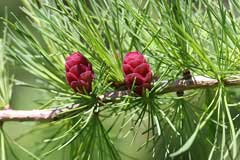
 |
|
http://www.fs.fed.us/ |
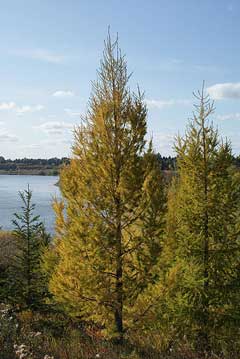 |
| http://commons.wikimedia.org/wiki/User:SriMesh |
Translate this page:
Summary
Bloom Color: Red, Yellow. Main Bloom Time: Early spring, Late spring, Mid spring.Form: Pyramidal.
Physical Characteristics

 Larix laricina is a deciduous Tree growing to 18 m (59ft 1in) at a medium rate.
See above for USDA hardiness. It is hardy to UK zone 2 and is not frost tender. It is in flower from March to April, and the seeds ripen in October. The species is monoecious (individual flowers are either male or female, but both sexes can be found on the same plant) and is pollinated by Wind.
Suitable for: light (sandy) and medium (loamy) soils, prefers well-drained soil and can grow in nutritionally poor soil. Suitable pH: mildly acid, neutral and basic (mildly alkaline) soils. It cannot grow in the shade. It prefers moist or wet soil. The plant can tolerates strong winds but not maritime exposure.
UK Hardiness Map
US Hardiness Map
Synonyms
L. americana.
Plant Habitats
Woodland Garden Canopy; Bog Garden;
Edible Uses
Edible Parts: Leaves Shoots
Edible Uses: Tea
The young shoots are used as an emergency food[177]. A tea is made from the roots[161]. A tea is made from the branches and needles[257].
References More on Edible Uses
Medicinal Uses
Plants For A Future can not take any responsibility for any adverse effects from the use of plants. Always seek advice from a professional before using a plant medicinally.
Alterative Astringent Disinfectant Diuretic Expectorant Laxative Poultice Salve
Tonic
Tamarack was employed medicinally by a number of native North American Indian tribes who used it to treat a variety of complaints[257]. It is little used in modern herbalism. A tea made from the bark is alterative, diuretic, laxative and tonic[4, 222]. It is used in the treatment of jaundice, anaemia, rheumatism, colds and skin ailments[222, 257]. It is gargled in the treatment of sore throats and applied as a poultice to sores, swellings and burns[222, 257]. A tea made from the leaves is astringent[4, 222]. It is used in the treatment of piles, diarrhoea etc[222]. An infusion of the buds and bark is used as an expectorant[257]. The needles and inner bark are disinfectant and laxative[257]. A tea is used in the treatment of coughs[257]. A poultice made from the warm, boiled inner bark is applied to wounds to draw out infections, to burns, frostbite and deep cuts[257]. The resin is chewed as a cure for indigestion[222]. It has also been used in the treatment of kidney and lung disorders, and as a dressing for ulcers and burns[226].
References More on Medicinal Uses
The Bookshop: Edible Plant Books
Our Latest books on Perennial Plants For Food Forests and Permaculture Gardens in paperback or digital formats.
Edible Tropical Plants
Food Forest Plants for Hotter Conditions: 250+ Plants For Tropical Food Forests & Permaculture Gardens.
More
Edible Temperate Plants
Plants for Your Food Forest: 500 Plants for Temperate Food Forests & Permaculture Gardens.
More
More Books
PFAF have eight books available in paperback and digital formats. Browse the shop for more information.
Shop Now
Other Uses
Disinfectant Fibre Resin Tannin Wood
Resin is extracted by tapping the trunk. It is obtained from near the centre of the trunk[171], one properly made borehole can be used for 20 - 30 years[64]. The resin has a wide range of uses including wood preservatives, medicinal etc. The hole is made in the spring and the resin extracted in the autumn[64]. The roots have been used as a sewing material in canoes and to make durable bags[257]. The bark contains tannin[229]. Wood - very strong, heavy, hard, durable even in water. It weighs 39lb per cubic foot and is used for telegraph poles, fence posts etc[46, 61, 171, 226, 235]. The roots are often curved by as much as 90° and are used by builders of small ships[226].
Special Uses
References More on Other Uses
Cultivation details
Landscape Uses:Specimen. Prefers an open airy position in a light or gravelly well-drained soil[200]. Plants are intolerant of shade[226]. Tolerates acid and infertile soils and waterlogged soils[200]. Succeeds on rocky hill or mountain sides and slopes[200]. A north or east aspect is more suitable than west or south[1]. This species is very cold-hardy when fully dormant, but the trees can be excited into premature growth in Britain by mild spells during the winter and they are then very subject to damage by late frosts and cold winds[1]. Hybridizes freely with other members of this genus[200]. Planted for forestry in Europe[50], they are not suitable for this purpose in Britain[1]. Growth is normally slow in this country with average height increases of less than 30cm per year[185]. The trees are generally not long-lived[185]. Planting them in boggy soil may improve growth rates[185]. Open ground plants, 1 year x 1 year are the best for planting out, do not use container grown plants with spiralled roots[200]. Plants transplant well, even when coming into growth in the spring[200]. Plants in this genus are notably resistant to honey fungus[200]. Special Features:North American native, Wetlands plant, Attractive flowers or blooms.
References Carbon Farming Information and Carbon Sequestration Information
Temperature Converter
Type a value in the Celsius field to convert the value to Fahrenheit:
Fahrenheit:
The PFAF Bookshop
Plants For A Future have a number of books available in paperback and digital form. Book titles include Edible Plants, Edible Perennials, Edible Trees,Edible Shrubs, Woodland Gardening, and Temperate Food Forest Plants. Our new book is Food Forest Plants For Hotter Conditions (Tropical and Sub-Tropical).
Shop Now
Plant Propagation
Seed - sow late winter in pots in a cold frame. One months cold stratification helps germination[113]. It is best to give the seedlings light shade for the first year[78]. As soon as they are large enough to handle, prick out the seedlings into individual pots. Although only a few centimetres tall, they can be planted out into their permanent positions in the summer providing you give them an effective weed-excluding mulch and preferably some winter protection for their first year. Otherwise grow them on in the cold frame for their first winter and plant them out in early summer of the following year. The seed remains viable for 3 years[113] If you are growing larger quantities of plants, you can sow the seed in an outdoor seedbed in late winter. Grow on the seedlings in the seedbed for a couple of years until they are ready to go into their permanent positions then plant them out during the winter.
Other Names
If available other names are mentioned here
Native Plant Search
Search over 900 plants ideal for food forests and permaculture gardens. Filter to search native plants to your area. The plants selected are the plants in our book 'Plants For Your Food Forest: 500 Plants for Temperate Food Forests and Permaculture Gardens, as well as plants chosen for our forthcoming related books for Tropical/Hot Wet Climates and Mediterranean/Hot Dry Climates. Native Plant Search
Found In
Countries where the plant has been found are listed here if the information is available
Weed Potential
Right plant wrong place. We are currently updating this section.
Please note that a plant may be invasive in one area but may not in your area so it’s worth checking.
Conservation Status
IUCN Red List of Threatened Plants Status :

Growth: S = slow M = medium F = fast. Soil: L = light (sandy) M = medium H = heavy (clay). pH: A = acid N = neutral B = basic (alkaline). Shade: F = full shade S = semi-shade N = no shade. Moisture: D = dry M = Moist We = wet Wa = water.

Expert comment
Author
(Du Roi.)K.Koch.
Botanical References
1143200
Links / References
For a list of references used on this page please go here
Readers comment
© 2010, Plants For A Future. Plants For A Future is a charitable company limited by guarantee, registered in England and Wales. Charity No. 1057719, Company No. 3204567.