 |
|
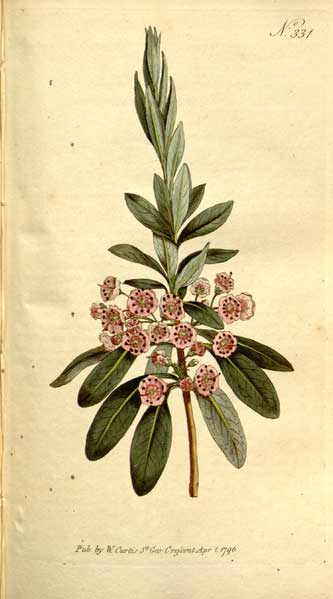
http://commons.wikimedia.org/wiki/File:The_Botanical_Magazine,_Plate_331_%28Volume_10,_1796%29.png |
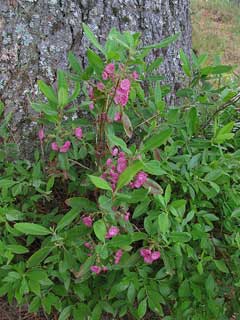 |
| http://commons.wikimedia.org/wiki/User:Jomegat |
Translate this page:
Summary
Physical Characteristics

 Kalmia angustifolia is an evergreen Shrub growing to 1.5 m (5ft) by 1.5 m (5ft).
See above for USDA hardiness. It is hardy to UK zone 2. It is in leaf all year, in flower in June, and the seeds ripen in September. The species is hermaphrodite (has both male and female organs) and is pollinated by Bees.
Suitable for: light (sandy), medium (loamy) and heavy (clay) soils and prefers well-drained soil. Suitable pH: mildly acid soils and can grow in very acid soils.
It can grow in semi-shade (light woodland) or no shade. It prefers moist soil.
UK Hardiness Map
US Hardiness Map
Synonyms
Plant Habitats
Woodland Garden Dappled Shade; Shady Edge;
Edible Uses
References More on Edible Uses
Medicinal Uses
Plants For A Future can not take any responsibility for any adverse effects from the use of plants. Always seek advice from a professional before using a plant medicinally.
Analgesic Astringent Narcotic Poultice Sedative
Sheep laurel is a very poisonous narcotic plant the leaves of which were at one time used by some native North American Indian tribes in order to commit suicide[4]. It is little, if at all, used in modern herbalism. The leaves are usually used externally as a poultice and wash in herbal medicine and are a good remedy for many skin diseases, sprains and inflammation[4, 257]. They can also be applied as a poultice to the head to treat headaches[257]. The singed, crushed leaves can be used as a snuff in the treatment of colds[257]. Used internally, the leaves are analgesic, astringent and sedative and have a splendid effect in the treatment of active haemorrhages, headaches, diarrhoea and flux[4, 21, 61, 257]. This species is said to be the best for medicinal use in the genus[4]. The plant should be used with great caution however, see the notes above on toxicity.
References More on Medicinal Uses
The Bookshop: Edible Plant Books
Our Latest books on Perennial Plants For Food Forests and Permaculture Gardens in paperback or digital formats.
Edible Tropical Plants
Food Forest Plants for Hotter Conditions: 250+ Plants For Tropical Food Forests & Permaculture Gardens.
More
Edible Temperate Plants
Plants for Your Food Forest: 500 Plants for Temperate Food Forests & Permaculture Gardens.
More
More Books
PFAF have eight books available in paperback and digital formats. Browse the shop for more information.
Shop Now
Other Uses
References More on Other Uses
Cultivation details
Requires an acid humus-rich soil, succeeding in part shade[182] or in full sun in cooler areas. Prefers almost full sun[11]. Dislikes dry soils[182], requiring cool, permanently moist conditions at the roots[21]. Succeeds in open woodland or along the woodland edge[200]. Plants are very cold-hardy, tolerating temperatures down to about -30°c[184]. A very ornamental and variable plant[11], there are many named varieties[200]. The flowers are produced at the end of the previous years growth[11]. Plants spread slowly by means of suckers[11]. Pruning is not normally necessary, though if older plants become bare at the centre they can be cut back hard and will regrow from the base[200].
References Carbon Farming Information and Carbon Sequestration Information
Temperature Converter
Type a value in the Celsius field to convert the value to Fahrenheit:
Fahrenheit:
The PFAF Bookshop
Plants For A Future have a number of books available in paperback and digital form. Book titles include Edible Plants, Edible Perennials, Edible Trees,Edible Shrubs, Woodland Gardening, and Temperate Food Forest Plants. Our new book is Food Forest Plants For Hotter Conditions (Tropical and Sub-Tropical).
Shop Now
Plant Propagation
Seed - surface sow in late winter in a cool greenhouse in light shade[78, 113]. Prick out the young seedlings into individual pots as soon as they are large enough to handle. The seedlings are rather sensitive to damping off, so water them with care, keep them well-ventilated and perhaps apply a fungicide such as garlic as a preventative. Grow the young plants on in light shade and overwinter them in the greenhouse for their first winter[78]. Plant them out into their permanent positions in early summer. The seed is dust-like and remains viable for many years[113]. Cuttings of half-ripe wood, August in a frame. Very poor results unless the cuttings are taken from very young plants[11, 78]. Layering in August/September. Takes 18 months[78]. The plants can also be dug up and replanted about 30cm deeper in the soil to cover up some of the branches. The plant can then be dug up about 12 months later when the branches will have formed roots and can be separated to make new plants[200].
Other Names
If available other names are mentioned here
Native Plant Search
Search over 900 plants ideal for food forests and permaculture gardens. Filter to search native plants to your area. The plants selected are the plants in our book 'Plants For Your Food Forest: 500 Plants for Temperate Food Forests and Permaculture Gardens, as well as plants chosen for our forthcoming related books for Tropical/Hot Wet Climates and Mediterranean/Hot Dry Climates. Native Plant Search
Found In
Countries where the plant has been found are listed here if the information is available
Weed Potential
Right plant wrong place. We are currently updating this section.
Please note that a plant may be invasive in one area but may not in your area so it’s worth checking.
Conservation Status
IUCN Red List of Threatened Plants Status :

Growth: S = slow M = medium F = fast. Soil: L = light (sandy) M = medium H = heavy (clay). pH: A = acid N = neutral B = basic (alkaline). Shade: F = full shade S = semi-shade N = no shade. Moisture: D = dry M = Moist We = wet Wa = water.

Expert comment
Author
L.
Botanical References
11200235
Links / References
For a list of references used on this page please go here
Readers comment
© 2010, Plants For A Future. Plants For A Future is a charitable company limited by guarantee, registered in England and Wales. Charity No. 1057719, Company No. 3204567.