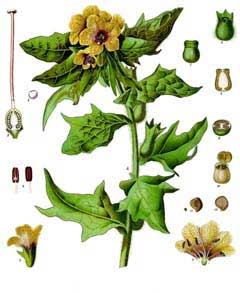
 |
|
http://commons.wikimedia.org/wiki/File:Koeh-073.jpg |
 |
| http://commons.wikimedia.org/wiki/User:Llez |
Translate this page:
Summary
Physical Characteristics

 Hyoscyamus niger is a ANNUAL/BIENNIAL growing to 1 m (3ft 3in) by 1 m (3ft 3in).
See above for USDA hardiness. It is hardy to UK zone 5 and is not frost tender. It is in flower from June to August, and the seeds ripen from August to September. The species is hermaphrodite (has both male and female organs) and is pollinated by Insects.
Suitable for: light (sandy), medium (loamy) and heavy (clay) soils and prefers well-drained soil. Suitable pH: mildly acid, neutral and basic (mildly alkaline) soils. It cannot grow in the shade. It prefers dry or moist soil. The plant can tolerate maritime exposure.
UK Hardiness Map
US Hardiness Map
Synonyms
Plant Habitats
Cultivated Beds; East Wall. In.
Edible Uses
References More on Edible Uses
Medicinal Uses
Plants For A Future can not take any responsibility for any adverse effects from the use of plants. Always seek advice from a professional before using a plant medicinally.
Anodyne Anthelmintic Antispasmodic Antitumor Diuretic Epilepsy Febrifuge Hallucinogenic
Hypnotic Mydriatic Narcotic Sedative Urinary
Henbane has a very long history of use as a medicinal herb, and has been widely cultivated to meet the demand for its use[4]. It is used extensively as a sedative and pain killer and is specifically used for pain affecting the urinary tract, especially when due to kidney stones[254]. Its sedative and antispasmodic effect makes it a valuable treatment for the symptoms of Parkinson's disease, relieving tremor and rigidity during the early stages of the disease[254]. This species is the form generally considered best for external use, whilst the white henbane (H. albus) is considered the most appropriate for internal use[4]. All parts of the plant, but especially the leaves and the seeds, can be used - they are anodyne, antispasmodic, mildly diuretic, hallucinogenic, hypnotic, mydriatic, narcotic and sedative[4, 9, 13, 21, 100, 165, 192, 218]. The plant is used internally in the treatment of asthma, whooping cough, motion sickness, Meniere's syndrome, tremor in senility or paralysis and as a pre-operative medication[238]. Henbane reduces mucous secretions, as well as saliva and other digestive juices[254]. Externally, it is used as an oil to relieve painful conditions such as neuralgia, dental and rheumatic pains[238, 254].The leaves should be harvested when the plant is in full flower and they can then be dried for later use[4]. There is an annual and a biennial form of this species, both can be used medicinally but the biennial form is considered to be superior[4]. This is a very poisonous plant that should be used with great caution, and only under the supervision of a qualified practitioner[21, 238]. See the notes above on toxicity. The seed is used in the treatment of asthma, cough, epilepsy, myalgia and toothache[218]. The seeds are used in Tibetan medicine, they are said to have a bitter, acrid taste with a neutral and poisonous potency[241]. Anthelmintic, antitumor and febrifuge, they are used in the treatment of stomach/intestinal pain due to worm infestation, toothache, inflammation of the pulmonary region and tumours[241].
References More on Medicinal Uses
The Bookshop: Edible Plant Books
Our Latest books on Perennial Plants For Food Forests and Permaculture Gardens in paperback or digital formats.

Edible Tropical Plants
Food Forest Plants for Hotter Conditions: 250+ Plants For Tropical Food Forests & Permaculture Gardens.
More

Edible Temperate Plants
Plants for Your Food Forest: 500 Plants for Temperate Food Forests & Permaculture Gardens.
More

More Books
PFAF have eight books available in paperback and digital formats. Browse the shop for more information.
Shop Now
Other Uses
References More on Other Uses
Cultivation details
Prefers a sunny position[4] and a dry soil[19]. Succeeds in ordinary garden soil[1] but prefers an alkaline soil[200]. Plants succeed in sandy spots near the sea[4]. Cultivated commercially as a medicinal plant[57], only the biennial form is considered officinal[4]. Grows well in maritime areas, often self-sowing freely[200]. Older plants do not transplant well due to a brittle taproot[200]. The growing plant inhibits the growth of clover[18]. The flowers emit a sickly fishy smell[245].
References Carbon Farming Information and Carbon Sequestration Information
Temperature Converter
Type a value in the Celsius field to convert the value to Fahrenheit:
Fahrenheit:
The PFAF Bookshop
Plants For A Future have a number of books available in paperback and digital form. Book titles include Edible Plants, Edible Perennials, Edible Trees,Edible Shrubs, Woodland Gardening, and Temperate Food Forest Plants. Our new book is Food Forest Plants For Hotter Conditions (Tropical and Sub-Tropical).
Shop Now
Plant Propagation
Seed - sow summer in a cold frame and pot on as soon as possible before the taproot is too long[200].
Other Names
If available other names are mentioned here
Native Plant Search
Search over 900 plants ideal for food forests and permaculture gardens. Filter to search native plants to your area. The plants selected are the plants in our book 'Plants For Your Food Forest: 500 Plants for Temperate Food Forests and Permaculture Gardens, as well as plants chosen for our forthcoming related books for Tropical/Hot Wet Climates and Mediterranean/Hot Dry Climates. Native Plant Search
Found In
Countries where the plant has been found are listed here if the information is available
Weed Potential
Right plant wrong place. We are currently updating this section.
Please note that a plant may be invasive in one area but may not in your area so it’s worth checking.
Conservation Status
IUCN Red List of Threatened Plants Status :

Growth: S = slow M = medium F = fast. Soil: L = light (sandy) M = medium H = heavy (clay). pH: A = acid N = neutral B = basic (alkaline). Shade: F = full shade S = semi-shade N = no shade. Moisture: D = dry M = Moist We = wet Wa = water.

Expert comment
Author
L.
Botanical References
17200
Links / References
For a list of references used on this page please go here
Readers comment