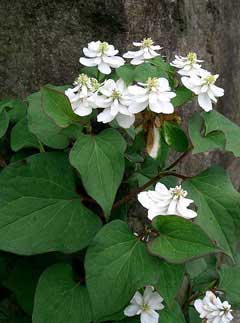
 |
|
http://commons.wikimedia.org/wiki/User:KENPEI |
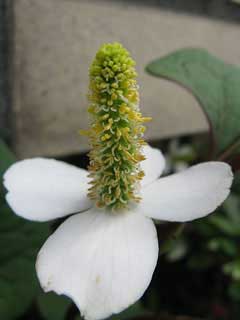 |
| http://commons.wikimedia.org/wiki/User:KENPEI |
Translate this page:
Summary
Bloom Color: White. Main Bloom Time: Early summer, Late summer, Mid summer. Form: Spreading or horizontal, Upright or erect, Variable spread.
Physical Characteristics

 Houttuynia cordata is a PERENNIAL growing to 0.6 m (2ft) by 1 m (3ft 3in) at a fast rate.
See above for USDA hardiness. It is hardy to UK zone 5 and is not frost tender. It is in flower in June. The species is hermaphrodite (has both male and female organs).
Suitable for: light (sandy), medium (loamy) and heavy (clay) soils. Suitable pH: mildly acid, neutral and basic (mildly alkaline) soils. It can grow in full shade (deep woodland) or semi-shade (light woodland). It prefers moist or wet soil and can grow in water.
UK Hardiness Map
US Hardiness Map
Synonyms
Gymnotheca chinensis. Polypara cochinchinensis.
Plant Habitats
Woodland Garden Sunny Edge; Dappled Shade; Shady Edge; Ground Cover; Pond; Bog Garden;
Edible Uses
Edible Parts: Fruit Leaves Root Shoots
Edible Uses:
Teder young shoots and leaves - raw or cooked as a pot-herb[2, 61, 103, 183, 272]. The leaves and young shoots are harvested in the spring when about 8cm long[264]. Strongly aromatic according to one report[183] whilst others say that it is rather smelly and somewhat like rotten fish[105, 178]. Our experience is that the leaves have a delicious orange-like smell and make a marvellous flavouring in salads[K]. One report says that there are two distinct chemotypes of this species. Plants from Japan have an orange scent, whilst those from China have a smell resembling coriander leaves (Coriandrum sativum)[238]. Some people seem to really like this leaf, others are indifferent to it or strongly dislike it[K]. It also varies quite considerably according to the time of year. In the spring and summer it has a very acceptable flavour, but by autumn a distinct bitterness has crept in[K]. Root - cooked[177, 183]. Same comments on the smell as for the leaves[105]. Fruit[183]. No further details[K], but the fruit is a capsule that contains many small seeds[200].
References More on Edible Uses
Medicinal Uses
Plants For A Future can not take any responsibility for any adverse effects from the use of plants. Always seek advice from a professional before using a plant medicinally.
Antibacterial Antidote Antiinflammatory Antiphlogistic Antiviral Astringent Depurative Diuretic
Dysentery Emmenagogue Febrifuge Hypoglycaemic Laxative Ophthalmic Women's complaints
The whole plant is antibacterial, antiinflammatory, antimicrbial, antiphlogistic, antiviral, depurative, diuretic, emmenagogue, febrifuge, hypoglycaemic, laxative and ophthalmic[103, 116, 147, 174, 176, 218, 238, 240, 279]. A decoction is used internally in the treatment of many ailments including cancer, coughs, dysentery, enteritis and fever[218]. Its use is said to strengthen the immune system[176]. Externally, it is used in the treatment of snake bites and skin disorders[238]. The leaves and stems are harvested during the growing season and used fresh in decoctions[238]. The leaf juice is antidote and astringent[218]. A root extract is diuretic[218, 240]. The root is also said to be used in medicinal preparations for certain diseases of women[240, 243]. The rhizomes yield a sterol, resembling sitosterol, which stimulates the secretion of antibiotic substances from a gram-positive spore-forming bacillus[240]. An active substance, effective in the treatment of stomach ulcers, has been extracted from the plant[240].
References More on Medicinal Uses
The Bookshop: Edible Plant Books
Our Latest books on Perennial Plants For Food Forests and Permaculture Gardens in paperback or digital formats.
Edible Tropical Plants
Food Forest Plants for Hotter Conditions: 250+ Plants For Tropical Food Forests & Permaculture Gardens.
More
Edible Temperate Plants
Plants for Your Food Forest: 500 Plants for Temperate Food Forests & Permaculture Gardens.
More
More Books
PFAF have eight books available in paperback and digital formats. Browse the shop for more information.
Shop Now
Other Uses
A good ground cover plant[200]. Plants do not form a weed-suppressing cover[K]. A spreading plant, it should be spaced about 45cm apart each way[208].
Special Uses
Food Forest Ground cover Scented Plants
References More on Other Uses
Cultivation details
Landscape Uses:Border, Container, Foundation, Ground cover, Massing, Woodland garden. Requires a moist to wet soil or shallow water, partial shade and a sheltered position[1, 31, 56, 238]. Whilst it grows best in a bog garden, it will succeed in moist garden borders[233] and has also grown fairly well in a dry soil in Cornwall[K]. It succeeds in full shade[208]. Plants are hardy to about -15°c[187], the top growth is killed back by frost though the roots are much hardier. Even the roots, though, can be killed in severe winters[56]. A very ornamental plant, there are some named varieties[187]. 'Chameleon' has very attractively variegated leaves with the same flavour as the species[K]. The bruised leaves emit a strong citrus smell rather like orange peel[K]. Plants have a widely spreading root system and are very invasive, though they are easier to control in drier soils[200]. Creeps harmlessly between ferns[187]. Cultivated as a salad crop in Vietnam[103] and in W. China[187].. Plants seem to be immune to the predations of rabbits[233]. Plants growing in an area with a high rabbit population were not eaten by them although other plants growing nearby were attacked[K]. Special Features:
Attractive foliage, Fragrant foliage, Not North American native, Invasive, Naturalizing, Wetlands plant, Inconspicuous flowers or blooms. The plant is heat tolerant in zones 12 through 1. (Plant Hardiness Zones show how well plants withstand cold winter temperatures.
Plant Heat Zones show when plants would start suffering from the heat.
The Plant Heat Zone map is based on the number of "heat days" experienced in a given area where the temperature climbs to over 86 degrees F (30°C).
At this temperature, many plants begin to suffer physiological damage. Heat Zones range from 1 (no heat days) to 12 (210 or more heat days).
For example Heat Zone. 11-1 indicates that the plant is heat tolerant in zones 11 through 1.) For polyculture design as well as the above-ground architecture (form - tree, shrub etc. and size shown above) information on the habit and root pattern is also useful and given here if available. The plant growth habit is a runner spreading indefinitely by rhizomes or stolons [1-2]. The root pattern is rhizomatous with underground stems sending roots and shoots along their length [1-2].
References Carbon Farming Information and Carbon Sequestration Information
Temperature Converter
Type a value in the Celsius field to convert the value to Fahrenheit:
Fahrenheit:
The PFAF Bookshop
Plants For A Future have a number of books available in paperback and digital form. Book titles include Edible Plants, Edible Perennials, Edible Trees,Edible Shrubs, Woodland Gardening, and Temperate Food Forest Plants. Our new book is Food Forest Plants For Hotter Conditions (Tropical and Sub-Tropical).
Shop Now
Plant Propagation
Seed - sow spring in a greenhouse. Prick out the seedlings into individual pots as soon as they are large enough to handle and plant them out in the summer. Division in spring[31, 56]. Very quick and easy, it can be done successfully at almost any time in the growing season[K]. Larger clumps can be replanted direct into their permanent positions, though it is best to pot up smaller clumps and grow them on in a cold frame until they are rooting well. Plant them out in the spring.
Other Names
If available other names are mentioned here
Native Plant Search
Search over 900 plants ideal for food forests and permaculture gardens. Filter to search native plants to your area. The plants selected are the plants in our book 'Plants For Your Food Forest: 500 Plants for Temperate Food Forests and Permaculture Gardens, as well as plants chosen for our forthcoming related books for Tropical/Hot Wet Climates and Mediterranean/Hot Dry Climates. Native Plant Search
Found In
Countries where the plant has been found are listed here if the information is available
Weed Potential
Right plant wrong place. We are currently updating this section.
Please note that a plant may be invasive in one area but may not in your area so it’s worth checking.
Conservation Status
IUCN Red List of Threatened Plants Status :

Growth: S = slow M = medium F = fast. Soil: L = light (sandy) M = medium H = heavy (clay). pH: A = acid N = neutral B = basic (alkaline). Shade: F = full shade S = semi-shade N = no shade. Moisture: D = dry M = Moist We = wet Wa = water.

Expert comment
Author
Thunb.
Botanical References
51200266
Links / References
For a list of references used on this page please go here
Readers comment