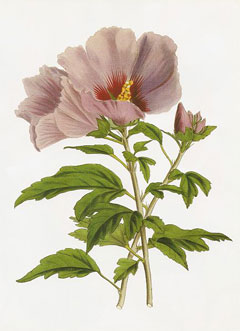
 |
|
http://commons.wikimedia.org/wiki/File:Hibiscus_syriacus_chinensis_RHS.jpeg |
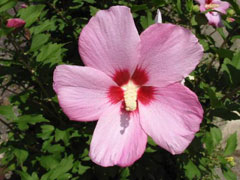 |
| http://simple.wikipedia.org/wiki/User:Green |
Translate this page:
Summary
Bloom Color: Blue, Lavender, Pink, Purple, Red, White. Main Bloom Time: Early summer, Late summer, Mid summer. Form: Rounded, Upright or erect.
Physical Characteristics

 Hibiscus syriacus is a deciduous Shrub growing to 3 m (9ft) by 2 m (6ft) at a medium rate.
See above for USDA hardiness. It is hardy to UK zone 5. It is in flower in September, and the seeds ripen in October. The species is hermaphrodite (has both male and female organs) and is pollinated by Insects.
Suitable for: light (sandy), medium (loamy) and heavy (clay) soils and prefers well-drained soil. Suitable pH: mildly acid, neutral and basic (mildly alkaline) soils. It can grow in semi-shade (light woodland) or no shade. It prefers moist soil.
UK Hardiness Map
US Hardiness Map
Synonyms
Althaea frutex.
Habitats
Woodland Garden Sunny Edge; Dappled Shade; Hedge;
Edible Uses
Edible Parts: Flowers Leaves Oil Root
Edible Uses: Oil Tea
Young leaves - raw or cooked[2, 177, 179, 183]. A very mild flavour, though slightly on the tough side, they make an acceptable addition to the salad bowl[K]. A tea is made from the leaves[2, 177, 240] or the flowers[183]. Flowers - raw or cooked[74, 105, 183]. A mild flavour and mucilaginous texture, they are delightful in salads, both for looking at and for eating[K]. Root - it is edible but very fibrousy[144]. Mucilaginous, without very much flavour[144].
References More on Edible Uses
Medicinal Uses
Plants For A Future can not take any responsibility for any adverse effects from the use of plants. Always seek advice from a professional before using a plant medicinally.
Anthelmintic Antiphlogistic Antipruritic Demulcent Diuretic Dysentery Emollient Expectorant
Febrifuge Ophthalmic Skin Stomachic Styptic
The leaves are diuretic, expectorant and stomachic[218, 240]. A decoction of the flowers is diuretic, ophthalmic and stomachic[147, 178, 218]. It is also used in the treatment of itch and other skin diseases[240], dizziness and bloody stools accompanied by much gas[147]. The bark contains several medically active constituents, including mucilage, carotenoids, sesquiterpenes and anthocyanidins[279]. A decoction of the root bark is antiphlogistic, demulcent, emollient, febrifuge, haemostatic and vermifuge[218, 240]. It is used in the treatment of diarrhoea, dysentery, abdominal pain, leucorrhoea, dysmenorrhoea[240, 279] and dermaphytosis[147].
References More on Medicinal Uses
Now available: PLANTS FOR YOUR FOOD FOREST: 500 Plants for Temperate Food Forests and Permaculture Gardens.
An important new book from PFAF. It focuses on the attributes of plants suitable for food forests, what each can contribute to a food forest ecosystem, including carbon sequestration, and the kinds of foods they yield. The book suggests that community and small-scale food forests can provide a real alternative to intensive industrialised agriculture, and help to combat the many inter-related environmental crises that threaten the very future of life on Earth.
Read More
Other Uses
Dye Fibre Hair Hedge Hedge Oil
A low quality fibre is obtained from the stems. It is used for making cordage and paper[74]. The seed contains about 25% oil[74]. No further details are given, but it is likely to be edible. A hair shampoo is made from the leaves[74]. A blue dye is obtained from the flowers[168]. This species is planted as a hedge in S. Europe[50].
Special Uses
Food Forest Hedge Hedge
References More on Other Uses
Cultivation details
Landscape Uses:Border, Container, Foundation, Standard, Seashore, Specimen. Prefers a well-drained humus rich fertile soil in a sheltered position in full sun[200]. Succeeds in any soil of good or moderate quality[11]. Dislikes shade or badly drained soils[11]. Plants grow best with their roots in cool moist soil and their tops in a hot sunny position. This species is hardy to about -20°c[200] but plants only really succeed in the warmer counties of Britain because of their late flowering habit[184]. When planted in colder areas of the country, they will need protection for the first few winters[200]. The flowers only open in sunny weather[219]. Plants rarely require pruning[219], though they respond well to pruning and trimming and this is best carried out in the spring or just after flowering[219]. Plants are late coming into leaf, usually around the end of May or early June[182]. A very ornamental plant[1], there are many named varieties[182]. Special Features:Attracts birds, Not North American native, Naturalizing, Attracts butterflies, Blooms are very showy. The plant is heat tolerant in zones 9 through 1. (Plant Hardiness Zones show how well plants withstand cold winter temperatures.
Plant Heat Zones show when plants would start suffering from the heat.
The Plant Heat Zone map is based on the number of "heat days" experienced in a given area where the temperature climbs to over 86 degrees F (30°C).
At this temperature, many plants begin to suffer physiological damage. Heat Zones range from 1 (no heat days) to 12 (210 or more heat days).
For example Heat Zone. 11-1 indicates that the plant is heat tolerant in zones 11 through 1.) For polyculture design as well as the above-ground architecture (form - tree, shrub etc. and size shown above) information on the habit and root pattern is also useful and given here if available. The plant growth habit is multistemmed with multiple stems from the crown [1-2].
References Carbon Farming Information and Carbon Sequestration Information
Temperature Converter
Type a value in the Celsius field to convert the value to Fahrenheit:
Fahrenheit:
The PFAF Bookshop
Plants For A Future have a number of books available in paperback and digital form. Book titles include Edible Plants, Edible Perennials, Edible Trees, and Woodland Gardening. Our new book to be released soon is Edible Shrubs.
Shop Now
Propagation
Seed - sow early spring in a greenhouse. Germination is usually fairly quick. Prick out the seedlings into individual pots when they are large enough to handle and grow them on in the greenhouse for their first year. Plant them out into their permanent positions in late spring or early summer. Some reports say that the seed can be sown in situ outside and that it gives a good rate of germination[78, 80, 113]. Cuttings of half-ripe wood, July/August in a frame. Good percentage[113]. Cuttings of mature wood, early autumn in a frame. Good percentage[113]. Layering in mid summer to early autumn[1].
Other Names
If available other names are mentioned here
Chaba, Gurhal, Kembang sepatu mawar, Kembang sepatu saro, Mu jin, Shrubby Althæa, Swet jaba, Thon-ban-hla, Woody Hibiscus,
Native Plant Search
Search over 900 plants ideal for food forests and permaculture gardens. Filter to search native plants to your area. The plants selected are the plants in our book 'Plants For Your Food Forest: 500 Plants for Temperate Food Forests and Permaculture Gardens, as well as plants chosen for our forthcoming related books for Tropical/Hot Wet Climates and Mediterranean/Hot Dry Climates. Native Plant Search
Found In
Countries where the plant has been found are listed here if the information is available
Africa, Asia, Australia, China*, East Africa, Europe, Fiji, France, Greece, Hawaii, India, Indochina, Italy, Marquesas, Mediterranean, Mozambique, Myanmar, Nepal, Pacific, Pakistan, Portugal, SE Asia, Spain, Taiwan, Tasmania, Thailand, USA, Vietnam,
Weed Potential
Right plant wrong place. We are currently updating this section.
Please note that a plant may be invasive in one area but may not in your area so it’s worth checking.
Conservation Status
IUCN Red List of Threatened Plants Status :

| Related Plants
|
| Latin Name | Common Name | Habit | Height | Hardiness | Growth | Soil | Shade | Moisture | Edible | Medicinal | Other |
| Hibiscus acetosella | Cranberry Hibiscus | Annual/Perennial | 1.5 |
9-11
| M | LMH | N | M | 3 | 2 | 2 |
| Hibiscus cannabinus | Kenaf, Brown Indianhemp | Annual/Perennial | 1.8 |
6-12
| F | LMH | N | M | 4 | 2 | 3 |
| Hibiscus diversifolius | Swamp Hibiscus | Shrub | 1.0 |
9-11
| | LMH | N | M | 2 | 1 | |
| Hibiscus heterophyllus | Native Rosella | Shrub | 1.8 |
9-11
| | LMH | N | M | 2 | 0 | 1 |
| Hibiscus moscheutos | Swamp Rose Mallow, Crimsoneyed rosemallow, Wild Cotton, Common Rosemallow, Eastern Rosemallow, Swamp | Perennial | 2.5 |
6-9
| M | LMH | SN | M | 1 | 2 | |
| Hibiscus mutabilis | Cotton Rose, Dixie rosemallow | Shrub | 3.0 |
7-10
| | LMH | N | M | 2 | 2 | 1 |
| Hibiscus radiatus | Monarch Rosemallow. Ruby hibiscus, Clavelina | Shrub | 2.0 |
9-11
| M | LMH | SN | M | 2 | 1 | 2 |
| Hibiscus rosa-sinensis | Chinese Hibiscus, Shoeblackplant, Hawaiian Hibiscus, Tropical Hibiscus, China Rose, Rose-of-China, S | Shrub | 2.5 |
9-11
| F | LMH | N | M | 3 | 3 | 3 |
| Hibiscus sabdariffa | Roselle | Annual/Perennial | 3.0 |
9-12
| | LMH | N | M | 3 | 3 | 2 |
| Hibiscus sinosyriacus | Rose Of Sharon | Shrub | 3.0 |
6-9
| M | LMH | SN | M | 4 | 2 | 3 |
| Hibiscus tilliaceus | Beach Hibiscus, Sea Hibiscus | Tree | 8.0 |
10-12
| F | LM | N | DMWe | 2 | 1 | 3 |
| Hibiscus trionum | Flower Of An Hour | Annual/Perennial | 0.6 |
9-11
| F | LMH | N | DM | 2 | 1 | 0 |
| Talipariti tiliaceum | Beach Hibiscus, Sea Hibiscus, Cottontree, Mahoe | Tree | 10.0 |
10-12
| F | LMH | N | MWe | 3 | 2 | 4 |
|
Growth: S = slow M = medium F = fast. Soil: L = light (sandy) M = medium H = heavy (clay). pH: A = acid N = neutral B = basic (alkaline). Shade: F = full shade S = semi-shade N = no shade. Moisture: D = dry M = Moist We = wet Wa = water.

Expert comment
Author
L.
Botanical References
5074200
Links / References
For a list of references used on this page please go here
Readers comment
| Add a comment |
|
If you have important information about this plant that may help other users please add a comment or link below. Only comments or links that are felt to be directly relevant to a plant will be included. If you think a comment/link or information contained on this page is inaccurate or misleading we would welcome your feedback at [email protected]. If you have questions about a plant please use the Forum on this website as we do not have the resources to answer questions ourselves.
* Please note: the comments by website users are not necessarily those held by PFAF and may give misleading or inaccurate information.
To leave a comment please Register or login here All comments need to be approved so will not appear immediately.
|
Subject : Hibiscus syriacus
|
|
|
|