 |
|
|
 |
| http://commons.wikimedia.org/wiki/File:Ginkgo_biloba_SZ136.png |
Translate this page:
Summary
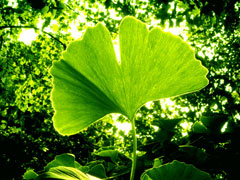
Bloom Color: Green. Main Bloom Time: Early spring, Late spring, Mid spring. Ginkgo is a unique species of tree with no close living relatives and is one of the best-known examples of a living fossil. They are very large deciduous trees, with an angular crown and long erratic branches. Leaves are fan-shaped, with two lobes, that turn yellow in autumn. Leaves are usually 5-10 cm (2-4”). Seeds are edible. Medicinal properties include: Antiasthmatic; Antibacterial; Antifungal; Astringent; Cancer; Digestive; Expectorant; Infertility; Ophthalmic; Sedative; Tonic; Vermifuge. Form: Pyramidal, Rounded.
Physical Characteristics

 Ginkgo biloba is a deciduous Tree growing to 30 m (98ft) by 9 m (29ft) at a slow rate.
See above for USDA hardiness. It is hardy to UK zone 4. It is in flower from April to May, and the seeds ripen from October to November. The species is dioecious (individual flowers are either male or female, but only one sex is to be found on any one plant so both male and female plants must be grown if seed is required). and is pollinated by Wind. The plant is not self-fertile.
Suitable for: light (sandy), medium (loamy) and heavy (clay) soils and prefers well-drained soil. Suitable pH: mildly acid, neutral and basic (mildly alkaline) soils. It cannot grow in the shade. It prefers dry or moist soil and can tolerate drought. It can tolerate atmospheric pollution.
UK Hardiness Map
US Hardiness Map
Synonyms
Salisburia adiantifolia. Pterophyllus salisburiensis. Ginkgo macrophylla. Salisburia biloba
Plant Habitats
Woodland Garden Canopy;
Edible Uses
Edible Parts: Oil Oil Seed
Edible Uses: Oil Oil
Seed - raw (in small quantities), or cooked[237]. A soft and oily texture[229], the seed has a sweet flavour[2, 63] and tastes somewhat like a large pine nut[237]. The baked seed makes very pleasant eating, it has a taste rather like a cross between potatoes and sweet chestnuts[K]. The seed can be boiled and used in soups, porridges etc[183, 237]. It needs to be heated before being eaten in order to destroy a mildly acrimonious principle[57]. Another report says that the seed can be eaten raw[132] whilst another says that large quantities of the seed are toxic[218]. See the notes above on toxicity for more details[237]. The raw seed is said to have a fish-like flavour[218]. The seed is rich in niacin[160]. It is a good source of starch and protein, but is low in fats[237]. These fats are mostly unsaturated or monosaturated[237]. A more detailed nutritional analysis is available[218]. An edible oil is obtained from the seed[2, 183].
References More on Edible Uses
| Composition
|
| Figures in grams (g) or miligrams (mg) per 100g of food.
|
|
|
Seed (Dry weight)
|
|
- 403 Calories per 100g
- Water : 0%
- Protein: 10.4g; Fat: 3.3g; Carbohydrate: 83g; Fibre: 1.3g; Ash: 3.5g;
- Minerals - Calcium: 11mg; Phosphorus: 327mg; Iron: 2.6mg; Magnesium: 0mg; Sodium: 15mg; Potassium: 1139mg; Zinc: 0mg;
- Vitamins - A: 392mg; Thiamine (B1): 0.52mg; Riboflavin (B2): 0.26mg; Niacin: 6.1mg; B6: 0mg; C: 54mg;
- Reference: [ 218]
- Notes:
|
|
Medicinal Uses
Plants For A Future can not take any responsibility for any adverse effects from the use of plants. Always seek advice from a professional before using a plant medicinally.
Antianxiety Antiasthmatic Antibacterial Antifungal Astringent Cancer Digestive Expectorant
Infertility Ophthalmic Sedative Tonic Urinary Vermifuge
Ginkgo has a long history of medicinal use in traditional Chinese medicine, where the seed is most commonly used. These uses are mentioned in more detail later. Recent research into the plant has discovered a range of medicinally active compounds in the leaves and this has excited a lot of interest in the health-promoting potential of the plant[237]. In particular, the leaves stimulate the blood circulation and have a tonic effect on the brain, reducing lethargy, improving memory and giving an improved sense of well-being[237]. They have also been shown to be effective in improving peripheral arterial circulation[218, 237] and in treating hearing disorders such as tinnitus where these result from poor circulation or damage by free radicals[237]. The leaves contain ginkgolides, these are compounds that are unknown in any other plant species[238]. Ginkgolides inhibit allergic responses and so are of use in treating disorders such as asthma[238]. Eye disorders and senility have also responded to treatment[237]. The leaves are best harvested in the late summer or early autumn just before they begin to change colour. They are dried for later use[237, 238]. The fruit is antibacterial, antifungal, astringent, cancer, digestive, expectorant, sedative, vermifuge[117, 147, 176, 178]. The fruit is macerated in vegetable oil for 100 days and then the pulp is used in the treatment of pulmonary tuberculosis, asthma, bronchitis etc[218]. (This report might be referring to the seed rather than the fleshy fruit[K]). The cooked seed is antitussive, astringent and sedative[218]. It is used in the treatment of asthma, coughs with thick phlegm and urinary incontinence[176, 238]. The raw seed is said to have anticancer activity and also to be antivinous[176, 218]. It should be used with caution, however, due to reports of toxicity[176, 218]. The cooked seeds stabilize spermatogenesis[176].
References More on Medicinal Uses
The Bookshop: Edible Plant Books
Our Latest books on Perennial Plants For Food Forests and Permaculture Gardens in paperback or digital formats.

Edible Tropical Plants
Food Forest Plants for Hotter Conditions: 250+ Plants For Tropical Food Forests & Permaculture Gardens.
More

Edible Temperate Plants
Plants for Your Food Forest: 500 Plants for Temperate Food Forests & Permaculture Gardens.
More

More Books
PFAF have eight books available in paperback and digital formats. Browse the shop for more information.
Shop Now
Other Uses
Oil Oil Soap Wood
An oil from the seed is used as a fuel in lighting[2]. A soap substitute is produced by mixing the pulp of the seed (is the fruit meant here?) with oil or wine[178]. Wood - light, soft, it has insect repelling qualities[117].
Special Uses
Carbon Farming Food Forest Scented Plants
References More on Other Uses
Cultivation details
Industrial Crop: Medicinal Management: Coppice Management: Standard Minor Global Crop Staple Crop: Balanced carb
Landscape Uses:Firewood, Pest tolerant, Specimen, Street tree. Succeeds in most soil types so long as they are well-drained[117, 200, 202], though it prefers a rather dry loam in a position sheltered from strong winds[11]. Some of the best specimens in Britain are found growing on soils over chalk or limestone[185]. Plants flower and fruit more reliably after hot summers or when grown in a warm sunny position[202]. Established plants are drought resistant[117], they also tolerate atmospheric pollution[117, 200]. Plants can grow in poor hard-packed soil, making the male forms good candidates for street planting[229]. Trees are often used for street planting in towns, only the males are used because the fruit from female plants has a nauseous smell. The fruit contains butanoic acid, it has the aroma of rancid butter[200]. Ginkgo is a very ornamental plant[1, 117] and there are several named forms[11, 200]. This species is the only surviving member of a family that was believed to be extinct until fairly recent times. It has probably remained virtually unchanged for at least 150 million years and might have been growing when the dinosaurs were roaming the earth[237]. It is exceptional in having motile sperm[185] and fertilization may not take place until after the seed has fallen from the tree[81]. This genus belongs to a very ancient order and has affinities with tree ferns and cycads[185]. The ginkgo is usually slow growing, averaging less than 30cm per year with growth taking place from late May to the end of August[185]. Growth is also unpredictable, in some years trees may not put on any new growth whilst in others there may be 1 metre of growth[185]. This variability does not seem to be connected to water or nutrient availability. Trees are probably long-lived in Britain, one of the original plantings (in 1758) is still growing and healthy at Kew (1993). Plants are not troubled by insects or diseases[132, 200], have they evolved a resistance?[132]. Ginkgo is a popular food and medicinal crop in China, the plants are often cultivated for this purpose and are commonly grown in and around temples. Plants are either male or female, one male plant can pollinate up to 5 females. It takes up to 35 years from seed for plants to come into bearing[117]. Prior to maturity the sexes can often be distinguished because female plants tend to have almost horizontal branches and deeply incised leaves whilst males have branches at a sharper angle to the trunk and their leaves are not so deeply lobed[132]. Branches of male trees can be grafted onto female frees in order to fertilize them. When a branch from a female plant was grafted onto a male plant at Kew it fruited prolifically[11]. Female trees have often been seen in various gardens with good crops of fruit[K]. Seeds are marked by two or three longitudinal ridges, it is said that those with two ridges produce female plants whilst those with three ridges produce male plants[178]. Trees can be coppiced[200]. They can also be pruned into a fan-shape for growing on walls[202]. Another report says that the trees dislike pruning and will often die back as a result[238]. Special Features:Attractive foliage, Not North American native, Fragrant flowers, Inconspicuous flowers or blooms, Flowers have an unpleasant odor. The plant is heat tolerant in zones 9 through 3. (Plant Hardiness Zones show how well plants withstand cold winter temperatures.
Plant Heat Zones show when plants would start suffering from the heat.
The Plant Heat Zone map is based on the number of "heat days" experienced in a given area where the temperature climbs to over 86 degrees F (30°C).
At this temperature, many plants begin to suffer physiological damage. Heat Zones range from 1 (no heat days) to 12 (210 or more heat days).
For example Heat Zone. 11-1 indicates that the plant is heat tolerant in zones 11 through 1.) For polyculture design as well as the above-ground architecture (form - tree, shrub etc. and size shown above) information on the habit and root pattern is also useful and given here if available. The plant growth habit is a standard with a non-suckering single trunk [1-2].
Carbon Farming
-
Industrial Crop: Medicinal
Most pharmaceuticals are synthesized from petroleum but 25% of modern medicines are based on plants.
-
Management: Coppice
Cut to the ground repeatedly - resprouting vigorously. Non-destructive management systems maintaining the soil organic carbon.
-
Management: Standard
Plants grow to their standard height. Harvest fruit, seeds, or other products. Non-Destructive management systems.
-
Minor Global Crop
These crops are already grown or traded around the world, but on a smaller scale than the global perennial staple and industrial crops, The annual value of a minor global crop is under $1 billion US. Examples include shea, carob, Brazil nuts and fibers such as ramie and sisal.
-
Staple Crop: Balanced carb
(0-15 percent protein, 0-15 percent oil, with at least one over 5 percent). The carbohydrates are from either starch or sugar. Annuals include maize, wheat, rice, and potato. Perennials include chestnuts, carob, perennial fruits, nuts, cereals, pseudocereals, woody pods, and acorns.
References Carbon Farming Information and Carbon Sequestration Information
Temperature Converter
Type a value in the Celsius field to convert the value to Fahrenheit:
Fahrenheit:
The PFAF Bookshop
Plants For A Future have a number of books available in paperback and digital form. Book titles include Edible Plants, Edible Perennials, Edible Trees,Edible Shrubs, Woodland Gardening, and Temperate Food Forest Plants. Our new book is Food Forest Plants For Hotter Conditions (Tropical and Sub-Tropical).
Shop Now
Plant Propagation
Seed - best sown as soon as it is ripe in a cold frame or in a sheltered outdoor bed[78, 80]. The seed requires stratification according to one report[78] whilst another says that stratification is not required[80] and that the seed can be sown in spring but that it must not have been allowed to dry out[80]. Germination is usually good to fair. Prick out the seedlings into individual pots when they are large enough to handle and grow them on in light shade in the greenhouse for their first year. Plant them out into their permanent positions in the following spring[78, 80] and consider giving them some protection from winter cold for their first winter outdoors[K]. Softwood cuttings in a frame in spring[238]. Cuttings of half-ripe wood, July/August in a frame. The cutting may not grow away in its first year but usually grows all right after that[113]. Cuttings of mature wood, December in a frame[200].
Other Names
If available other names are mentioned here
Native Plant Search
Search over 900 plants ideal for food forests and permaculture gardens. Filter to search native plants to your area. The plants selected are the plants in our book 'Plants For Your Food Forest: 500 Plants for Temperate Food Forests and Permaculture Gardens, as well as plants chosen for our forthcoming related books for Tropical/Hot Wet Climates and Mediterranean/Hot Dry Climates. Native Plant Search
Found In
Countries where the plant has been found are listed here if the information is available
Weed Potential
Right plant wrong place. We are currently updating this section.
Please note that a plant may be invasive in one area but may not in your area so it’s worth checking.
Conservation Status
IUCN Red List of Threatened Plants Status :

Growth: S = slow M = medium F = fast. Soil: L = light (sandy) M = medium H = heavy (clay). pH: A = acid N = neutral B = basic (alkaline). Shade: F = full shade S = semi-shade N = no shade. Moisture: D = dry M = Moist We = wet Wa = water.

Expert comment
Author
L.
Botanical References
11200
Links / References
For a list of references used on this page please go here
Readers comment