 |
|
|
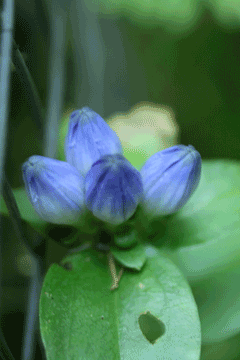 |
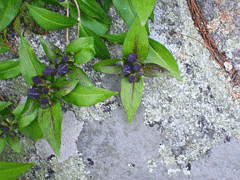
| http://flickr.com/photos/53817483%40N00Gentiana crassicaulis |
Translate this page:
Summary
Physical Characteristics

 Gentiana andrewsii is a PERENNIAL growing to 0.6 m (2ft) by 0.3 m (1ft in).
See above for USDA hardiness. It is hardy to UK zone 6. It is in flower from July to August. The species is hermaphrodite (has both male and female organs) and is pollinated by Bumblebees, butterflies.
Suitable for: light (sandy), medium (loamy) and heavy (clay) soils and prefers well-drained soil. Suitable pH: mildly acid, neutral and basic (mildly alkaline) soils. It can grow in semi-shade (light woodland) or no shade. It prefers moist soil.
UK Hardiness Map
US Hardiness Map
Synonyms
Plant Habitats
Woodland Garden Sunny Edge; Cultivated Beds;
Edible Uses
References More on Edible Uses
Medicinal Uses
Plants For A Future can not take any responsibility for any adverse effects from the use of plants. Always seek advice from a professional before using a plant medicinally.
Antidote Appetizer Bitter Digestive Ophthalmic Poultice Stomachic Tonic
The root is said to be an antidote to snakebites[61, 254]. An infusion of the roots has been used as a wash and also taken internally in the treatment of pain and headaches[257]. An infusion of the roots has been used as drops for sore eyes[257]. This N. American species has medicinal properties practically identical with the European gentians[4]. The following notes are based on the general uses of G. lutea which is the most commonly used species in the West[K]. Gentian root has a long history of use as a herbal bitter in the treatment of digestive disorders and is an ingredient of many proprietary medicines. It contains some of the most bitter compounds known and is used as a scientific basis for measuring bitterness[238]. It is especially useful in states of exhaustion from chronic disease and in all cases of debility, weakness of the digestive system and lack of appetite[4]. It is one of the best strengtheners of the human system, stimulating the liver, gall bladder and digestive system[238], and is an excellent tonic to combine with a purgative in order to prevent its debilitating effects[4]. The root is anthelmintic, anti-inflammatory, antiseptic, bitter tonic, cholagogue, emmenagogue, febrifuge, refrigerant, stomachic[4, 7, 9, 14, 21, 165, 238]. It is taken internally in the treatment of liver complaints, indigestion, gastric infections and anorexia[238]. It should not be prescribed for patients with gastric or duodenal ulcers[238]. The root is harvested in the autumn and dried for later use[4]. It is quite likely that the roots of plants that have not flowered are the richest in medicinal properties[4].
References More on Medicinal Uses
The Bookshop: Edible Plant Books
Our Latest books on Perennial Plants For Food Forests and Permaculture Gardens in paperback or digital formats.

Edible Tropical Plants
Food Forest Plants for Hotter Conditions: 250+ Plants For Tropical Food Forests & Permaculture Gardens.
More

Edible Temperate Plants
Plants for Your Food Forest: 500 Plants for Temperate Food Forests & Permaculture Gardens.
More

More Books
PFAF have eight books available in paperback and digital formats. Browse the shop for more information.
Shop Now
Other Uses
References More on Other Uses
Cultivation details
In general, gentians require a moist well-drained soil in a sheltered position, a certain minimum of atmospheric humidity, high light intensity but a site where temperatures are not too high[239]. They are therefore more difficult to grow in areas with hot summers and in such a region they appreciate some protection from the strongest sunlight[200, 239]. Most species will grow well in the rock garden[200]. This species is fairly easy to grow, succeeding in most humus-rich soils[239]. It tolerates more shade (but not full shade) than most members of the genus, growing well in a woodland garden[200, 239]. Plants are intolerant of root disturbance[200]. A moisture loving plant, preferring to grow with full exposure to the sun but with plenty of underground moisture in the summer, it grows better in the north and west of Britain[1].
References Carbon Farming Information and Carbon Sequestration Information
Temperature Converter
Type a value in the Celsius field to convert the value to Fahrenheit:
Fahrenheit:
The PFAF Bookshop
Plants For A Future have a number of books available in paperback and digital form. Book titles include Edible Plants, Edible Perennials, Edible Trees,Edible Shrubs, Woodland Gardening, and Temperate Food Forest Plants. Our new book is Food Forest Plants For Hotter Conditions (Tropical and Sub-Tropical).
Shop Now
Plant Propagation
Seed - best sown in early January in a light position in a cold frame[239]. It can also be sown in late winter or early spring but the seed germinates best if given a period of cold stratification and quickly loses viability when stored, with older seed germinating slowly and erratically[200, 239]. It is advantageous to keep the seed at about 10°c for a few days after sowing, to enable the seed to imbibe moisture[239]. Following this with a period of at least 5 - 6 weeks with temperatures falling to between 0 and -5°c will usually produce reasonable germination[239]. It is best to use clay pots, since plastic ones do not drain so freely and the moister conditions encourage the growth of moss, which will prevent germination of the seed[239]. The seed should be surface-sown, or only covered with a very light dressing of compost. The seed requires dark for germination, so the pots should be covered with something like newspaper or be kept in the dark[239]. Pot up the seedlings into individual pots as soon as they are large enough to handle and grow on in light shade in the greenhouse for at least their first winter. The seedlings grow on very slowly, taking 2 - 7 years to reach flowering size[239]. When the plants are of sufficient size, place them out into their permanent positions in late spring or early summer. Division in March[111]. Most members of this genus have either a single tap-root, or a compact root system united in a single root head, and are thus unsuitable for division[239]. Cuttings of basal shoots in late spring[238].
Other Names
If available other names are mentioned here
Native Plant Search
Search over 900 plants ideal for food forests and permaculture gardens. Filter to search native plants to your area. The plants selected are the plants in our book 'Plants For Your Food Forest: 500 Plants for Temperate Food Forests and Permaculture Gardens, as well as plants chosen for our forthcoming related books for Tropical/Hot Wet Climates and Mediterranean/Hot Dry Climates. Native Plant Search
Found In
Countries where the plant has been found are listed here if the information is available
Weed Potential
Right plant wrong place. We are currently updating this section.
Please note that a plant may be invasive in one area but may not in your area so it’s worth checking.
Conservation Status
IUCN Red List of Threatened Plants Status :

Growth: S = slow M = medium F = fast. Soil: L = light (sandy) M = medium H = heavy (clay). pH: A = acid N = neutral B = basic (alkaline). Shade: F = full shade S = semi-shade N = no shade. Moisture: D = dry M = Moist We = wet Wa = water.

Expert comment
Author
Griseb.
Botanical References
43200
Links / References
For a list of references used on this page please go here
Readers comment
© 2010, Plants For A Future. Plants For A Future is a charitable company limited by guarantee, registered in England and Wales. Charity No. 1057719, Company No. 3204567.