 |
|
http://commons.wikimedia.org/wiki/User:Wouterhagens |
 |
| http://commons.wikimedia.org/wiki/User:Wsiegmund |
Translate this page:
Summary
Bloom Color: Pink, White. Main Bloom Time: Early summer, Late spring, Mid summer. Form: Spreading or horizontal.
Physical Characteristics

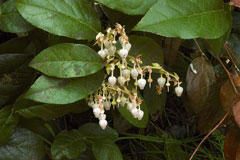
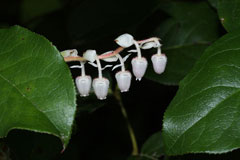
 Gaultheria shallon is an evergreen Shrub growing to 1.2 m (4ft) by 1 m (3ft 3in) at a medium rate.
See above for USDA hardiness. It is hardy to UK zone 5. It is in leaf all year, in flower from May to June, and the seeds ripen from September to October. The species is hermaphrodite (has both male and female organs) and is pollinated by Insects.
Suitable for: light (sandy) and medium (loamy) soils. Suitable pH: mildly acid soils and can grow in very acid soils.
It can grow in full shade (deep woodland) semi-shade (light woodland) or no shade. It prefers dry or moist soil and can tolerate drought.
UK Hardiness Map
US Hardiness Map
Synonyms
Plant Habitats
Woodland Garden Sunny Edge; Dappled Shade; Shady Edge; not Deep Shade; Ground Cover;
Edible Uses
Edible Parts: Fruit
Edible Uses: Tea
Fruit - raw, cooked or dried for later use[2, 3, 4, 183]. Sweet and juicy with a pleasant flavour[11, 95, 101], it makes good raw eating[K]. The fruit can also be made into preserves, pies, drinks etc or be dried and used like raisins[183]. The fruit is about 10mm in diameter[200] and is produced over a period of several weeks in late summer[K]. A pleasant tea is made from the leaves[101].
References More on Edible Uses
Medicinal Uses
Plants For A Future can not take any responsibility for any adverse effects from the use of plants. Always seek advice from a professional before using a plant medicinally.
Astringent Poultice Stomachic
A poultice of the toasted, pulverized leaves has been applied to cuts[257]. A poultice of the chewed leaves has been applied to burns and sores[257]. The leaves have been chewed to dry the mouth[257]. An infusion of the leaves have been used as a stomach tonic and a treatment for diarrhoea, coughs, TB etc[257].
References More on Medicinal Uses
The Bookshop: Edible Plant Books
Our Latest books on Perennial Plants For Food Forests and Permaculture Gardens in paperback or digital formats.
Edible Tropical Plants
Food Forest Plants for Hotter Conditions: 250+ Plants For Tropical Food Forests & Permaculture Gardens.
More
Edible Temperate Plants
Plants for Your Food Forest: 500 Plants for Temperate Food Forests & Permaculture Gardens.
More
More Books
PFAF have eight books available in paperback and digital formats. Browse the shop for more information.
Shop Now
Other Uses
Dye
A purple dye is obtained from the fruit[99]. It is dark green[168]. A greenish-yellow dye is obtained from the infused leaves[257]. A ground cover plant for a shady position under trees, spreading slowly by means of suckers[188]. It should be spaced about 90cm apart each way[208].
Special Uses
Food Forest Ground cover
References More on Other Uses
Cultivation details
Landscape Uses:Erosion control, Ground cover, Hedge, Massing. Prefers a moist but not boggy humus rich soil in shade or semi-shade[11, 182], but it can also succeed in full sun. A peat and moisture loving species, it requires a lime-free soil[11, 182]. One report says that it can succeed in dry shade[188] and another that it can withstand considerable drought once it is established[208]. Plants are hardy to about -20°c[184]. A vigorous suckering plant, it can be invasive when growing in good conditions, but responds to cutting back[1, 28]. It also succeeds when planted under trees[28, 49]. Plants in this genus are notably resistant to honey fungus[200]. Special Features:
North American native. The plant is heat tolerant in zones 8 through 6. (Plant Hardiness Zones show how well plants withstand cold winter temperatures.
Plant Heat Zones show when plants would start suffering from the heat.
The Plant Heat Zone map is based on the number of "heat days" experienced in a given area where the temperature climbs to over 86 degrees F (30°C).
At this temperature, many plants begin to suffer physiological damage. Heat Zones range from 1 (no heat days) to 12 (210 or more heat days).
For example Heat Zone. 11-1 indicates that the plant is heat tolerant in zones 11 through 1.) For polyculture design as well as the above-ground architecture (form - tree, shrub etc. and size shown above) information on the habit and root pattern is also useful and given here if available. An evergreen. The plant growth habit is a running thicket former forming a colony from shoots away from the crown spreading indefinitely [1-2]. The root pattern is flat with shallow roots forming a plate near the soil surface [1-2]. The root pattern is stoloniferous rooting from creeping stems above the ground [1-2].
References Carbon Farming Information and Carbon Sequestration Information
Temperature Converter
Type a value in the Celsius field to convert the value to Fahrenheit:
Fahrenheit:
The PFAF Bookshop
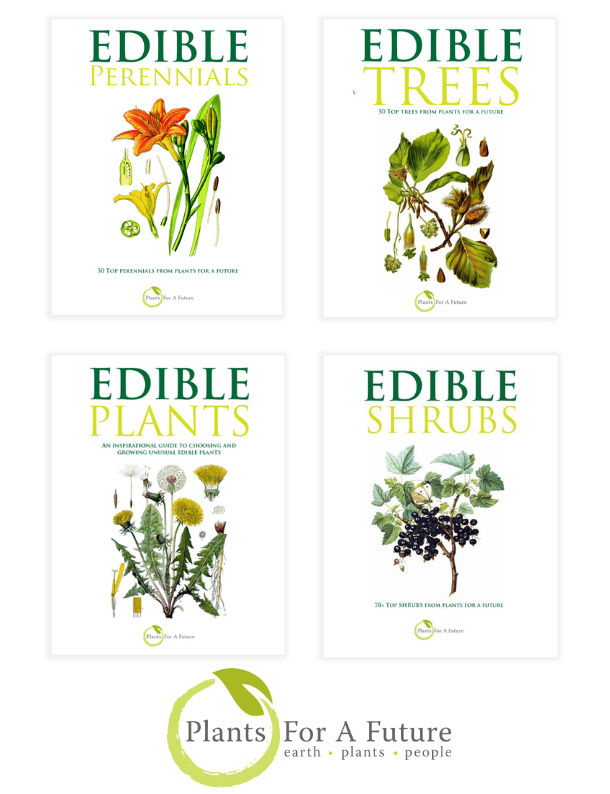
Plants For A Future have a number of books available in paperback and digital form. Book titles include Edible Plants, Edible Perennials, Edible Trees,Edible Shrubs, Woodland Gardening, and Temperate Food Forest Plants. Our new book is Food Forest Plants For Hotter Conditions (Tropical and Sub-Tropical).
Shop Now
Plant Propagation
The seed requires a period of cold stratification. Pre-chill for 4 - 10 weeks and then surface sow in a lime-free compost in a shady part of the greenhouse and keep the compost moist[78]. The seed usually germinates well, usually within 1 - 2 months at 20°c, but the seedlings are liable to damp off. It is important to water them with care and to ensure that they get plenty of ventilation. Watering them with a garlic infusion can also help to prevent damping of[K]. Prick out the seedlings into individual pots when they are about 25mm tall and grow them on in light shade in the greenhouse for at least their first winter[K]. Plant them out in late spring or early summer. The seedlings are susceptible to spring frosts so might need some protection for their first few years outdoors. The leaves remain very small for the first few years[11]. Cuttings of half-ripe wood 3 - 6cm long, July/August in a frame in a shady position. They form roots in late summer or spring[78]. A good percentage usually take. Division in spring when new growth is about 7cm tall. Divided plants can be rather slow to get established[182]. We have found that it is best to pot up the clumps and grow them on in a shady position in a cold frame until they are rooting well. Plant them out in the spring.
Other Names
If available other names are mentioned here
Native Plant Search
Search over 900 plants ideal for food forests and permaculture gardens. Filter to search native plants to your area. The plants selected are the plants in our book 'Plants For Your Food Forest: 500 Plants for Temperate Food Forests and Permaculture Gardens, as well as plants chosen for our forthcoming related books for Tropical/Hot Wet Climates and Mediterranean/Hot Dry Climates. Native Plant Search
Found In
Countries where the plant has been found are listed here if the information is available
Alaska, Australia, Britain, Canada, Europe, North America*, Tasmania, USA,
Weed Potential
Right plant wrong place. We are currently updating this section.
Please note that a plant may be invasive in one area but may not in your area so it’s worth checking.
Conservation Status
IUCN Red List of Threatened Plants Status :

Growth: S = slow M = medium F = fast. Soil: L = light (sandy) M = medium H = heavy (clay). pH: A = acid N = neutral B = basic (alkaline). Shade: F = full shade S = semi-shade N = no shade. Moisture: D = dry M = Moist We = wet Wa = water.

Expert comment
Author
Pursh.
Botanical References
1160200
Links / References
For a list of references used on this page please go here
Readers comment